
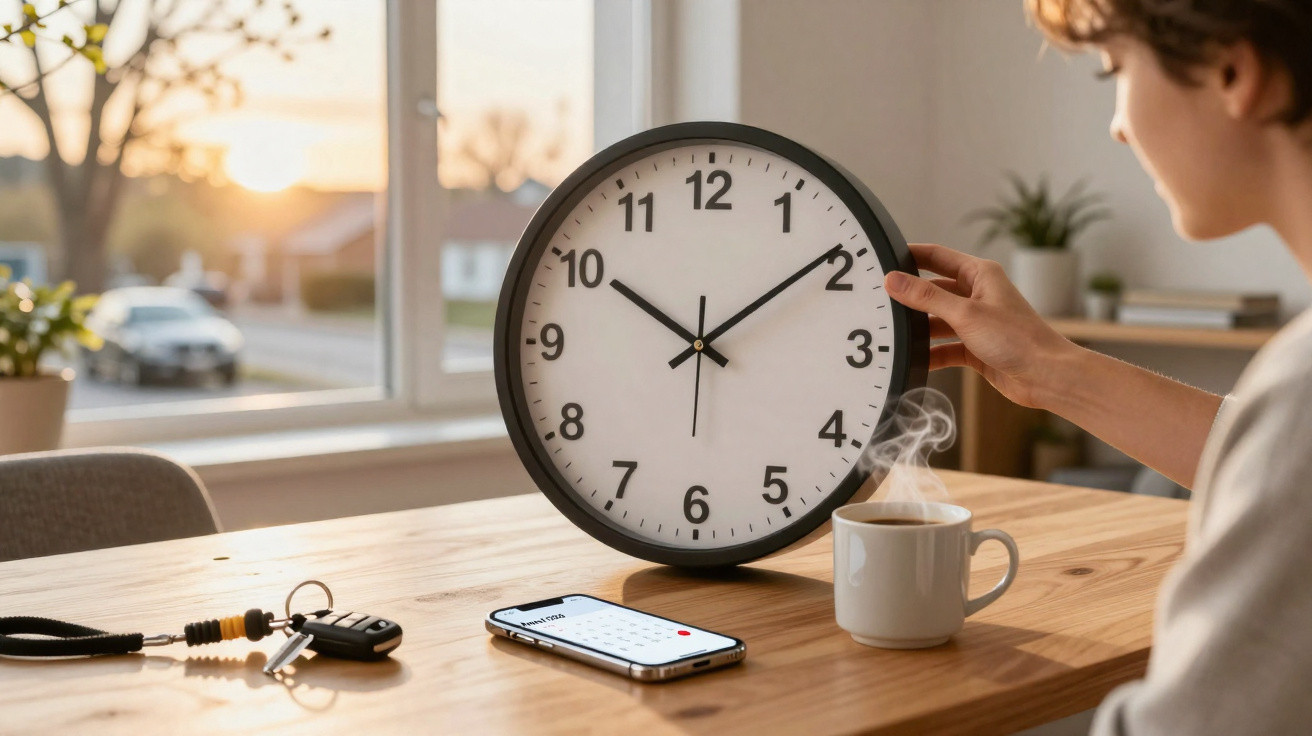
At the end of March, it is that time again: clocks go forward by an hour and we lose an hour’s sleep. In 2026, this intervention in daily life takes place on a slightly earlier date than it did the previous year – although the EU rule itself has not changed. Many people are asking why this is, what it means in practical terms for their own routine, and how this small bout of jet lag can be eased.
When the clocks change to summer time in 2026
The rules governing the clock change are in fact very clear. Since 1996, the same requirement has applied across all European Union member states: summer time always begins on the final Sunday in March.
Start of summer time 2026: During the night from Saturday 28 March to Sunday 29 March, clocks move forward from 2.00 am to 3.00 am.
The change therefore falls on 29 March in 2026, one day earlier than in 2025, when the final Sunday in March was the 30th. Nothing changes in principle: the familiar pattern remains the same, but the date on the calendar is different.
Why the 2026 date falls earlier
The reason is essentially mundane and has nothing to do with a new regulation. Dates shift slightly from year to year because a year does not contain precisely 365 days:
- A standard year has 365 days.
- A week consists of 7 days, so weekdays effectively move forward each year.
- Leap years, with 366 days, create additional shifts in the calendar.
2025 is a standard year. In calendar terms, 2026 falls in such a way that the final Sunday in March is already 29 March rather than 30 March, as it was the year before. The EU rule of the “final Sunday in March” is therefore untouched; only the specific date changes, as it does every year.
What the clock change means for everyday life
For many people, the calendar date matters less than the effect the change has on the body. Moving to summer time means nominally losing an hour of sleep, as the clocks jump forward by one hour overnight. Anyone who normally gets up at 7.00 am suddenly has to rise at what feels like 6.00 am.
This is often noticeable, particularly during the first few days, in the following ways:
- Tiredness and difficulty concentrating in the morning
- Trouble getting to sleep in the evening
- Irritability and a sense of being “out of sync”
- Increased consumption of coffee or energy drinks
Children, shift workers and people whose sleeping pattern is already irregular can be especially sensitive to the change. Pets do not follow the clock either; instead, they rely on set routines such as feeding, walks and playtime. For many animals, the one-hour shift is visibly confusing at first.
Making the transition to summer time easier
Anyone who does not want simply to endure the change can prepare their body gradually. Small adjustments during the week before the clocks change can help:
- Go to bed 10–15 minutes earlier each day.
- Move the alarm forward in small stages as well.
- Cut back on late, heavy meals and alcohol before the changeover date.
- On the morning of the change, get into daylight straight away, ideally outdoors.
- Avoid a nap, or keep it much shorter, so that the evening does not become too long.
Light has a crucial role here. Bright daylight tells the body it is daytime, while darkness signals night. Opening the curtains early on the Sunday after the change or taking a short walk can help the internal body clock adapt more quickly.
More evening daylight: what changes in 2026
The lost hour of sleep frustrates many people, but it also has benefits. Summer time moves more of the day’s light into the evening. Employees in particular can benefit, as there is more daylight left after work.
Typical effects of summer time include:
- Outdoor sport and hobbies can be scheduled later in the day.
- Playgrounds, beer gardens and parks stay busier into the evening.
- Less artificial lighting is needed during the early evening.
Those wishing to plan more precisely can use digital tools that simulate the position of the sun. These show exactly where the sun will be at a given time at a person’s location and which areas will be in shade. This can be useful when organising garden parties and barbecues, or when creating a comfortable balcony space.
Road traffic risks after the clock change
One aspect that is often underestimated is the impact on traffic. Tiredness and an altered body rhythm can affect reaction times. In the days following the time shift, road-safety experts repeatedly record more accidents.
“Drivers who are overtired react more slowly – the combination of the clock change, twilight and wildlife crossings increases the risk on familiar routes.”
In addition, wild animals such as deer, wild boar and foxes do not recognise summer time. They respond to daylight rather than the clock. From a human perspective, the critical twilight period moves, while animals keep to their usual patterns. Anyone who spends a lot of time driving in the morning or evening should therefore be particularly alert and take speed limits seriously in areas known for wildlife crossings.
Why the clock change remains despite criticism
For years, there has been debate over whether changing the clocks is still appropriate. Many people see it as unnecessary stress. Health organisations point to the strain placed on the body clock, while business representatives cite possible disruption to operations. Some countries have already abandoned the twice-yearly clock adjustment altogether.
Despite extensive debate, Germany continues as before. The arrangement is tied to the EU. There is no shared decision by all member states, and without such an agreement, virtually nothing changes. As long as this political deadlock continues, people will have to live with the twice-yearly switch.
Winter time, summer time and “standard time” – what do they mean?
The term “standard time” often appears in these discussions. It refers to Central European Time (CET), historically introduced as the standard time in Central Europe. Summer time is an artificial one-hour shift forward – in other words, CET plus one hour, known as Central European Summer Time (CEST).
| Name | Abbreviation | Difference |
|---|---|---|
| Central European Time | CET | “Standard time”, base time |
| Central European Summer Time | CEST | CET plus 1 hour |
Many sleep researchers support keeping standard time permanently because it is closer to the natural light-dark cycle. Supporters of permanent summer time, on the other hand, argue that it provides more evening light and improves quality of life after work.
Practical advice for families, shift workers and pet owners
Parents will know the issue: the official clock says it is bedtime, yet it is still light outside for a long time. That can make the spring change especially demanding. Blackout curtains in children’s bedrooms and consistent evening rituals that do not depend on daylight can help, such as reading aloud, quiet music and no screen shortly before sleep.
Shift workers should check their rota and clarify in good time how the extra hour in autumn or the missing hour in spring will be paid. Otherwise, night shifts around the changeover date can cause frustration and confusion.
Pet owners can help their animals adjust gently by moving feeding and walking times by 10–15 minutes at a time, starting a few days beforehand. This makes the jump to official summer time feel less abrupt for both people and animals.
Keeping these points in mind can make the start of summer time 2026 more relaxed, even though the clocks change a day earlier than in the previous year.






Comments
No comments yet. Be the first to comment!
Leave a Comment