
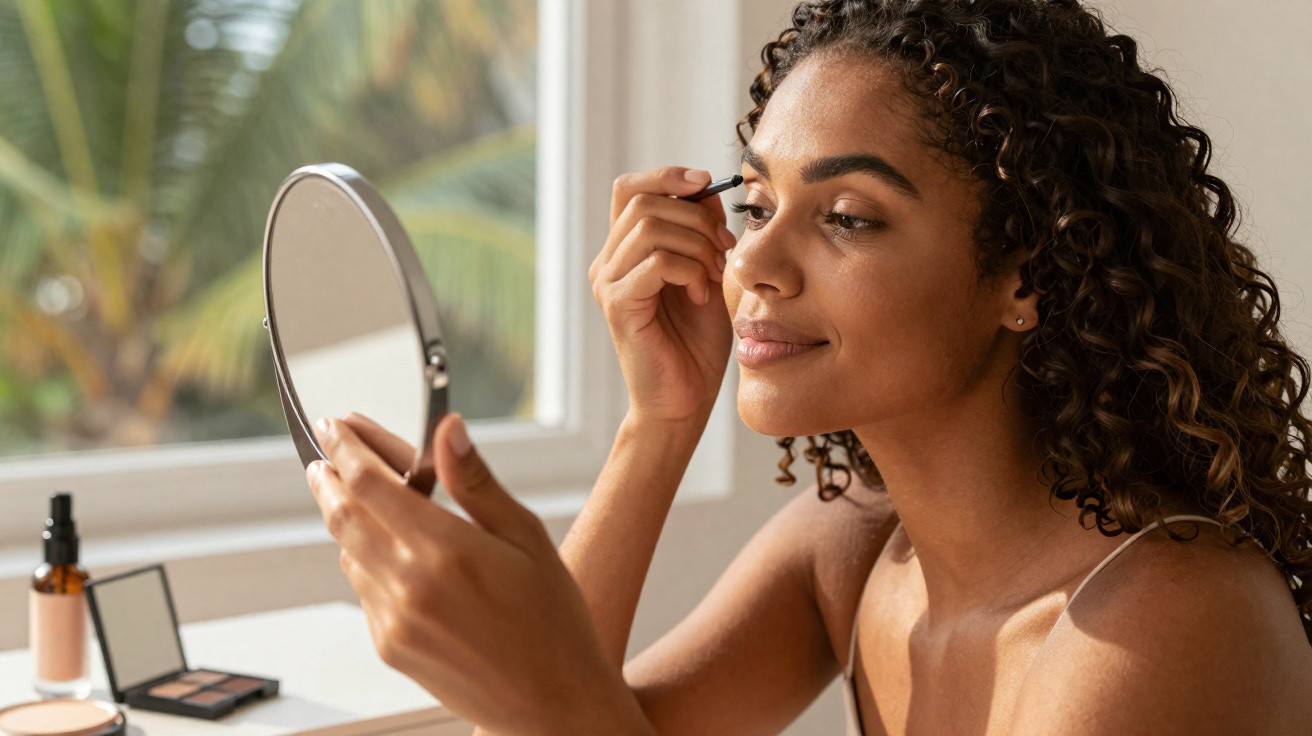
The woman sitting in the makeup chair does not look in the mirror straight away.
Instead, she opens the front-facing camera on her phone. With her chin lowered, she blinks, lets out a breath and repeats the familiar line heard from so many women with hooded eyes: “My eyes just… disappear.”
The makeup artist does not pick up a bold cut-crease look, a four-colour palette or a 40-minute tutorial played back in slow motion. She uses only a narrow brush, soft brown eyeshadow and a subtle change to the placement of colour. It goes not on the lid, but higher - almost higher than feels comfortable.
Seven minutes later, the woman looks up once more. She stays still. Her eyes appear larger, brighter and almost playful, as though she has slept, shed a few tears and then made up her mind. The brush has changed one small thing, but it transforms the entire expression in her gaze.
And it begins in the very place you have probably been told you are not “supposed” to apply makeup.
The familiar frustration of hooded eyes
Classic eye looks can bring a particular kind of disappointment when you have hooded eyes. You blend a beautiful bronze shade across the lid, add shimmer at the centre and perhaps finish with a carefully drawn liner flick. Then you raise your gaze and look forward… only to find that half the work has disappeared into the fold.
The lid you spent time colouring is concealed beneath skin. The liner you applied along the lashes becomes a thick, irregular band. Photographs make the effect seem flatter still. On Zoom, your eyes can look weary rather than sultry. All at once, “smokey eye for hooded lids” can feel less like a tutorial title and more like a personal insult.
Hooded eyes are neither unusual nor a problem; they have simply not been catered for enough. Makeup has largely been designed, demonstrated and marketed for eyes with plenty of visible lid space. That Instagram runway look? It was probably created on an eye that folds differently from yours. It is easy to start believing that your features are at fault.
A makeup artist in London explained it plainly: “Most people with hooded eyes are trying to decorate space that isn’t visible.” It is rather like putting a painting inside a cupboard and wondering why nobody praises it. The more product you layer over the mobile lid, the more of it disappears into the crease once you look straight ahead.
A survey by a major beauty retailer several years ago found that “hooded eye makeup” and “droopy eyelid makeup” ranked among the fastest-rising search terms in the eye category. This is more than a passing trend. It means millions of women are searching late at night, enlarging bathroom selfies and trying to understand why their eyeliner transfers and their eyeshadow turns muddy.
One 34-year-old teacher told me that she stopped wearing eye makeup to work completely. “By the time I finished first period, my liner printed all over my lid. My students said I looked tired even when I wasn’t. I decided mascara was safer than feeling defeated in the staff bathroom every day.”
Most of us have caught our reflection in a bus window and performed a rapid assessment: hair, fine; skin, fine; eyes… droopy? Soft light, overhead screens and unforgiving daylight can all intensify the way hooded eyes visually pull the face downwards. This is not simply about vanity: it affects how others interpret your mood, energy and even confidence.
There is a straightforward reason conventional placement does not work here. If the fleshy upper lid sits over your crease, any product applied “in” that crease will be hidden when the eye is open. Liner that looks slim when you look down can appear thick and square when you look up, because the skin physically folds across it.
The answer is not extra product or a stronger colour. It is about moving where the visual impact sits. Shift the makeup’s visual “weight” away from the concealed lid and onto the visible area immediately above it. That small repositioning of shadow and lines can make the eye register lift where it previously seemed heavy.
Put another way, your eye structure is not the issue. You simply need to create the look on the level that is actually visible, rather than in the unlit basement of your crease.
Hooded-eye makeup: the placement change that lifts the look
The adjustment is this: rather than placing your darkest eyeshadow in the natural crease, draw a new crease slightly above it, over the visible area of the hood. You may call it a fake crease, lifted crease or “floating” crease. The label is irrelevant; the placement is what matters.
Face the mirror with your expression relaxed and your brows unraised. Notice where your natural fold conceals the lid. Next, use a fine brush and a mid-tone matte shade - soft taupe, muted brown or terracotta, depending on your skin tone - to sketch a gentle line just above that fold, where it remains visible with your eyes open.
Diffuse the shade upwards rather than pulling it downwards. Keep the true mobile lid largely bare, or cover it only with a soft wash of light colour. The depth now lies on the hood itself, visually sending that area backwards and making the rounded shape of the eye appear more open and raised. In effect, you are creating a little extra socket depth where nature did not make one quite so pronounced.
Complete the effect by keeping the lash line neat and light. A fine line of liner angled gently upwards, without running into the fold, is more flattering than a heavy wing reaching towards the temple. The raised “crease” should take centre stage, while liner plays a supporting role.
This is the point at which many people hesitate: taking colour that high feels intimidating. It can seem as though you are applying eyeshadow into the brow area, something years of beauty advice have presented as wrong. Mirror positioning can make matters worse. When you lean close and tilt your head backwards, you see much more lid than anyone else does.
One small change can make a huge difference: apply hooded-eye makeup entirely with your eyes open and looking directly ahead. Do not pull or stretch the skin, and do not close one eye while working on it. If the placement works when your eyes are open, it will work in everyday life, on camera, at work and under supermarket aisle lighting. That is the only test that really counts.
The second common error is choosing shades that are too dark too quickly. Deep colours draw attention, but they also make the visible space appear smaller. Begin with a shade only two tones darker than your skin, then build it gradually in soft layers. You do not need a smoky nightclub look at 8 a.m. in the office kitchen. Let’s be honest: nobody really does that every day.
There is an emotional element, too. Many people with hooded or asymmetrical eyes have heard comments such as “You look tired,” “Are you sad?” or “You have droopy eyes like your dad.” When they first see bolder shadow placed higher up, they can panic. It feels “too much”, even when it is actually creating balance across the face.
London-based makeup artist Karla Mendez, who specialises in hooded eyes, described it this way:
“You’re not fighting your eye shape, you’re redirecting attention. When you move the deepest color up by even a few millimetres, the brain reads ‘lifted’ instead of ‘heavy’. It’s like tailoring a suit to your shoulders instead of someone else’s.”
Consider this simple change a compact, adaptable toolkit. You do not need ten stages; you need a short routine that works with your anatomy:
- Begin at the mirror with your eyes open and your face relaxed.
- Mark a soft “fake crease” just above the natural fold.
- Blend upwards into a haze, rather than down onto the lid.
- Keep eyeliner narrow and prevent it from crossing the fold.
- Apply shimmer low on the mobile lid, rather than high in the crease area.
You can use this framework for a smoky eye, a subtle office look or full evening glamour simply by increasing or reducing the intensity. The underlying structure remains unchanged. That is why hooded-eye makeup can suddenly become so manageable: instead of starting from scratch each time, you are adjusting volume on a shape that finally suits your own eyes.
Redefining what “beautiful eyes” can be
There is a quiet sense of relief in no longer forcing your features to fit a template. Hooded eyes are not the “before” image of some imagined ideal face. They are an eye shape, just as almond, round and deep-set eyes are, with distinctive qualities of their own: softness, mystery and intensity.
This slight eyeshadow change is not truly about raising the crease; it is about taking back control in an area that can seem dominated by filters and one-size-fits-all tutorials. When you realise your eyes look more lifted with the deepest colour placed where you can actually see it, it changes what you search for, whose advice you value and which pictures you save.
You may begin doing something understated: taking screenshots of real people whose eyes resemble yours. Perhaps you save a wedding photograph of your aunt because her soft, lifted liner now seems more useful than an image of a celebrity with large, visible lids. You talk with friends and discover you were not the only person who believed their eyes were “wrong” until one tiny technique changed the narrative.
That is the surprising strength of a makeup adjustment: it fixes nothing. Instead, it reveals that there was never anything broken. It offers a way to experiment on your own terms. You may wear more eyeshadow or less of it, but the decision becomes deliberate rather than resigned.
This is the sort of tip people pass on quietly in front of bathroom mirrors, during sleepover conversations and on rushed workday mornings: “Try putting it a bit higher, on the hood. Look again.” It travels because it works in real lighting, on real faces and within real time constraints. Once you have watched your own eyes look lifted without tape, filters or surgery, it is difficult to unsee the effect.
| Key point | Detail | Why it matters to the reader |
|---|---|---|
| Create a “fake” crease | Apply matte eyeshadow slightly above the natural fold, across the hooded lid | Visually opens and lifts the eye without complicated techniques |
| Apply makeup with eyes open | Always work facing the mirror, with lids open and relaxed | Prevents unwelcome surprises when you lift your head or appear in photographs |
| Keep liner fine and subtle | Draw a slim line that does not cut through the fold and rises slightly | Keeps the lid looking light and enlarges the eyes instead of weighing them down |
FAQ:
- How do I know if I really have hooded eyes? Look directly into the mirror with relaxed brows. If most of your mobile lid is hidden beneath a fold of skin, or your crease is not clearly visible, you are part of the hooded-eye family.
- Can this lifted placement work for mature or crepey lids? Yes. Choose softer matte formulas and a fluffy brush. The higher, diffused shadow can blur the appearance of texture while adding a gentle lift.
- Do I need different brushes for hooded-eye makeup? You do not need an entirely new collection. One small, gently tapered blending brush and one precise liner or pencil brush will usually be enough for placing and softening colour where required.
- What eyeliner shape flatters hooded eyes most? A fine line close to the lashes, made slightly thicker towards the outer third, followed by a short upward flick that does not cross the fold. Aim for a subtle lift rather than a dramatic wing.
- Is shimmer eyeshadow a bad idea for hooded eyes? Not at all. Keep shimmer on the mobile lid or inner corner, and use matte shades for the fake crease and hood area so the lifting effect appears smooth and deliberate.




Comments
No comments yet. Be the first to comment!
Leave a Comment