
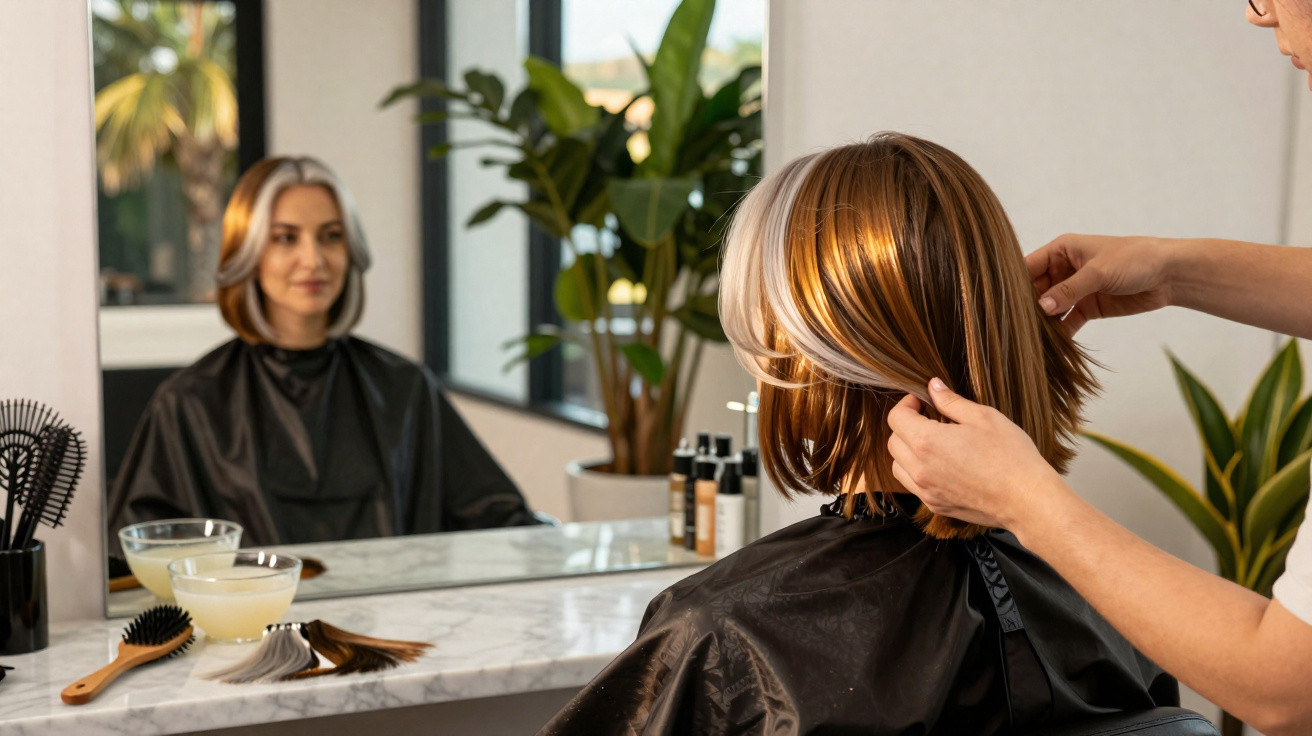
Her roots are silver while the rest of her hair remains warm chestnut. The colourist stands ready, mixing bowl in hand, yet this time she pauses. “I’m tired,” she says quietly. She is not tired of ageing; she is tired of chasing the person she used to be.
Beside her, a younger client is scrolling through Instagram. She shows a picture of a model with gleaming grey streaks and a sharply defined cut. The stylist smiles. “You know, I can make your gray look like that… without dye.” Intrigued, the first woman listens. No bleach, no all-over colour and no three-hour appointments every four weeks.
The untouched dye bowl remains on the counter. Instead, the stylist picks up scissors, a gloss and a small tub of tinted styling cream. The way we approach grey hair is changing.
Why people are giving up dye but still concealing grey hair
You notice it everywhere: in waiting rooms, on work Zoom calls and over family meals. Grey hair seems to arrive earlier, more quickly and more noticeably than people expect, while the familiar cycle of frequent colouring is beginning to feel like another job. Reducing dye use is no longer merely a beauty decision; it can feel like a decision made for your peace of mind.
A growing group of people say they do not want the full “granny hair” look, but neither do they want to smell ammonia every three weeks. They are not necessarily “embracing their gray” in the Instagram sense. Instead, they are finding ways to manage it: blending it and drawing attention away from it. It is less a battle against time and more a quiet truce.
A London stylist told me that, over two years, her client list had moved from 80% full-colour appointments to almost half choosing “low-intervention gray strategies”. The wording may sound clinical, but in practice it means looking fresher without having to live at the salon.
Consider Carla, 46, who once paid €180 every five weeks for all-over colour. Her natural hair is dark brown, with grey concentrated mainly at her temples and along her parting. “If I missed one appointment, I felt like everyone was staring at my roots,” she says. The constant mental burden wore her down.
Last year, her stylist proposed another approach. Rather than applying full colour, they created soft face-framing layers, used a translucent gloss close to her natural shade and applied a grey-blending spray only along the exposed root line. There was no stark regrowth line and no need to coat her entire scalp.
After three months, she noticed something surprising: friends repeatedly said she looked “rested”, yet nobody mentioned her grey hair. She now colours twice a year rather than ten times. Her photographs make her look younger, not because every grey strand has disappeared, but because the cut, gloss and styling lead the eye away from the few silver hairs.
Research supports this idea. Surveys conducted by several haircare brands suggest that people do not always want to erase signs of age; they want to remove the impression of looking tired. Grey hair is only one part of that picture. When the overall appearance looks considered, scattered silver strands stop shouting and begin to recede.
Our brains do not assess hair as a collection of separate details. We take in the overall effect: shape, movement, shine and contrast. A crisp, contemporary cut can immediately refresh the face, while healthy, glossy texture conveys energy and vitality. The grey remains, but it has to compete with more striking visual signals.
Contrast matters too. As skin tone becomes softer with age, very dark, flat-looking hair can make facial features appear harsher. Grey hair around the face can be balanced with warmer make-up or a carefully lightened front section. This makes the face seem softer, brings out the eyes and turns visible grey into an intentional detail rather than an “oops”.
This understated change reflects a quiet rebellion: refusing to make self-worth depend on a completely uniform hair colour. The controversial element is not the method itself. It is being willing to say, “I’ll keep some gray, but I still want to hack the ‘you look younger’ effect, my way.”
The non-dye grey hair playbook: cut, gloss and camouflage
The most effective way to make grey hair less visible without dye is not found in a bottle; it starts with the scissors. A heavy, blunt one-length cut can make each grey hair stand out like an alarm. Gentle layers, a softer fringe or a side-swept fringe can break up clusters of grey at the hairline and parting straight away.
Stylists now discuss “gray placement” in much the same way colourists discuss highlights. Which area troubles you most: the temples or the front section? A slightly fuller, deeper fringe can discreetly cover that area while leaving the rest of the hair untouched. Think of it as an in-built filter.
Next comes gloss. This is not a strong colour treatment, but a sheer, demi-permanent glaze close to your natural shade. It does not completely conceal grey hair; it softens it. The translucent strands reflect light differently and blend with the glossed lengths, creating what looks like intentional dimension. Add tinted root spray or powder only where needed, and in ten minutes you can reduce your “visible gray” by half.
Here is what product packaging rarely explains: application technique matters more than how much you use. Many people take a root spray and coat their entire head. The resulting rigid, opaque band clearly looks like a cover-up. A subtler method is more effective: use a light mist or powder only along the parting, around the face and at the crown, where the hair naturally separates.
At home, styling is your hidden advantage. Loose waves and tousled texture allow grey strands to blend into the movement. Pin-straight hair, particularly when it is dark, puts silver strands in the spotlight. A quick blow-dry using a round brush at the roots lifts the hair from the scalp and disrupts dense areas of grey.
And it is worth saying plainly: most people do not have the time or energy to recreate salon-quality styling every morning. Let’s be honest: nobody really does that every day. The goal is therefore a few small rituals that create maximum impact with minimal effort: a 5-minute root touch-up stick, a different parting, or a gloss treatment every few months rather than substantial colour appointments every three weeks.
As one Paris stylist told me:
“We used to think gray was all or nothing – cover it completely or flaunt it proudly. Now the real luxury is nuance. You keep the silver you like, you soften the ones you don’t, and you stop organizing your life around your roots.”
That sense of nuance is also evident in the products available. Think less “permanent color” and more “instant distraction”. Lightweight tinted dry shampoos can deepen the appearance of roots slightly while adding volume. Clear serums deliver glass-like shine, allowing grey hair to reflect light rather than seem dull. Soft brown or taupe brow pencils restore framing and contrast to the face, preventing the eye from focusing solely on the hair.
- Concentrate coverage on the areas people notice first: the parting, hairline and crown.
- Choose a sheer gloss to boost shine and soften contrast, rather than fully conceal grey hair.
- Improve the cut before using colour: shape disguises grey more effectively than pigment.
- Experiment with your parting: a diagonal or side part interrupts a solid grey line.
- Define brows and lashes slightly, so your face rather than your roots becomes the main focus.
Redefining “younger”: when grey hair becomes a style choice
There is a subtle shift in power when you choose to manage grey rather than fight it. It becomes less about concealing age and more about refining what you see in the mirror on a weary Monday morning: a sharper cut, a touch more glow in the skin, a softer root line. There is no dramatic reveal and no extreme transformation.
You can see this new attitude on a busy Underground train. There is the woman with silver strands at her temples and a striking bob that moves as she walks. There is the man whose salt-and-pepper curls appear purposeful because his neckline is neat and his beard is trimmed. They are not trying to look 30; they simply look like themselves, only more finely tuned.
We have all experienced that moment in the bathroom, beneath unforgiving lighting and without filters, when one persistent grey hair appears twice as thick as every other strand. The old instinct is to pull it out or arrange an emergency colour appointment. The newer response, gradually catching on, is to ask: what small adjustment would help me enjoy what I see without pretending to be someone else?
The most compelling discussions about grey hair do not take place in beauty campaigns. They happen in group chats and around kitchen tables. One friend gives up dye with pride and wears a full silver mane. Another quietly extends the time between appointments, tries a fringe and swaps permanent colour for a gentle glaze. A third finds that changing her parting and applying tinted brow gel removes five “tired years” from photographs.
There is no moral superiority in any of these choices. There are simply different budgets, energy levels and personal stories. Some people feel liberated when their natural grey is fully visible. Others feel more like themselves when it remains but is softened, partly obscured by texture and shine. Both are valid. In a world still fixated on youth, the radical choice is doing what genuinely makes you feel good when you catch your reflection in a shop window.
The controversial new way to conceal grey hair is not a single miracle product. It is a mindset: less panic and more strategy. Touch up only the areas that truly bother you. Explore cut, gloss and texture before committing to heavy colour. Use small, considered techniques - root powder here, a slightly lighter front section there - to alter the story your hair tells.
Perhaps you will not share a dramatic “I’m going gray!” announcement. Maybe your friends will not even identify what has changed; they will only notice that you seem brighter, lighter and more comfortable in yourself. That is the quiet revolution taking place one strand at a time: not saying goodbye to grey hair, but refusing to let it set the rules.
| Key point | Detail | Benefit for the reader |
|---|---|---|
| Cut before colouring | A new cut, light layers or a fringe can visually cover white areas | Reduces the visibility of grey hair without a major chemical commitment |
| Gloss and tinted products | A transparent gloss plus root spray or powder softens targeted regrowth | Creates a younger, fresher effect while retaining some grey |
| Use texture and the parting | Soft waves, a changed parting and root volume | Diffuses grey contrast, making touch-ups less frequent and less stressful |
FAQ:
- Can I really hide gray hair without using permanent dye? Yes. A well-planned haircut, demi-permanent gloss, root sprays or powders, and more strategic styling can soften grey hair and divert attention from it. You will not remove every white strand, but you can make them much less obvious.
- What’s the best haircut to make gray less obvious? Soft layers, a side-swept fringe or a slightly undone bob break up solid areas of grey. Very blunt, flat cuts generally reveal every silver strand, especially along the parting.
- Are gray-blending sprays and powders safe for daily use? Most are designed for regular use, sit on the hair’s surface and wash out with shampoo. Apply them sparingly to avoid build-up that can make roots appear dull.
- How often should I get a gloss if I’m skipping full dye? Many people repeat a gloss every 6–10 weeks. As it fades gradually, there is no harsh regrowth line, allowing you to extend appointments without looking “undone”.
- What if I actually like my gray but want to look less tired? Focus instead on shine, cut and face-framing. A defined shape, healthy texture and slightly stronger brows can help you appear more awake without concealing your natural silver at all.






Comments
No comments yet. Be the first to comment!
Leave a Comment