
A home exercise routine that trains the base of support, single-leg support and weight transfer often does more for the balance of people aged over 60 than many isolated gym sessions. The reason is straightforward: the body improves by repeating patterns genuinely used when walking, standing up from a chair, turning in a hallway and stepping up onto a kerb.
Why can home training be more effective than the gym?
At the gym, many machines develop strength through guided movement paths. While this benefits the muscles, it does not always challenge the ankles, hips, centre of mass and postural reactions in the way everyday life demands. For people over 60, functional improvements are more evident when training includes stability, coordination and fine body control while standing.
At home, a home exercise can be performed on the same flooring a person walks on every day, close to a sofa, worktop or wall. This setting encourages repetition, confidence and carry-over into practical tasks. The benefits are often seen in stride, steadiness while turning and reaction time after a stumble.
Which movement usually delivers the greatest stability benefits?
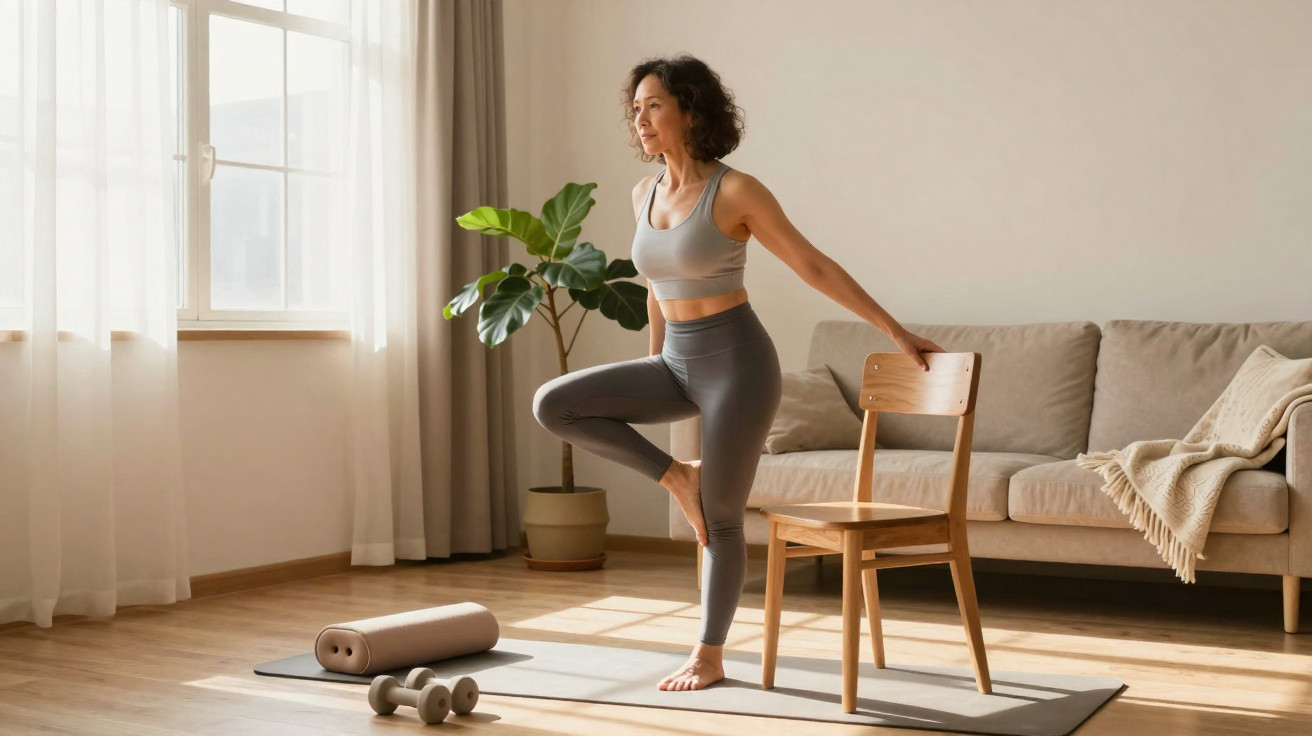
Among the most effective options, standing on one leg while making controlled touches with the other foot combines almost everything that matters: a narrower base of support, trunk adjustment, hip control and ankle response. It is a straightforward home exercise requiring no equipment, and it can be progressed safely when side support is available.
In practice, the person stands beside a worktop or sturdy chair, supports their weight on one leg, then touches the toes of the other foot in front, to the side and behind them, returning to the centre without rushing. This pattern makes balance work in several directions, something the gym does not always replicate with the same specificity.
How can people over 60 build a safe routine?
To make this training happen consistently, organise sessions around a few minutes of work completed regularly. Movement quality matters more than excessive fatigue.
- Stand beside a wall, sink or sturdy chair.
- Keep the abdominal muscles engaged and focus your eyes on a fixed point.
- Complete 3 to 5 repetitions in each direction with each leg.
- Perform 2 to 3 sets on alternate days.
- Progress by using less hand support, but never by removing safety measures.
If there is dizziness, significant joint pain or a recent history of falls, progression should be more cautious. People over 60 with neuropathy, labyrinthitis or substantial weakness benefit from a prior assessment by a physiotherapist, as changes to movement range and support can greatly alter the effect of the training.
What has science already shown about home training and postural control?
This approach has gained momentum because postural control improves through specific practice that is repeated and relevant to daily routines. When exercise challenges support, movement direction and body awareness, the functional response tends to be better than with general machine-based training.
According to the clinical trial Home-based interventions improve trained, but not novel, dual-task balance performance in older adults: A randomized controlled trial, published in Gait & Posture, interventions carried out at home improved trained balance performance in older adults. The research supports the principle of practising tasks similar to real life rather than relying only on gym equipment. The study can be accessed through its PubMed study page, which links to the original article.
Which mistakes make this home exercise less effective?
Many people turn balance training into a test of courage. They remove hand support too soon, speed up the movement and compensate by leaning their trunk. The body then avoids the task instead of learning to control its sway. The same can happen in the gym when someone increases the load without improving their mechanics.
A few adjustments make this home exercise both more effective and safer:
- Do not hold your breath while maintaining the position.
- Avoid pushing the hip out towards the side of the supporting leg.
- Do not use a lightweight chair or an object that might slide.
- Choose a small number of well-executed repetitions rather than long sets.
- Stop if you experience blurred vision, feeling unwell or unusual instability.
What changes in everyday life when steadiness improves?
Better balance is not just about being able to stand on one foot for longer. It can be noticed in a steadier gait, when turning to answer the door, getting out of the car and getting out of bed without that initial wobble. For people over 60, this improvement reduces fear of falling and helps preserve independence in basic household activities.
When training includes single-leg support, weight transfer, posture and frequent repetition, the body develops coordination that is more useful in everyday life. For this reason, a well-guided home exercise routine often outperforms the gym when the main aim is functional stability, fall prevention and the confidence to keep moving.




Comments
No comments yet. Be the first to comment!
Leave a Comment