
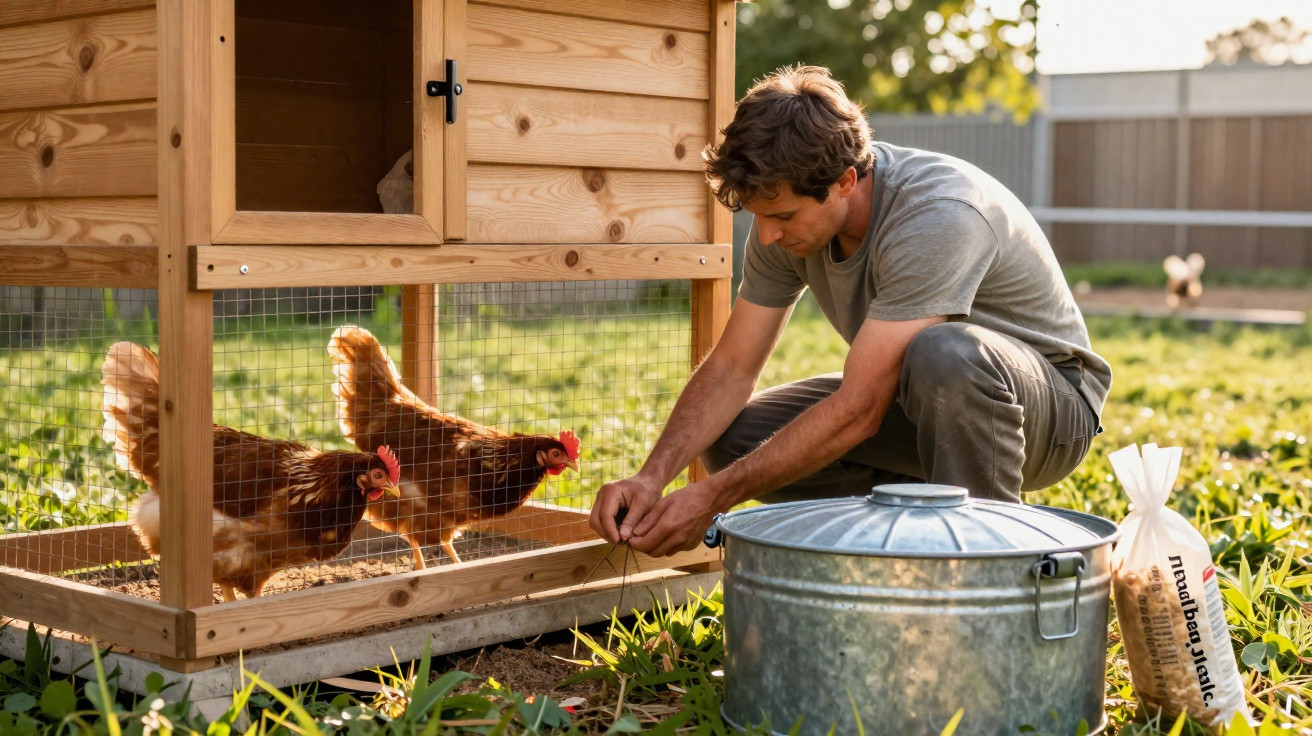
Keeping chickens means that, sooner or later, you are likely to encounter rats. These rodents do more than consume feed: they can also threaten the birds’ health and productivity. The encouraging news is that a few straightforward habits and targeted alterations can make the coop so unappealing that the infestation often disappears without costing a fortune.
Why rats are so attracted to chicken coops
To a brown rat, a chicken coop resembles an all-inclusive resort: there is a constant supply of food and water, dry hiding places and usually very little disturbance. They also have remarkable abilities. A rat can jump almost 1 metre, swim, dig deep burrows and squeeze through gaps of barely 2 centimetres – about the size of a 20-cent coin. Its teeth can get through wood, thin plastic and poor-quality concrete.
The consequences extend far beyond a few missing grains. Rats raid eggs, attack chicks and young birds, and keep hens under continual stress. In affected coops, egg production can fall by as much as one third. Their droppings contaminate bedding and the run, while pathogens such as Salmonella and leptospires find ideal conditions.
Allowing rats to remain in the coop risks fewer eggs, sick birds and an ongoing hygiene problem.
Clear warning signs include scratching noises at night, a pungent smell, small tunnels and holes in the ground, gnawed feed bags, or even rats appearing during daylight hours. By that stage, you need a plan – and something more considered than a spontaneous “poison campaign”.
Rat control is a game of chess, not a blitzkrieg
Rats are cautious and highly capable of learning. Setting just one trap or putting out poison once may win a battle, but it will not win the war. Successful chicken keepers take a strategic approach: the coop should simply cease to be of interest to rats. With no buffet and no comfortable places to hide, they will move on.
For small-scale keepers, the benefit is that much of this approach costs little or nothing. It relies on changing routines and making a few sensible structural improvements, rather than buying expensive high-tech systems.
Five immediate measures that cost almost nothing
You can make the coop less inviting as early as this evening. The following steps often achieve surprisingly good results:
- Bring feed in at night: Take down feeders or move them entirely indoors or into a locked room.
- Remove leftovers rigorously: Grain left in the run is an invitation. Offer smaller quantities instead, topping them up when needed.
- Collect eggs every day: Eggs left overnight quickly become prey, while also attracting more rodents.
- Inspect water points: Dripping drinkers provide rodents with free drinking water. Check seals and replace faulty drinkers.
- Rethink the compost heap: An open compost heap beside the chicken coop is a rodent magnet. Place it farther away or transfer it to a sealed container.
Food scraps are particularly problematic. Meat, cheese or leftover yoghurt in the compost or chicken run are like a feast for rats. Such waste belongs in the food-waste bin or general rubbish, not near the coop.
Store feed bags properly: metal beats plastic
Many keepers keep grain feed in thin plastic buckets or leave bags open in a corner. For rats, this is effortless. Sturdier containers are a better choice:
| Container type | Resistance to rats | Note |
|---|---|---|
| Thin plastic bucket | Poor | Often gnawed through |
| Metal bin with lid | Very good | Inexpensive and often available second-hand |
| Thick plastic feed cabinet | Moderate to good | Check the quality and wall thickness |
An old metal bin with a tightly fitting lid protects feed far more effectively than any cheap plastic sack. Keeping the floor clean is equally important: sweep up spilled grain immediately.
The feeders themselves also matter. A treadle feeder works with a flap that opens only when a chicken stands on it. This means that very little grain reaches the ground, and nocturnal visitors cannot access the feed.
If you do not have an automatic feeder: use portions
Even without a treadle feeder, there is plenty you can do. Give smaller portions several times a day rather than filling the trough to the brim. Remove all feed from the run in the evening. This disrupts the rats’ most important routine: feeding in the chicken area at night.
Turn the chicken coop into a fortress: structural rat-proofing
Over the long term, the construction of the coop determines whether rodents have an easy route in. A rat-proof chicken coop starts from the ground up.
Solid option: a concrete slab
If you are building new or renovating, a concrete slab around eight to ten centimetres thick beneath the full coop area is an excellent solution. It stops rats from digging tunnels into the coop from below. Bedding can then be spread over it without difficulty.
Lighter option: raise the coop on stilts
For lightweight wooden structures, mounting the coop on stilts is a practical option. The coop should stand 30 to 40 centimetres above the ground. The space underneath remains fully visible. Rats avoid exposed areas without cover because they are easy prey for cats, birds of prey or foxes.
Weak point: reinforce wooden floors with wire mesh
Many small coops have a simple wooden floor. In this case, it is worth reinforcing the underside with welded wire mesh. It can be fixed in place using staples, or screws and battens. A mesh size between six and thirteen millimetres is essential. Larger openings leave too much room for young rats.
If a pencil cannot fit through it, a rat generally cannot either – the pencil test exposes weak points.
Small cracks and holes can be packed with steel wool, pressed firmly into place and, if necessary, secured with a little mortar. Plain wood or foam is unsuitable for plugging gaps, as rats will soon gnaw through it again.
Secure the chicken run with a wire barrier
The chicken run also needs attention. Standard wire fencing may keep chickens enclosed, but it does not keep rats out. A properly constructed wire barrier around the run can significantly reduce the number of tunnels and holes.
Welded, fine-mesh wire extending around 20 centimetres into the soil has proved effective. Bend the bottom edge of the wire outwards. Covering this area with soil or stones afterwards creates an unpleasant obstacle for digging rats.
Traps, poison and professional help: what really makes sense
Many keepers prefer to avoid poison because of concerns about dogs, cats, wildlife or birds of prey that could eat poisoned rats. Traps are an alternative, although they require some strategy.
Using traps correctly
Place powerful snap traps or modern electric traps along walls wherever possible. Rats dislike crossing open spaces. One important tactic is to leave the traps unset for two days at first, baiting them with food. The rodents become accustomed to the “new feeding place” and lose their caution. Only then should the traps be set.
If rats are still visible during the day in the coop or run despite traps and structural measures, there is usually a large local population. In these cases, calling in a pest controller may be sensible. Professionals use approved rodenticides in secure bait boxes to reduce the risk to other animals.
Health risks for people and animals
Rats in a chicken coop are not simply a nuisance; they pose a risk to everyone involved. Bacteria can be transferred through droppings and urine into the soil, onto eggs or into open wounds. Salmonella causes diarrhoea, fever and weakness in chickens and people alike. Leptospires can affect the kidneys and liver.
When working in the coop, always wear sturdy footwear and gloves, and wash your hands thoroughly afterwards. Children should not play barefoot in the run, or enter it with open wounds, where rodents are suspected.
Practical everyday examples
Many small-scale keepers report that simply removing feed overnight makes a noticeable difference. One reader from Bavaria described how the nighttime noises disappeared within two weeks after changing the feed bin, compost and drinkers – entirely without poison or traps.
Another example illustrates how strongly construction faults can contribute: a cheap ready-made coop with a thin wooden floor stood directly on soil. Within one month, rats had dug a tunnel, eggs began to disappear and the hens became nervous. Only the later addition of a concrete slab solved the problem permanently.
What beginners often overlook
People new to chicken keeping understandably focus on coop size, breed choice and feed. The rodent issue tends to fade into the background – until the first rat darts across the yard in the torchlight. Planning before buying the birds can prevent a great deal of trouble later.
This includes choosing the location carefully. A chicken coop immediately beside a wood store, compost heap and feed supplies brings together several factors that attract rats. A little more distance, better visibility and clear separation between these areas significantly reduce the risk.
Benefits of consistent rat prevention in chicken coops
Making the coop systematically unpleasant for rats brings several advantages. Hens lay more consistently, remain calmer and show less stress-related behaviour. Feed consumption falls because it is no longer ending up in unwanted stomachs. Last but not least, hygiene improves throughout the garden area.
Keeping rats away does not require a luxury coop. What matters are simple rules: no feed left out overnight, robust storage, a sealed floor, fine wire mesh and close attention to the earliest signs. Follow these principles and rats lose their incentive, allowing you to focus again on what a chicken coop should be about: contented birds and fresh eggs.





Comments
No comments yet. Be the first to comment!
Leave a Comment