
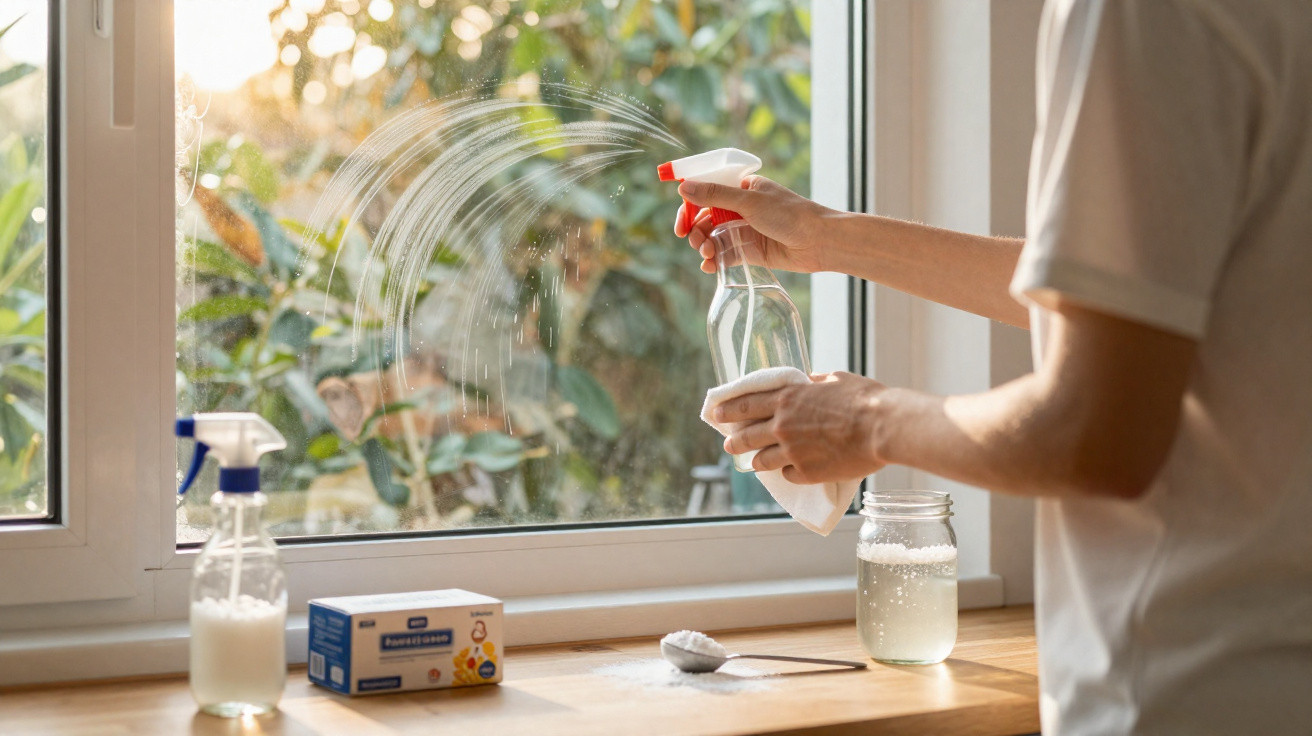
Many households now swear by white vinegar as a miracle cleaner for glass surfaces. Yet, particularly in sunlight, it often leaves behind a greyish haze that undoes all the effort. A simple kitchen staple normally used in sauces or cakes offers a surprisingly better way to achieve crystal-clear panes.
Why white vinegar does not make windows perfectly clean
Mix white vinegar with water, spray it onto the pane and wipe it away: this is the standard advice in countless cleaning videos. In reality, however, the result can look quite different. When sunlight hits the glass directly or the room is too warm, streaks and dull edges often appear.
This happens because of the way vinegar and water dry on glass. The liquid evaporates extremely quickly, while dirt particles and tiny limescale residues are left behind and spread unevenly. Under certain light, these deposits become visible as an unsightly film. The larger the glass surface, the more noticeable the problem becomes, such as on patio doors, large living-room windows or frameless mirrors.
There is another drawback: the strong vinegar smell can linger in a room for a long time. This is far from pleasant in small flats without a through-draught. Many people therefore add more water or combine it with other cleaners. Although that can reduce the odour, it does little to solve the streaking issue.
“The answer is not even more vinegar, but an entirely different component in the cleaning product – and it is usually already in the kitchen cupboard.”
Cornflour: the overlooked wonder ingredient for glass
The key powder is cornflour, sold in supermarkets under brands such as Maizena. It is usually used to thicken sauces or make cakes lighter, but in window cleaner it performs a surprisingly different task.
The fine cornflour particles alter the liquid’s surface tension. Put simply, the water-and-alcohol mixture spreads more evenly across the pane instead of running into droplets. At the same time, the cornflour captures tiny grease and dirt particles which might otherwise remain on the glass as a pale haze.
Practical users report that three elements work particularly well together:
- Alcohol (rubbing alcohol or cleaning alcohol) dissolves grease and disinfects.
- Water acts as the carrier and dilutes the mixture.
- Cornflour binds residues and helps the surface dry evenly.
The result is a solution that dries fast, leaves barely any residue and contains no overpowering smell.
Recipe: streak-free window spray with cornflour
To try this method at home, you need only a few ingredients and an empty spray bottle. Ideally, use a clean bottle with a fine mist nozzle, like those used for glass cleaners.
How to mix your own glass cleaner
For a useful quantity that will last through several window-cleaning sessions, use the following proportions:
| Ingredient | Quantity | Purpose |
|---|---|---|
| Water (preferably lukewarm) | approx. 250 ml | Base liquid that dilutes the alcohol |
| Alcohol (rubbing alcohol, approx. 70%) | approx. 250 ml | Dissolves grease and helps it dry quickly |
| Cornflour | 1 level tablespoon | Binds residue and prevents streaks |
Pour the water into the bottle first, followed by the alcohol and finally the cornflour. Close the bottle tightly and shake it vigorously until no lumps remain. The liquid will look slightly milky, which is entirely normal.
“Anyone sensitive to smells will appreciate this: the mixture is almost odourless, making it suitable for bedrooms and children’s rooms too.”
Correct use: keeping windows and mirrors streak-free
Even the best mixture delivers little if it is not used properly. A few straightforward steps, however, help you get the most from this DIY spray.
Step-by-step instructions
- Shake the bottle: Shake it well before every use so that the cornflour is evenly distributed again.
- Do not spray too much: Apply a light mist rather than soaking the pane. Using less product makes it easier to spread without streaks.
- Use a microfibre cloth: A clean, dry microfibre cloth works considerably better than kitchen roll or old cloths.
- Clean from top to bottom: This prevents drips from running onto areas you have already cleaned and leaves fewer marks.
- Avoid sunny hours: Clean in the morning or evening where possible, so the mixture does not dry too quickly.
This approach works not only on standard windows and balcony doors, but also on:
- large wall mirrors in bathrooms
- mirrors in hallways or bedrooms
- glass shower screens
- glass tops on coffee tables
What to do about grease splashes and stubborn marks
Every glass cleaner eventually reaches its limits in the kitchen, especially with deposits above the hob. Over time, a layer of grease, steam and dust builds up there. For these areas, the cornflour spray can be adjusted easily.
If desired, add a small amount of vinegar to the mixture, for example two to three tablespoons for the quantity given above. Alcohol remains the main grease-fighting ingredient, while the cornflour continues to keep surfaces clear. The vinegar mainly helps with stubborn deposits.
It is important to keep the amount low and always test how sensitive frames or seals are. Strongly acidic components should not come into contact with painted wooden frames or delicate plastic surfaces.
How long does homemade cleaner last?
Over time, the cornflour may settle and make the liquid slightly thicker. This indicates that it is time to prepare a fresh batch. It is therefore sensible to mix smaller quantities that can be used within a few weeks.
If a thick layer forms at the bottom of the bottle or the liquid becomes stringy, pour the remaining cleaner down the sink. Make a new mixture, rinse the bottle briefly with hot water, and it is ready to use again.
Practical tips for permanently clear panes
For consistently good results, it is worth paying brief attention to the window frame and surrounding area. Dust, pollen and fine particulate matter tend to gather in corners, then get dragged across the glass during wiping, creating another cause of streaks.
A useful routine is:
- Wipe the frames first with a slightly damp cloth.
- Remove dust and leaves from window sills.
- Only then clean the glass with the cornflour spray.
If you live in an area with very hard water, use still mineral water or boiled tap water for the mixture. Less limescale further reduces the risk of marks on the glass.
Why cornflour works so well
From a physical perspective, cornflour acts like a tiny framework within the water-and-alcohol mixture. It stops droplets from joining into uneven trails that dry on the pane and leave streaks. It also absorbs some of the dissolved dirt that would otherwise remain on the glass surface.
The effect is similar to the principle used by commercial glass cleaners, but with far more straightforward ingredients. There is no perfume, no colourants and no complicated chemical names – just a product many people already keep in their kitchen cupboard.
Anyone wishing to streamline their cleaning shelf can replace several bottles of glass cleaner with this simple recipe. And those who have previously relied on white vinegar often notice after the first sunny day that the panes look visibly clearer, the familiar haze is gone, and their nose benefits too.


Comments
No comments yet. Be the first to comment!
Leave a Comment