
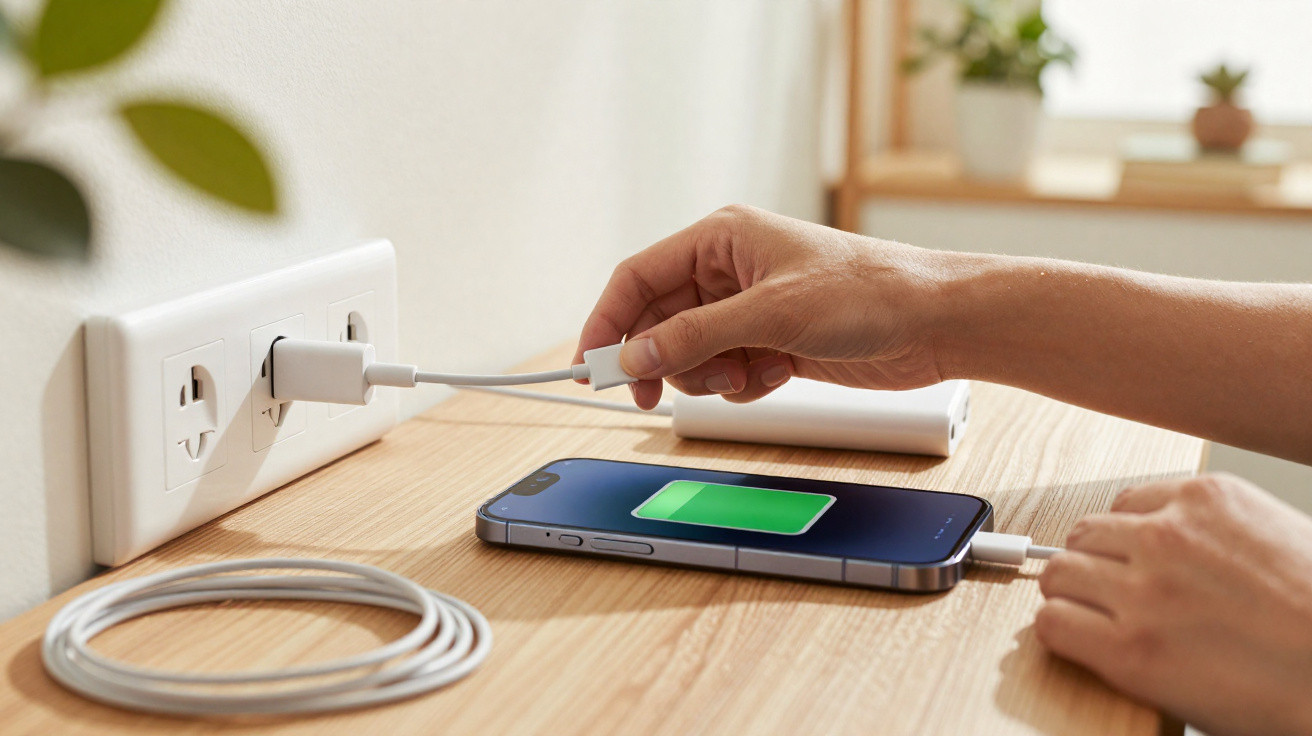
A small mistake, however, can cause serious long-term damage to your device.
Smartphones have long been constant companions for payments, navigation, streaming and work. It is therefore unsurprising that their batteries regularly run low. What many people do not realise is that the charger and cable are not the only things that matter: how and in which order you connect and disconnect your phone also plays a part. Careless handling can lead to irritating loose connections, charging faults and, in the worst case, costly repairs.
The most common mistake: connecting the phone to the cable before the mains socket
Many people do it automatically: they pick up the phone, plug the charging cable into the smartphone and only then insert the plug into the mains socket. It sounds harmless, but it is not a good idea, particularly with inexpensive chargers or slightly damaged cables.
Basic charging rule: plug the charger into the mains socket first, then connect the cable to the phone – not the other way round.
The explanation is straightforward: when the plug is inserted into the mains socket, a brief voltage or current surge can occur. High-quality chargers usually absorb this, while cheap or worn chargers do not always do so. If the smartphone is already connected at that point, the charging port receives the full impact of that voltage fluctuation.
You will not notice this immediately, but it may lead to problems over time:
- the USB or Lightning port is placed under greater strain
- faint scorch marks or wear can develop on the contacts
- loose connections can occur sooner
- charging may occasionally stop by itself or fail to start at all
The correct order for plugging in your smartphone
Anyone wishing to charge their phone more gently should follow a fixed sequence. It takes no extra time, yet can make a noticeable difference to the device’s lifespan.
How to connect your phone correctly
- Plug the charger into the mains socket first.
- Wait until the charger has a stable power supply, which is usually immediate; for switched extension leads, wait until after turning the switch on.
- Then connect the charging cable to the phone, avoiding any twisting or forcing of the connector.
If you use a switched extension lead, turn it on only once everything has been connected properly. This helps prevent unexpected switching spikes reaching the phone.
Why the cable matters so much
Many people underestimate how much a poor-quality cable can strain the port. Loose connectors, bent contacts or the familiar kink just behind the plug all put pressure on the socket.
Typical warning signs include:
- the phone charges only when the cable is held in a particular position
- the charging indicator repeatedly turns on and off
- the connector feels unusually loose or excessively tight
In these cases, replace the cable first rather than forcing it further into the port. Too much pressure can eventually damage the socket on the mainboard, and replacing that is considerably more expensive than buying a new cable.
You can also make mistakes when unplugging
The disconnection sequence is just as important as connecting the charger. Especially when in a hurry, many people pull the mains plug first and simply yank out the cable while it remains attached to the phone.
Better: always remove the connector from the phone first, then unplug the charger from the socket.
The reason is that abruptly pulling the mains plug from the socket while the cable is still attached to the phone creates pulling forces on the smartphone’s delicate port. This often happens when you are half asleep in bed at night or rushed in the morning. The cable catches or twists, and the socket gradually works loose from the casing.
Recommended unplugging order:
- Check the charging level: is the phone above 80–90 per cent? If so, carefully remove the connector from the smartphone.
- Only then unplug the charger from the mains socket or extension lead.
- Loosely coil the cable or place it down so that it does not develop kinks.
How much does incorrect charging really affect the battery?
It is not only the port that suffers when charging goes wrong; the battery can also be affected. The phone’s electronics do protect against major faults, but repeated stress at the limit reduces usable capacity more quickly.
Factors that put additional strain on the battery
- high heat while charging, such as under a pillow or in direct sunlight
- high-power fast charging for many hours rather than only for short periods
- continually charging to 100 per cent and draining the battery to almost 0 per cent
- uncertified cheap chargers with fluctuating voltage
To treat a phone battery gently, ideally keep its charge between roughly 20 and 80 per cent. Fully charging it before a long journey makes sense, but leaving it connected at 100 per cent all the time is not a good approach.
Using apps to monitor charging
Useful tools are available for Android smartphones that show how much current is actually flowing and whether the charger is working properly. These apps measure the rate at which the phone is charging and whether the readings match the charger being used.
This offers several benefits:
- faulty or poor-quality cables can be identified
- you can see whether a mains socket or adapter is causing problems
- you can notice if the phone becomes unusually warm
It is particularly worthwhile checking these readings on older devices. If the charging speed suddenly drops significantly, this may indicate a worn port, a weak charger or a deteriorating battery.
Solar chargers, power banks and more: take extra care when away from home
Many people charge their phones on the move using power banks or solar panels. This is convenient, but it can place even greater demands on the port than charging from a mains socket.
What to consider with power banks and solar panels
- Always switch on or activate the power bank before connecting the cable to the phone.
- With solar panels, wait for a stable voltage: clouds and shade cause continual fluctuations.
- Do not leave your phone in blazing sunshine simply because it is charging “for free”.
Unstable power sources make the phone’s charging controller work particularly often. Over time, this puts strain on the device’s electronics. Anyone who frequently charges with solar power or external batteries benefits especially from good-quality hardware and reliable cables.
Practical tips for a long smartphone life
A few simple habits can noticeably protect your smartphone’s port, battery and electronics. None of them costs much; the important thing is to keep them up consistently.
- Follow the sequence: when connecting, plug the charger into the mains socket first and then into the phone. Reverse the order when disconnecting.
- Never twist the connector: insert it straight, do not press it from the side or pull on the cable.
- Inspect cables regularly: cracks in the outer coating, bent contacts or obvious kinks? Replace the cable instead.
- Avoid heat: do not leave the phone under pillows, blankets or in a sunlit car while charging.
- Use original or certified accessories: particularly for fast charging, choose tested chargers.
Treating your smartphone this way means it should need repairs less often and retain its resale value. An intact charging port is almost a mark of quality when selling second-hand, as many buyers check whether the charging cable clicks securely into place.
One final point that is often overlooked is dust and lint. A phone port is often exposed to lint-filled trouser pockets. Dirt gradually collects in the socket, the connector sits less deeply and it can seem as though the cable has “worn out”. In reality, debris is simply blocking the contacts. In many cases, the port can be cleaned with a soft wooden toothpick and extreme care, but metal objects are off limits because they can damage the contacts.
Making these small steps routine significantly reduces the risk of expensive damage. The reward is more reliable charging, a longer-lasting phone and no need to retire it early simply because of a worn charging port.






Comments
No comments yet. Be the first to comment!
Leave a Comment