
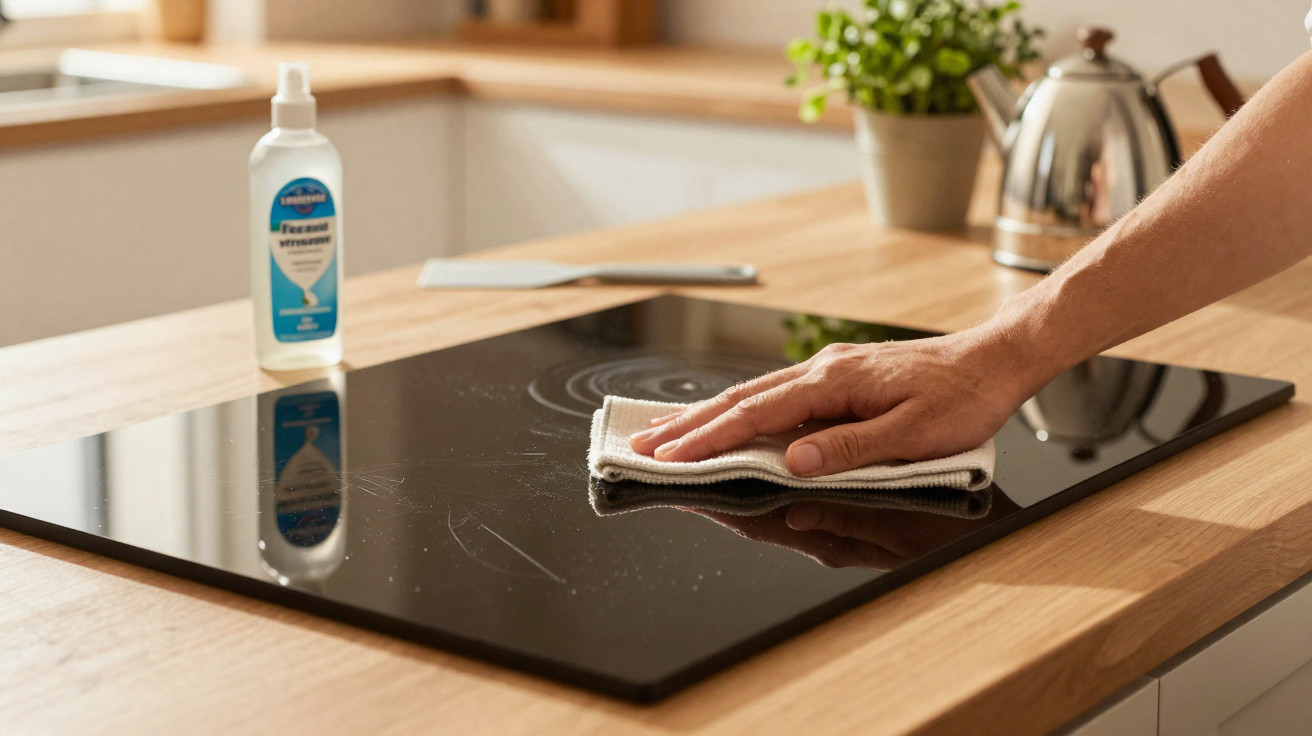
The first scratch always feels like the worst one. In one moment, your glass cooktop is a gleaming black mirror and the pride of the kitchen. In the next, a heavy pan is pulled a fraction too far and leaves a pale streak across it, like a scar on a familiar face. You turn on the light, shift your angle and trace it with a fingertip, wishing it were only a smear. It is not.
After that, it is all you notice whenever you cook.
Many people immediately consider replacing the entire cooktop, mentally adding up the cost. Yet that worn, scratched surface may not be beyond saving. It may be possible to bring it back to life quietly.
Why glass cooktops start to look “old” long before they are
Stand in front of a glass cooktop at 8 p.m., after dinner, with the overhead light switched on. Suddenly, it shows every mark accumulated over time: small circular shadows where pans have boiled over, fine scratches from moved cookware and a light mistiness around the burners used most often, like fog that never fully clears.
This is the point at which people think, “Well, that’s it. The new-kitchen phase is over.” It may sound a little dramatic, but it is understandable, particularly when the cooktop cost hundreds of pounds and the warranty does not cover “daily life.”
Consider Clara. Five years ago, during a kitchen refurbishment, she chose a sleek black induction cooktop. With two young children, regular pasta dinners and a heavy cast-iron frying pan, tiny scratches gradually became clearly visible rings. Then, while helping to make dinner, her brother-in-law pulled a steel stockpot over the glass and created one long, bright scratch.
Later that evening, she searched “replace glass cooktop” online and winced at the prices: £400, £600, and sometimes more. She was close to pressing “order” when she found a forum discussion where people admitted that they had recovered surfaces in worse condition through sanding, polishing and buffing.
What we label as “ruined” is often only surface damage. Glass-ceramic cooktops are designed to withstand heat rather than gentle abrasion. As a result, dirt, burnt sugar and mineral deposits stick to them, while sliding pans press those particles into the surface like sandpaper.
A large number of the grey “scratches” are actually deposits lodged in microscopic grooves, where they catch the light. Once you recognise this, the approach changes. Rather than thinking “I ruined it,” you begin asking “What’s actually on top of this glass that I can safely remove.” That modest change in perspective opens the way to restoration.
How to gently “reset” a scratched glass cooktop
The basic rescue technique is remarkably simple. Begin with a cold cooktop and a quality cleaning cream made for glass-ceramic surfaces. Apply a small amount to the worst affected section, then work it in using a folded paper towel or soft microfibre cloth in small circular movements. The aim is not to scrub aggressively, but to polish.
For deeper, more obvious scratches, many repair professionals discreetly use a tiny quantity of non-gel toothpaste or a purpose-made glass polish. Use the same circular motion and the same patience. Wipe away the product, examine the area in strong light and repeat. Over time, sharp white lines can fade into slight shadows, sometimes becoming almost impossible to spot unless you bend down and search for them.
There are also those who favour razor scrapers and those who do not. Supporters use a flat, fresh blade at a very shallow angle to remove burnt-on residue before polishing. Used correctly, it lifts hardened deposits responsible for many scratches in the first place. Used incorrectly, it can leave a fresh scar in seconds.
In reality, hardly anyone follows this routine every day. Life is busy, sauce boils over and spills remain until the next day. That is precisely how hard, crusty patches develop on the surface. If you choose to use a scraper, reserve it for glass, replace the blades regularly and work only on a cool cooktop. It is a tool, not a weapon.
Sometimes the goal isn’t perfection, it’s that quiet moment when you walk into your kitchen and think, “Oh. This actually looks good again.”
- Banish gritty cleaners
Avoid powders and abrasive pads. They wear into the glass, making small marks far more noticeable. - Say yes to soft cloths
Microfibre cloths or old T-shirts are your strongest allies. Anything rough or designed for “scrubbing” becomes a long-term problem. - Work with the light
Polish first, then tilt your head and inspect the surface from several angles. Your eyes are more useful than any instruction manual. - Keep a small “cooktop kit” nearby
Store cleaner, a cloth and perhaps a razor in a protective cover close at hand. If the kit is easy to reach, you are more likely to use it. - If the scratch catches your fingernail deeply, it’s likely permanent
Its appearance can be softened, but it cannot be removed altogether.
The emotional reset that goes with the visual one
There is a particular sense of relief in discovering that a cooktop does not need to be flawless to feel nearly new again. When the worst scratches become less obvious and the grey film clears, the mood of the whole kitchen shifts. You can set down a pan without flinching. At night, the cloth moves smoothly across the surface rather than catching on unnoticed raised spots.
You may even find yourself quietly showing it off when visitors come in and assume that you have replaced the cooktop. You know that you have not. You simply chose not to abandon it.
Choosing repair instead of replacement also brings a subtle satisfaction. In a world that encourages us to upgrade at the first cosmetic imperfection, carefully reviving a scratched cooktop can feel almost rebellious. You save money, prevent a large piece of glass-ceramic from going to landfill and gain a better understanding of how your own kitchen functions.
The next time a pan drags across the surface or a spill burns on, your response changes. Instead of panic, you make a mental note: “I can deal with this.” That confidence may be the real improvement.
If you have been living with a “ruined” glass cooktop, this could be the time to inspect it closely under bright light and from a different angle. Do not do so to judge it, but to identify what is dirt, what is residue and what is genuinely scratched. Share this small experiment with someone who has been side-eyeing their own cooktop for years.
Sometimes a tired surface only needs patience, gentle polishing and the decision that it deserves saving. The returning shine is not limited to the glass.
| Key point | Detail | Value for the reader |
|---|---|---|
| Gentle polishing works | Use glass-ceramic cleaner, toothpaste, or glass polish with soft circular motions | Offers a realistic way to fade scratches without replacing the surface |
| Avoid hidden scratch-makers | No gritty powders, rough pads, or dirty pan bottoms full of residue | Prevents new damage and keeps the “restored” look longer |
| Deep scratches can be softened | They may not disappear but can become far less visible with patient care | Sets expectations and encourages repair instead of expensive replacement |
FAQ:
- Can toothpaste really help remove scratches from a glass cooktop? Yes, provided it is white, non-gel and non-abrasive toothpaste. It works as a very mild polish. Use a tiny amount, rub it gently in circles with a soft cloth, wipe it clean and inspect the result. Repeat gradually instead of applying heavy pressure.
- When is a scratch too deep to fix? If your fingernail noticeably catches as you pass it over the scratch, the damage extends further into the glass. Careful polishing can make it less visible, but it is unlikely to erase it completely.
- Is it safe to use a razor blade on a glass cooktop? Yes, if the manufacturer permits it and you use a new, sharp blade held almost flat against the surface. Use it only on a cold cooktop to lift hard burnt-on deposits, not for everyday cleaning.
- Will polishing damage the heating elements underneath? No. You are working only on the outer glass-ceramic layer. Provided you use mild cleaners and do not strike the cooktop with anything heavy, the internal components remain unaffected.
- How often should I “deep clean” to avoid new scratches? For most households, a quick wipe after cooking plus a more thorough clean once a week is sufficient. The important part is clearing spills before they harden and become tiny abrasives beneath your pans.




Comments
No comments yet. Be the first to comment!
Leave a Comment