
That is often how it begins: a harmless reach for an attractive open shelf, followed by a morning spent dusting, sorting and returning items to where they are supposedly meant to be. The shelf may still photograph beautifully, yet your mind feels all over the place. Your mugs no longer match, the spice jars are an assorted collection, and you quietly worry about anyone unexpectedly opening the kitchen door.
A few years back, open shelving dominated Instagram. Now, an increasing number of homeowners are discreetly putting the doors back on. It is not that appearance matters less to them; they are simply worn out. Behind streamlined cabinet fronts is something more desirable than a perfectly styled image: calm.
That sense of calm is closely tied to what remains out of sight.
Why open shelving is losing its appeal
Spend an entire day in a kitchen with open shelves and pay attention. Breakfast cereal in the morning, hurried lunches, midnight snacks, and a friend dropping in “just for a coffee” all leave their mark on exposed surfaces. Bowls drift elsewhere. Glasses are returned to the wrong place. A forgotten peanut butter jar ends up beside your best wine glasses.
By evening, the shelves have become a record of the day’s disorder. Worse still, it is always visible: from the sofa, the hallway and even the dining area. That continual visual clutter can be draining, much like a television murmuring in the background after everyone has forgotten it is switched on.
One couple in London discovered this for themselves. They removed their wall cabinets in favour of crisp white-oak shelves that looked as though they belonged in a design magazine. During the first week, they arranged everything meticulously: cookbooks grouped by colour, neatly piled plates and carefully chosen ceramics. By the third month, weekday reality had taken charge. Plastic cups for the children, partly empty cereal packets and an old water bottle that nobody owned had appeared.
They began to avoid photographing the kitchen because “it always looks messy”. When they eventually returned to their kitchen designer, they requested something they had never imagined wanting: tall, closed cabinets to conceal it all. They were surprised by how different the room felt. “It’s like our shoulders dropped,” they said.
There is a straightforward explanation for this change. Open shelving requires every item displayed on it to look attractive at all times. Closed storage reverses that expectation. Cabinets provide a backstage space where everyday life can be untidy, while the kitchen’s visible “stage” stays composed and uncluttered. This divide eases visual stress and lightens the mental burden of repeatedly tidying whatever others could see.
Closed doors offer practical benefits, too, shielding contents from dust, grease and sunlight. Crockery remains cleaner, food keeps for longer, and there is less need to wipe rows of glassware that are rarely used. This is not merely a move towards minimalism; it is about being kinder to your future self.
How to make closed storage work better than open shelves
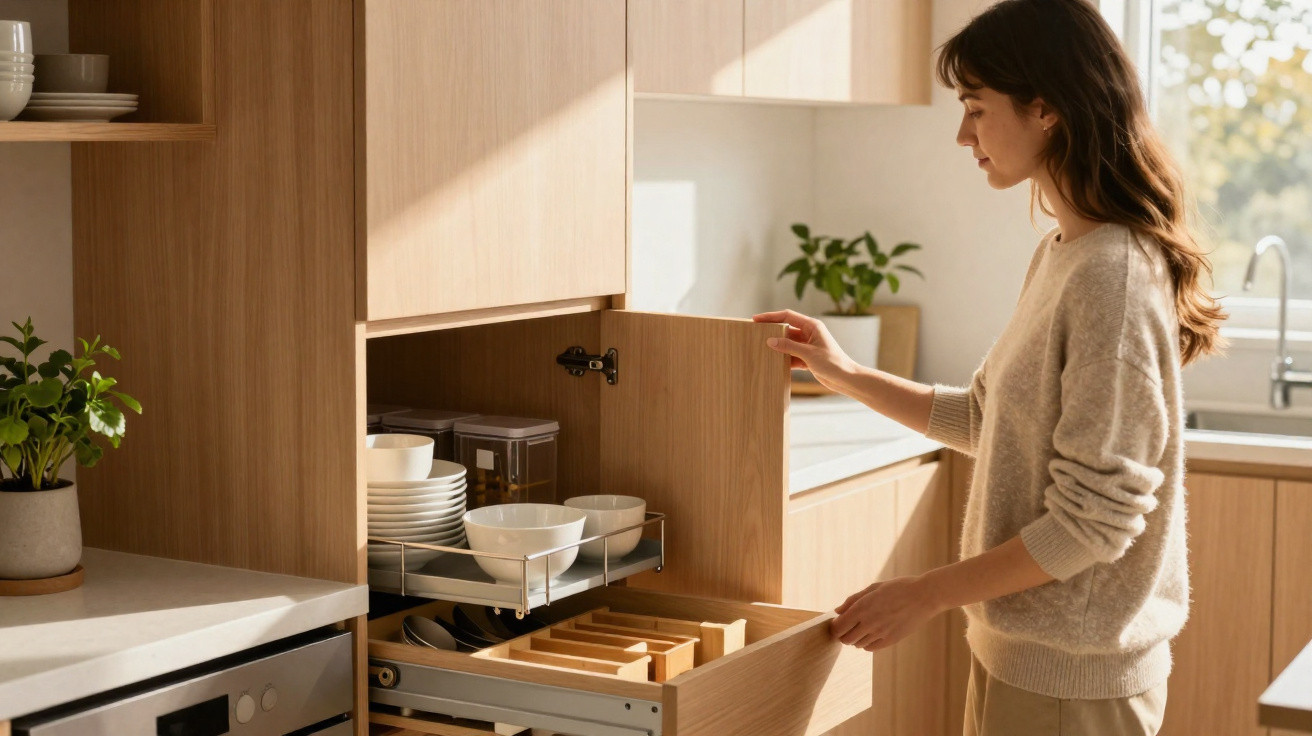
The key to closed storage is not simply installing extra cabinets. It is planning them as a system. Begin by considering an ordinary day in your kitchen. Where do you genuinely reach for coffee? Where do the children do their homework? Where are keys and post usually put down?
Plan your closed storage around these routines. Store daily crockery close to the dishwasher. Keep breakfast supplies by the fridge. Add a “landing drawer” near the entrance for chargers, receipts and the miscellaneous objects that never seem to belong anywhere. Your cabinets then become quiet helpers rather than hiding places for clutter.
Work in layers. Use deep bottom drawers for saucepans, frying pans and mixing bowls. Reserve mid-depth drawers for food containers and their lids. Put cutlery and the utensils used ten times a day in shallow drawers. Once each space has a defined role, closed storage no longer feels like a mysterious black box; it becomes easy to navigate.
This is where many households go wrong: they fit lovely closed cabinets, then throw everything inside and expect the doors to solve the mess. They do not. The clutter has merely relocated. The next time the cupboard opens, a pile of plastic containers may spill out like something from a comedy sketch.
A colour-coordinated Pinterest pantry is not necessary to prevent this. Simple zones are enough: one shelf for baking, one for snacks and one for everyday evening-cooking essentials. Labels can be useful, but routines matter more. Keep items where your hand instinctively goes, rather than where they would look best in a photograph. Let’s be honest: nobody really maintains a storage system every day if it is unintuitive.
Be kind to yourself when things go awry. During a difficult week, the “snack basket” may overflow. That is not a failure; it simply shows that storage needs to adapt to your life, rather than forcing your life to adapt to storage. If a cabinet arrangement consistently fails, revise the arrangement rather than blaming yourself.
“The best kitchen isn’t the one that looks perfect in a still photo,” says an interior designer friend who secretly regrets her open shelves. “It’s the one that still works when you’ve had a terrible day and just want to dump everything and sit down.”
For many homes, that ease now comes from carefully planned closed storage: a tall pantry with solid doors that accommodates bulk food shopping; a slim pull-out beside the hob for oils and spices; or charging points concealed in a drawer to keep worktops clear. As soon as the doors are shut, the room can look reset in moments.
- Set aside one “ugly cabinet” for appliances and miscellaneous gadgets you may not like but still need.
- Leave one shelf largely empty to absorb unexpected clutter on busy days.
- Fit racks to cabinet doors for foil, wraps and small bottles, freeing up entire shelves.
These small measures may sound basic, but on a Wednesday evening they can feel like a breath of fresh air.
A calmer kitchen with closed storage
There is a gentle satisfaction in switching off the kitchen lights when the worktops are clear and the cabinet doors are closed. It is not because the space is perfect, but because there is somewhere for the mess to go. Your eyes can relax, and your mind follows.
For a decade, we have celebrated display: open shelves, glazed fronts and styled stacks. Now the balance is shifting towards sanctuary. Closed storage is becoming the more considered option, not because beauty no longer matters, but because people are redefining it. Less performance, more peace.
On one friend’s kitchen wall, three long open shelves once held cookbooks and ceramics. That wall now has full-height cabinets in a soft matt shade, interrupted only by one understated piece of artwork. The room appears taller, gentler and more forgiving. Behind the doors is real life: mismatched mugs, children’s artwork and the chipped bowl nobody can bring themselves to discard.
Everyone knows the moment when the doorbell rings and the kitchen needs to look “okay” within ten seconds. Closed storage manages that better than any styling trick. Sweep a few loose items from the worktop, place them behind a door and breathe again. It is not about concealing who you are; it is about having the freedom to live untidily without feeling untidy all the time.
Perhaps the kitchen of the future is not the open, curated stage we once expected. Perhaps it is a collection of considered, enclosed compartments that quietly carry the weight of daily life, leaving the visible space feeling lighter. That subtle change affects the appearance of a room. It also alters how you feel when you enter it late at night, in the half-light, reaching for a glass of water in a kitchen that finally seems to be working with you.
| Key point | Detail | Benefit for the reader |
|---|---|---|
| Closed storage reduces visual noise | Cabinet doors conceal daily clutter and mismatched items | Helps the kitchen feel calmer, even on busy days |
| Design storage around real routines | Position items according to how and where they are genuinely used | Makes cooking and tidying quicker and less frustrating |
| Use “flex” zones inside cabinets | Empty or loosely organised areas take in overflow and unexpected clutter | Keeps the system functioning even when life becomes chaotic |
FAQ
- Is open shelving completely out of style now? Not quite. Open shelves can still work in limited amounts, such as a single short shelf for favourite pieces. What is fading is the idea of replacing every wall cabinet with fully open storage.
- Can a small kitchen benefit from closed cabinets? Yes. Tall closed cabinets can make a compact kitchen appear more cohesive and less cluttered. Handleless fronts and pale colours help them blend into the space visually.
- How do I stop closed cabinets from turning into junk zones? Give every cabinet a clear function, use straightforward bins or baskets, and designate one small area as a “catch-all” to reset each week. Small routines are more effective than major clear-outs.
- Should I mix open and closed storage? Many designers now prefer predominantly closed cabinets, with a small open-shelving section for objects you genuinely love and use regularly. This approach retains character without inviting chaos.
- What door style works best for a calm look? Flat doors or simple Shaker-style doors with matt finishes usually create the most soothing result. Fewer lines and decorative details mean fewer visual distractions in everyday life.

Comments
No comments yet. Be the first to comment!
Leave a Comment