
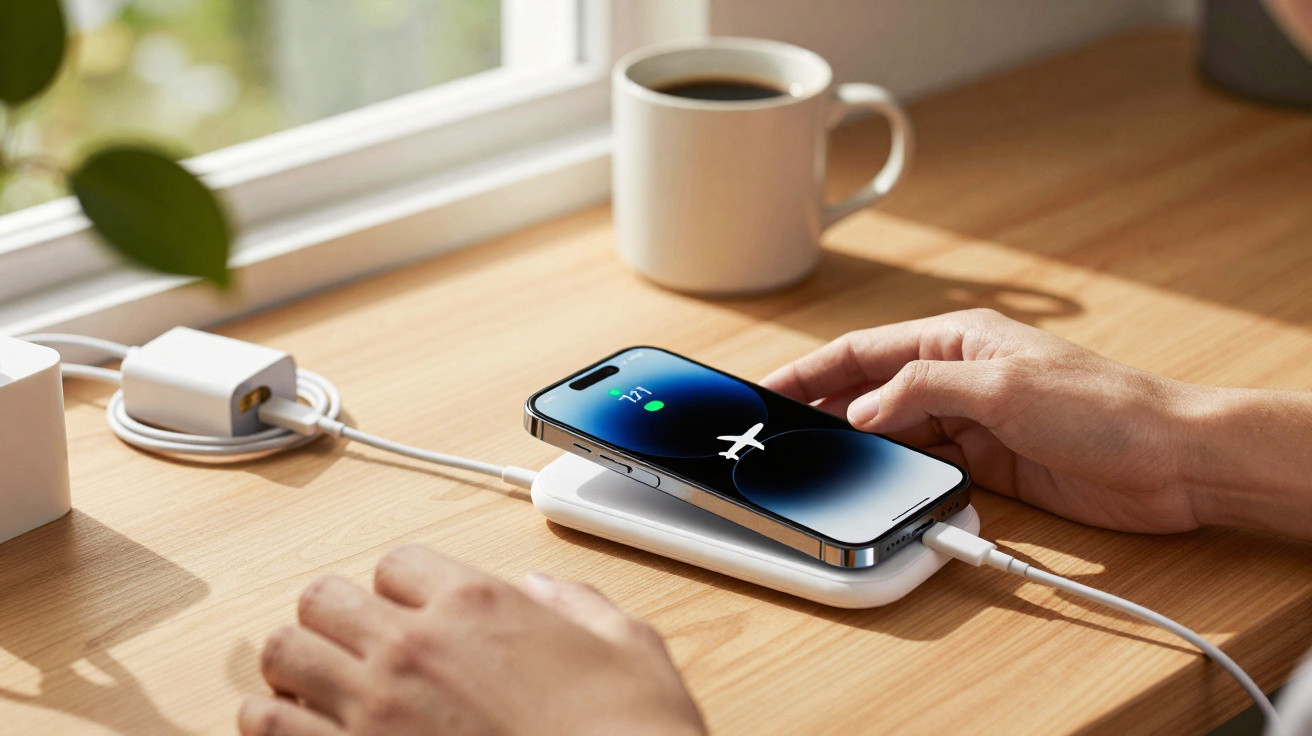
No incoming calls, no alerts, no vibration - only the small aeroplane symbol lit up in the screen’s corner. You are not travelling anywhere, but your phone is technically “in the air”.
You have probably heard somebody say, “Charge in airplane mode, it’s better for the battery.” Perhaps you have done it yourself when working, sleeping or simply wanting to switch off for a while. The battery level rises more quickly, the handset remains cool, and it feels as though you are doing something mildly clever and tech-savvy.
So what is actually happening inside the slim device in your hand? Are you quietly helping it last longer, or is the impact almost negligible? The answer is more subtle, less dramatic and slightly unexpected.
What airplane mode really changes when you charge on the ground
Tapping the small aeroplane icon switches off your phone’s key radios: mobile data, cellular connection, Wi-Fi, Bluetooth and, on some devices, GPS. With one action, you stop a torrent of constant activity in the background. The phone no longer searches for a signal, moves between masts or communicates with every network within range.
When you connect it to a charger, the battery therefore has fewer demands competing for its power. There is less heat created in the background and less minute, unseen “micro-strain” on its cells. In effect, you give the phone a more peaceful charging setting - rather like lowering the lights and quietening a room so that a tired friend can rest.
In practical terms, you may see the percentage rise slightly faster. Almost all the charger’s energy can go towards replenishing the battery rather than being divided between antennas, real-time app synchronisation and location updates. There is no trick involved; the hardware simply has less disorder to manage simultaneously.
A further, less obvious benefit is reduced heat. Radios consume electricity, and electricity produces warmth. If a phone is struggling to find a weak signal on the ground, its modem works harder, draws more current and heats the battery. Heat is one of the understated threats to long-term battery health. Charging in airplane mode, particularly where reception is poor, can therefore keep the battery a few degrees cooler.
Will this double your battery’s lifespan? No. The benefit is far smaller than popular claims imply. Still, in the gradual decline of lithium-ion battery health, avoiding unnecessary heat cycles and heavy use during charging does make a difference. It is more like adding a few thousand extra kilometres to a car’s life through gentle city driving than fitting an entirely new engine.
Airplane mode makes the greatest difference when the phone is under more pressure while charging - during gaming, hotspot use, video calls or poor network coverage. Consider a busy train journey with unreliable 4G. Your phone strains to remain connected to a mast, the battery chart falls sharply and the device becomes warm in your pocket. Plugging it in on that journey while using airplane mode would save the modem from that demanding task.
There is a small-scale testing element to this: technology reviewers and enthusiasts comparing charge times with and without airplane mode have generally seen modest but repeatable differences. We are talking minutes rather than hours, with a possible 5–15% faster charge in certain circumstances. That is the sort of gain you notice when you are late for work and only need “five more percent” before leaving.
Across a long day, this minor advantage can also affect how much charge remains once the cable is removed. A phone charged quietly - with the screen off and radios inactive - will often leave the socket slightly cooler and more “relaxed” than one that spent the same hour streaming TikTok over 5G. You may not spot the difference after one or two days, but you could after a year.
From a technical standpoint, airplane mode does not alter lithium-ion chemistry itself. The cells have no idea whether you are on an aircraft or in a café. What changes is the charging context: processor demand, network traffic, screen-on time and incoming notifications. Each of these means the phone is charging while also carrying out work.
Whenever the battery must replenish itself while powering demanding tasks, it works through a tougher cycle, produces more warmth and experiences a marginally harsher life. Airplane mode removes a substantial portion of that background load. It is comparable to refuelling a car with its engine switched off rather than revving it at every set of traffic lights.
For battery lifespan alone, the major principles remain more important: avoid repeatedly going from 0% to 100%, keep the handset cool, do not leave it at 100% overnight in very hot rooms, and aim to remain roughly between 20% and 80% where possible. Using airplane mode while charging merely supports those principles by eliminating some hidden drains working against them.
How to use airplane mode as a quiet battery ally
The easiest approach is simple: plug it in, activate airplane mode and leave it alone. Let the phone charge uninterrupted for 20–40 minutes whenever you are not using it - during a work break, shower, lunch or before going to bed. You achieve two things at once: a quicker top-up and slightly kinder treatment for the battery.
If Wi-Fi is still necessary, you can switch it back on manually while remaining in airplane mode. Most current phones support this. You can then prevent power-hungry cellular signal searching while still receiving WhatsApp or iMessage messages through your home or workplace network. It is a useful hybrid setting that many people overlook.
Some people take this further overnight: they put the phone in airplane mode, connect it to power, then use either a timer plug or an in-built “Optimized Charging” feature to avoid leaving it at 100% for hours. Is that a little extreme? Perhaps. However, if battery ageing is already a concern, combining airplane mode with smarter overnight charging can discreetly slow the wear.
One frequent misunderstanding is to treat airplane mode as a miracle solution. It is not. If your phone is beneath your pillow, its brightness is at maximum, the case remains fitted and it is connected to a hot, inexpensive charger, airplane mode will not prevent heat from building up. A battery still ages more rapidly when it effectively lives in a sauna.
Another mistake is relying on airplane mode purely to rush-charge from 5% to 100% every day. Those deep cycles are hard on lithium-ion cells. To help a phone last for years, try not to spend your time in the 0–10% red zone. A lunchtime airplane-mode top-up from 35% to 65% is gentler than an emergency charge from near-empty each evening.
On a personal level, airplane mode can also provide a small digital boundary. On the train, over dinner or during a focused work session, you plug in, cut the connection and stop your phone acting like a tiny manager demanding your attention. On a difficult day, that may be worth more than an extra month of battery health. Let’s be honest: nobody really does this every day.
“Airplane mode doesn’t magically heal your battery. It simply gives it a quieter room to breathe while it’s recharging.”
Here is a quick real-world cheat sheet:
- Use airplane mode when charging in areas with weak signal - on trains, in basements or in rural locations - to reduce heat.
- Consider short, quiet airplane-mode charges when you will not need the phone for 30–40 minutes.
- Manually turn Wi-Fi back on if you want to receive messages without the 4G/5G drain.
- Do not game or make video calls while charging, whether airplane mode is enabled or not.
- Treat airplane mode as a useful extra, rather than a miracle answer to poor charging habits.
Rethinking your daily charging rituals
There is something valuable about recognising what your phone does when you are not watching it. Radios seek networks, apps synchronise, adverts load and widgets refresh - all while the small battery icon slowly rises. Enabling airplane mode during charging is like pausing that unseen treadmill.
On some evenings, it is less about battery science than mental space. You arrive home exhausted, your phone is at 23%, and your mind is full of notifications you have not even read. You plug it in and tap airplane mode; for one brief hour, both you and your phone can recharge without being pulled in ten different directions. This small action can change your relationship with the device, making it a tool again rather than a leash.
Over months and years, these small decisions accumulate. Every slightly cooler charge, every avoided combination of “hotspot plus charging plus weak signal”, and every brief, calm top-up makes your battery-health graph a little flatter. Not dramatically - just enough that, after three years, your phone may still finish the day at 25% instead of struggling along at 3%.
We do not often discuss our devices as things that age alongside us. Yet people now tend to keep phones for longer, delaying upgrades and using one model for four or five years. In that setting, modest habits such as charging in airplane mode become more relevant. They need not become an obsession; they are simply a quiet way of caring for a tool you depend upon every day.
Perhaps the real change is this: you begin using airplane mode not only when instructed by a flight attendant, but whenever you choose to slow things down - for your battery and for yourself.
| Key point | Detail | Why it matters to the reader |
|---|---|---|
| Airplane mode reduces background drain | It disables cellular connections, data and most radios, meaning energy mainly goes into charging rather than network tasks | It can help your phone charge slightly faster with less hidden strain |
| Cooler charging is healthier | Less signal searching produces less heat during charging, especially in low-reception locations | It supports long-term battery health and reduces uncomfortable handset warmth |
| A habit, not a miracle | It works best alongside partial charges, avoiding 0–100% swings and avoiding demanding use while plugged in | It provides a realistic, sustainable way to keep your battery feeling younger for longer |
FAQ:
- Does charging in airplane mode actually charge my phone faster? Often, yes, although only by a small amount. As the phone is not using power for radios and background data, more incoming energy reaches the battery directly, potentially cutting a few minutes from a full charge.
- Is it better for long-term battery health to always charge in airplane mode? It can help slightly, mainly because it reduces heat and workload during charging, but the greatest benefits come from avoiding constant 0–100% cycles and extreme temperatures. Airplane mode is a useful addition, not the primary answer.
- Can I still use Wi-Fi while my phone is in airplane mode? On most modern phones, yes. Once airplane mode is enabled, you can manually turn Wi-Fi back on to stay online without the drain caused by cellular networks.
- Does airplane mode stop all background activity on my phone? No. Apps may still operate in the background, particularly through Wi-Fi. It chiefly disables network radios; it does not pause the operating system or close every app.
- Should I charge overnight with airplane mode on? If you value a quieter night and want to lower minor drains and heat, it is a sensible habit. Combine it with features such as “Optimized Charging” or a partial top-up to avoid remaining at 100% for many hours and create an even gentler routine.






Comments
No comments yet. Be the first to comment!
Leave a Comment