
The first time you spot it, the feeling can be surprisingly close to betrayal.
The ring you adored last summer is now lying dull and grey at the bottom of a dish on the bathroom shelf. The bracelet you wore to every party has disappeared beneath a brownish film. You rub it with your thumb, breathe on it and try the edge of your T-shirt. Nothing changes. The gleam you remember has vanished, leaving a weary, grimy-looking sheen.
You may start asking yourself whether the jewellery was inexpensive, or whether you have done something wrong. Perhaps you wore it in the shower too many times. Maybe your skin “doesn’t like” silver. Someone on TikTok insists toothpaste is the answer, while another person in the comments warns that toothpaste ruins everything. Then you search for “how to clean silver at home” and come across an odd-looking combination: aluminium foil, baking soda and boiling water. It resembles a spell from the kitchen.
That is where the understated magic starts.
Why silver really tarnishes - and what your skin has to do with it
Silver does not actually “go bad”. Instead, it reacts. The bright finish you like is metal, while the air around it contains countless invisible culprits. Sulphur compounds from pollution, central heating and even certain foods settle on silver and gradually transform it into silver sulphide, which can appear dark, yellow or nearly black. This is not simply dirt sitting on the surface. It is a fresh layer of material created when silver meets the world around it.
Living in a city can accelerate this reaction. Cooking regularly with garlic and onions can speed it up too. Storing silver in the bathroom, directly above a can of hairspray, makes it faster still. Sweat matters as well: some people have slightly more acidic skin or skin richer in particular minerals, so their jewellery darkens in days rather than months. The silver item itself has not changed; its surroundings make all the difference.
Consider the necklace your grandmother stored in a velvet box. When you open it decades later, you might expect an almost rusty, lacklustre chain, only to find it needs little more than a gentle polish. That box served as a small protective barrier, slowing the chemical exchange between the silver and the air. Contrast that with a ring left beside the sink, exposed daily to splashes of water, soap and steam. That ring is effectively living in a miniature chemical factory. Once tarnish is understood as a reaction rather than a flaw, it becomes much easier to explain.
Jewellers are well aware of this. A great deal of silver jewellery is finished with rhodium or another protective coating to postpone tarnishing. Sterling silver (92.5% silver, 7.5% other metals like copper) is particularly reactive because of the copper it contains. This is why some premium brands use anti-tarnish treatments or include storage pouches with every piece. It is not empty marketing; it is chemistry colliding with everyday life. Recognising that is the first move towards breaking the “buy, love, forget, find it ugly, shove it in a drawer” cycle.
The kitchen-table experiment: aluminium foil, baking soda and a little chemistry
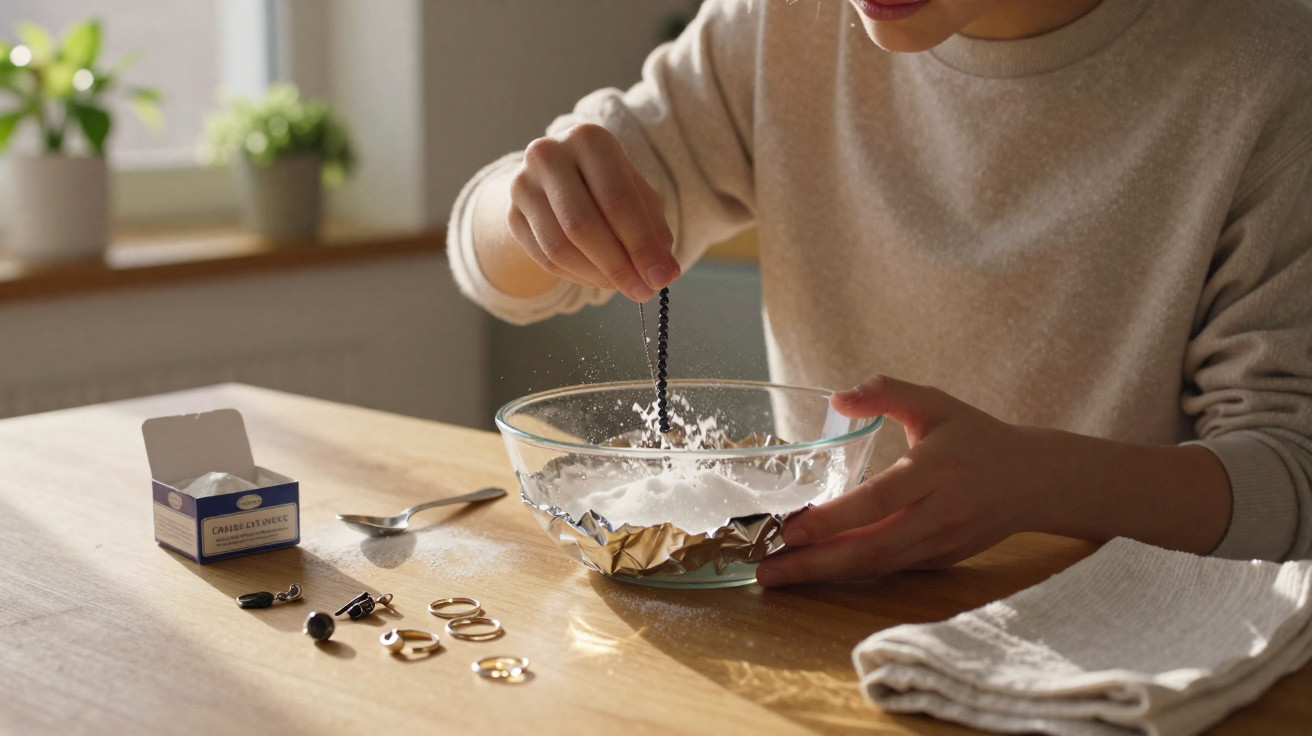
The aluminium-foil-and-baking-soda technique looks like an experiment from a science lesson you vaguely recall. First, line a bowl with bright foil, scatter in baking soda, place the tarnished silver inside and pour over hot, nearly boiling water. Seconds later, a mild sulphurous odour may rise and tiny bubbles appear on the metal. With some scepticism, you watch the dark marks begin to lift. It can seem as though you are somehow outsmarting physics.
In reality, a small redox reaction is doing the work for you. Silver sulphide, the dark tarnish, gives back its sulphur. Aluminium is the more “active” metal and, in effect, offers to tarnish instead of the silver. Sulphur transfers from the silver to the aluminium and becomes aluminium sulphide on the foil. The ring recovers its silver surface through chemical restoration rather than scrubbing. It’s less cleaning than time travel for metal.
Baking soda makes the water mildly alkaline, allowing electrons to move more easily and hastening the transfer between aluminium and silver. That subtle rotten-egg smell comes from minute traces of hydrogen sulphide released as chemical bonds break and form again. The unusual satisfaction of this process lies in seeing, almost moment by moment, a simple piece of chemistry affect something that matters to you. You immerse it, wait, rinse it, and an old favourite seems to return to life in your hand as if it had never gone away.
Let us be honest: nobody really does this every day. You tend to remember it only when an important occasion is approaching, or while decluttering and finding a box of neglected chains. The welcome surprise is that the method does not penalise procrastination. Unlike aggressive polishing, it does not remove layers of silver every time it is used. It simply reverses a reaction that was never personal. Tarnish was not a verdict on your hygiene or taste; it was merely silver being silver in a world full of sulphur and steam.
How to use the foil-and-baking-soda method safely without wrecking your jewellery
This straightforward approach generally works for plain sterling silver. Line a glass or ceramic bowl with aluminium foil, with the shiny side facing upwards. Add two to three tablespoons of baking soda, using enough to lightly cover the base. Put the tarnished silver pieces in so that they make contact with the foil. Next, pour over very hot water from a kettle until the jewellery is fully covered. You may notice bubbles and a faint smell. Leave the pieces for two to five minutes, lift them out with a spoon, rinse them beneath cool water and gently pat them dry with a soft cloth.
The technique is most suitable for chains, plain rings and solid silver pieces without glued stones. It is quick, inexpensive and unexpectedly soothing. If tarnish is especially stubborn, repeat the process and give the pieces another dip. Finish with a careful buff using a microfibre cloth to restore the final mirror-like shine. A quiet benefit of this method is that it reaches difficult spaces a polishing cloth cannot, including chain links and the backs of detailed designs.
The problem for many people is applying it to unsuitable items. Treated pearls, softer stones such as opals, turquoise and amber, plus anything with a glued setting, do not respond well to heat or alkalinity. Antique jewellery with unknown finishes may react poorly too. A considerate rule of thumb is this: if an item is precious emotionally or financially, first test a small concealed area or speak to a jeweller. There is no need to feel embarrassed; professionals hear “I tried this hack I saw online” every week.
“The most heartbreaking moments aren’t broken clasps,” a London jeweller once told me, “they’re heirlooms ruined by good intentions and the wrong cleaning trick.”
A few simple precautions can prevent that kind of regret:
- Use the foil method only for plain sterling silver with no delicate stones.
- Avoid boiling-hot water for items that seem thin, fragile or antique.
- Never use toothpaste or abrasive powders – they scratch the surface.
- Keep cleaned silver in soft pouches or zip bags with anti-tarnish strips.
- Wear your silver regularly – skin oils can slow tarnish more than you think.
Living with silver: better habits and fewer “oh no” moments
On a calm evening, laying your jewellery across a table can feel unexpectedly personal. Every item holds a memory: the inexpensive silver ring from a teenage summer, the bracelet bought with your first proper salary, the locket handed down through three generations. Finding them dull and overlooked may bring a flicker of guilt, as though you had failed old friends. Cleaning them becomes less about appearance and more about reconnecting with moments from your own life.
The aluminium foil and baking soda reaction offers a practical route back. Yet beyond this immediate solution, it suggests a modest lesson in daily care. Getting used to taking silver off before hot showers, swimming or applying hairspray lengthens the interval between thorough cleans. Adding a small anti-tarnish strip to the box holding your favourite pieces can prevent that dispiriting “all my jewellery looks grey” moment before it happens. A little dish on a hallway shelf for “rings off, keys down, day over” can gently reshape your routine.
On a personal level, restoring shine rather than discarding and replacing an item can be grounding. Rather than chasing the next trend, you are valuing something you chose before. The tarnish that irritated you in the morning may become a story shared with a friend later that day: “I tried that baking-soda thing and my necklace looks brand new.” You might even send a photograph. Small transformations at home rarely make headlines, but they are often the ones that remain with us. When a bracelet next darkens at the back of your wrist, you will know it is simply chemistry inviting you back for another small kitchen-table ritual.
| Key point | Detail | Benefit for the reader |
|---|---|---|
| Why silver tarnishes | A reaction with sulphur compounds in the air, on the skin and in the surrounding environment | Understand that tarnish is neither a defect nor a sign of “poor quality” |
| Aluminium + baking soda reaction | A gentle redox reaction transfers sulphur from silver to aluminium | Learn to use a simple piece of chemistry to restore shine without harming the metal |
| Good everyday habits | Remove jewellery in the shower, avoid harsh products and store it more carefully | Space out cleaning sessions and keep jewellery bright for longer |
FAQ:
- Does tarnish mean my silver is fake? Tarnish is usually a sign of real silver reacting with its environment. Many fake pieces stay suspiciously bright or peel rather than darken evenly.
- How often should I clean my silver jewellery? For pieces you wear a lot, a gentle wipe every few weeks and a deeper foil-and-baking-soda clean every few months is often enough.
- Can I use the foil method on silver-plated items? Yes, but with care: frequent cleaning or very hot water can thin the plating over time, so keep sessions short and occasional.
- Is toothpaste safe for cleaning silver? It’s abrasive and can scratch the surface, especially on polished or detailed pieces, so professionals generally advise against it.
- Why does my silver turn black so quickly compared to my friends’? Your skin chemistry, sweat, skincare products and even the air in your home can speed up tarnish; it says more about your environment than about you.


Comments
No comments yet. Be the first to comment!
Leave a Comment