
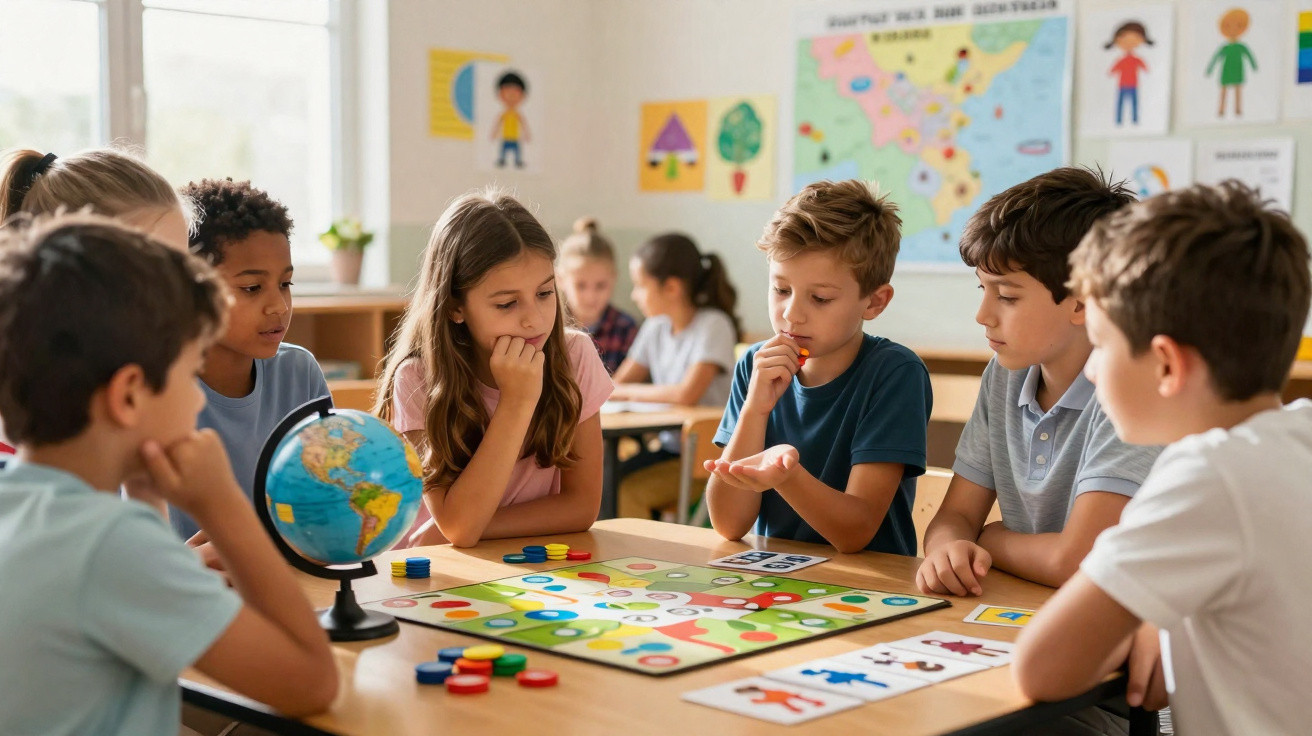
Whether children share sweets or tell the truth may not carry the same meaning in every part of the world. Research spanning different societies indicates that cooperation is learned through local social rules, rather than developing along a single universal route.
A major international study examined how children acquire fairness, trust, forgiveness and honesty as they grow up in distinct social settings.
Its findings suggest that, although children show comparable behaviour in early childhood across cultures, their decisions gradually change as they take in the values of their homes, schools and communities.
Researchers argue that cooperation emerges through cultural learning, not through fixed moral principles.
Culture shapes cooperation in children
The team studied more than 400 children aged five to 13 across five societies: urban communities in the United States and Canada, rural populations in Peru and Uganda, and Shuar hunter-horticulturalist groups in Amazonian Ecuador.
Adults and children in each setting gave their views on what constitutes proper behaviour. The study considered how social norms shape cooperative behaviour, as well as how children come to learn these expectations over time.
“We wanted to try and map the regularities and variation in how cooperation develops, and what it looks like across different cultures, which was the impetus for the cross-cultural developmental angle,” said Dorsa Amir, assistant professor of psychology and neuroscience at Duke University.
“We wanted to uncover the roots of human cooperation, which surpass those of all other species in scale and flexibility.”
Childhood starts with self-focus
In each of the five societies, younger children commonly selected choices that left more resources for themselves.
Games involving sharing sweets found that children’s earliest decisions tended to prioritise receiving rewards instead of producing balanced results. The research indicates that this behaviour may represent a shared starting point in human development.
Scientists say that early childhood is a period of learning. Before behaving in ways that match social norms, children watch rules, responses and expectations.
Learning culture requires both time and practice, particularly where cooperating comes at a personal cost.
Using games to study behaviour
To investigate cooperation, the researchers used four straightforward games. One assessed fairness by presenting unequal divisions of sweets, while another measured trust by asking children to reciprocate favours.
A forgiveness exercise required responses to unintentional errors. In a test of honesty, children were asked to give back extra sweets received following an unexpected reward.
Every task represented a situation that could arise in daily life. Taken together, the games showed how children weigh individual advantage against social expectations.
The findings showed that cooperation does not develop as a single characteristic. Instead, it consists of related behaviours influenced by experience.
Culture shapes choices
From the ages of eight to 13, children’s behaviour increasingly aligned with the values of their communities. In industrial societies, children were often more willing to share with unfamiliar peers.
Children in Shuar communities instead placed greater emphasis on preventing waste and making efficient use of resources.
The researchers say cooperation adjusts to local demands. Where resources are perceived as scarce, using them efficiently can sustain survival and family networks. These decisions express social rules, rather than selfishness.
“In cross-cultural research, it’s common to measure behavior and then speculate about the causes,” said Amir.
“But we wanted to contextualize the work: to actually talk to people in these communities and understand how those choices fit their environment. What we find is that in places like Ecuador, these behaviors aren’t breaking a norm, they are the norm.”
Knowing versus doing
A comparison of children’s actions with adult expectations identified a clear trend: children frequently understood the “right” action before they reliably put that knowledge into practice.
Honesty demonstrated this divide particularly clearly. Many children who recognised the correct choice still found it difficult to behave accordingly.
Forgiveness produced a different result. In every society, there was strong support for forgiving accidental mistakes.
The researchers suggest that forgiveness may be easier because responding kindly does not necessarily mean giving up personal benefits.
Different strategies for cooperation
The analysis identified three principal strategies of cooperation. The first centred on maximising resources for oneself.
The second promoted wide-ranging cooperation with unfamiliar peers. The third varied cooperative behaviour according to the situation and the partner involved.
The use of these strategies changed with age and varied between societies. Industrial communities displayed more broad cooperation, whereas communities centred on close relationships preferred selective cooperation.
The scientists stressed that none of these strategies is inherently better or worse. Every approach suits particular local social structures.
Why culture matters in development
These findings question the notion that children’s development follows one worldwide pattern. They show that cooperation develops through social learning influenced by culture, environment and everyday life.
“There’s no culture-free development. You cannot take culture out of the developmental process,” said Amir.
By examining children in a range of societies, the researchers show how cooperation adapts to human environments and why cultural learning is a central part of growing up.





Comments
No comments yet. Be the first to comment!
Leave a Comment