
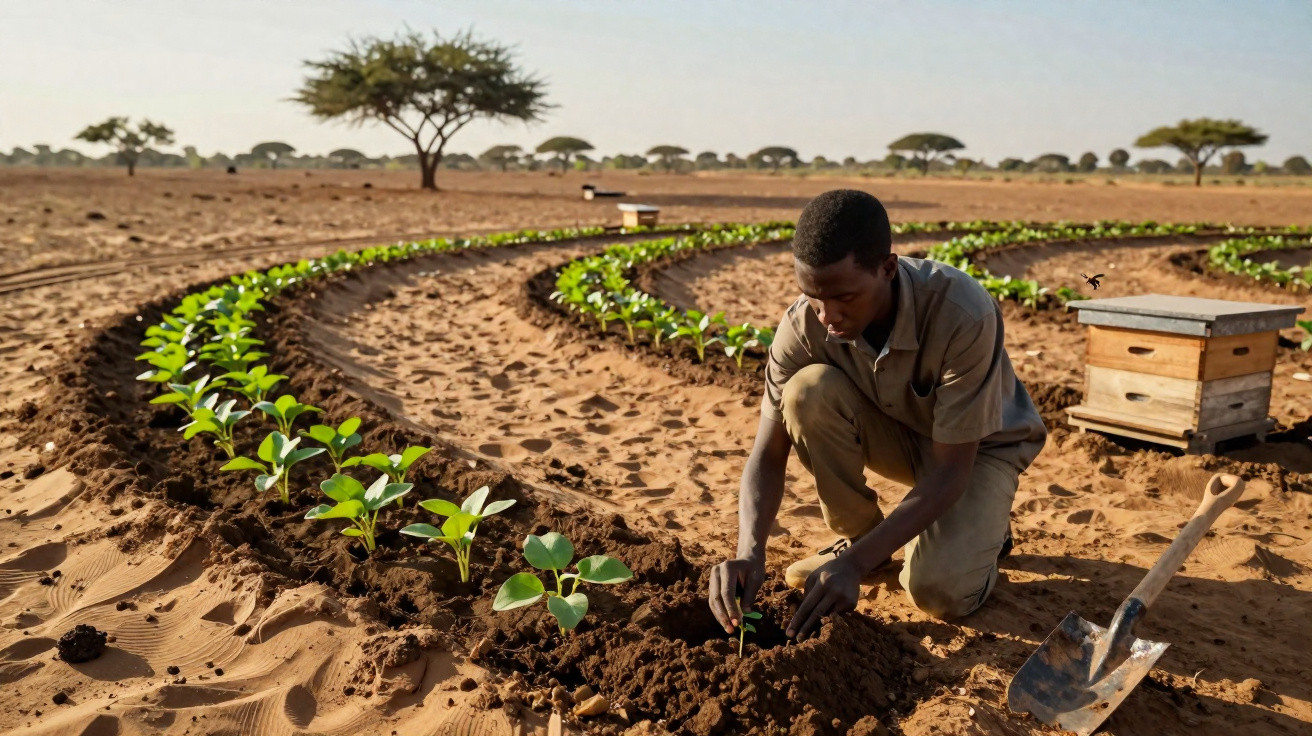
The account of millions of bees being taken to halt the Sahara’s advance has attracted attention as an illustration of the dangers of interfering in extreme environments before restoring the soil. Although the precise details and scale of this episode are not widely recorded, its central lesson is sound: introducing pollinators and planting trees cannot solve desertification if hardened ground is unable to absorb or retain water.
Why would bees be brought to a desert region?
The reported aim of the project was to use bees to support pollination in areas undergoing restoration. By enabling more plants to reproduce, the expectation was to increase vegetation cover, shield the ground from erosion and establish conditions for the gradual return of other animals.
- Increase pollination among introduced plants;
- Encourage the reproduction of local vegetation;
- Promote the development of small ecosystems;
- Support reforestation and agricultural projects;
- Produce honey as a potential source of community income.
What caused the hives to fail in extreme heat?
Bees can control the temperature inside a colony through ventilation and water evaporation, but this capacity has limits. In exceptionally hot, dry places, the absence of shade, water and vegetation raises the likelihood of overheating, while honeycomb wax may soften and lose its shape.
According to the account of efforts to contain desertification, the heat damaged the combs and turned the hives into hazardous spaces for the bees themselves. The phrase “melted bees” is an oversimplification: it was the wax that would have melted, causing the combs to collapse and the colonies to die from the heat.
How does crescent geometry restore the soil?
The approach that delivered more reliable results did not involve moving animals, but altering the route taken by water. Communities in the Sahel dig semicircular structures called crescents, following the contours of the land to capture rainfall that would otherwise run across the hardened surface.
- The curved edge slows down surface runoff;
- Water remains on the ground for longer;
- Digging breaks up compacted soil;
- Moisture can reach deeper layers;
- Seeds, manure and organic matter can be placed inside them;
- Vegetation helps limit further soil loss.
Why was planting large numbers of trees not enough?
Saplings do not survive simply because they have been put into the ground. Where soil is compacted, rainwater runs off quickly, carrying away fertile particles, while the remaining moisture evaporates before roots can establish themselves. Without preparing the land and using suitable species, large-scale planting campaigns can have high mortality rates.
Crescents work before reforestation by creating small areas that are more favourable for growth. Within these spaces, water infiltrates, organic matter gathers and soil temperatures may become less harsh. Only after this initial recovery do plants have better conditions in which to develop roots and support future pollinators.
Can this geometry truly stop the Sahara’s advance?
Semicircular structures do not create a barrier capable of stopping the entire desert. They are local tools for tackling soil degradation, particularly in the dry parts of the Sahel, the belt south of the Sahara. When used on a large scale alongside vegetation management, they can reduce erosion, restore farmland and improve the use of rainfall.
The episode demonstrates that ecosystem restoration requires the right sequence. Before introducing bees or planting thousands of trees, the soil must regain its capacity to receive water. In this process, simple curves formed in the ground can be more effective than grand interventions that overlook the physical conditions of the environment.




Comments
No comments yet. Be the first to comment!
Leave a Comment