
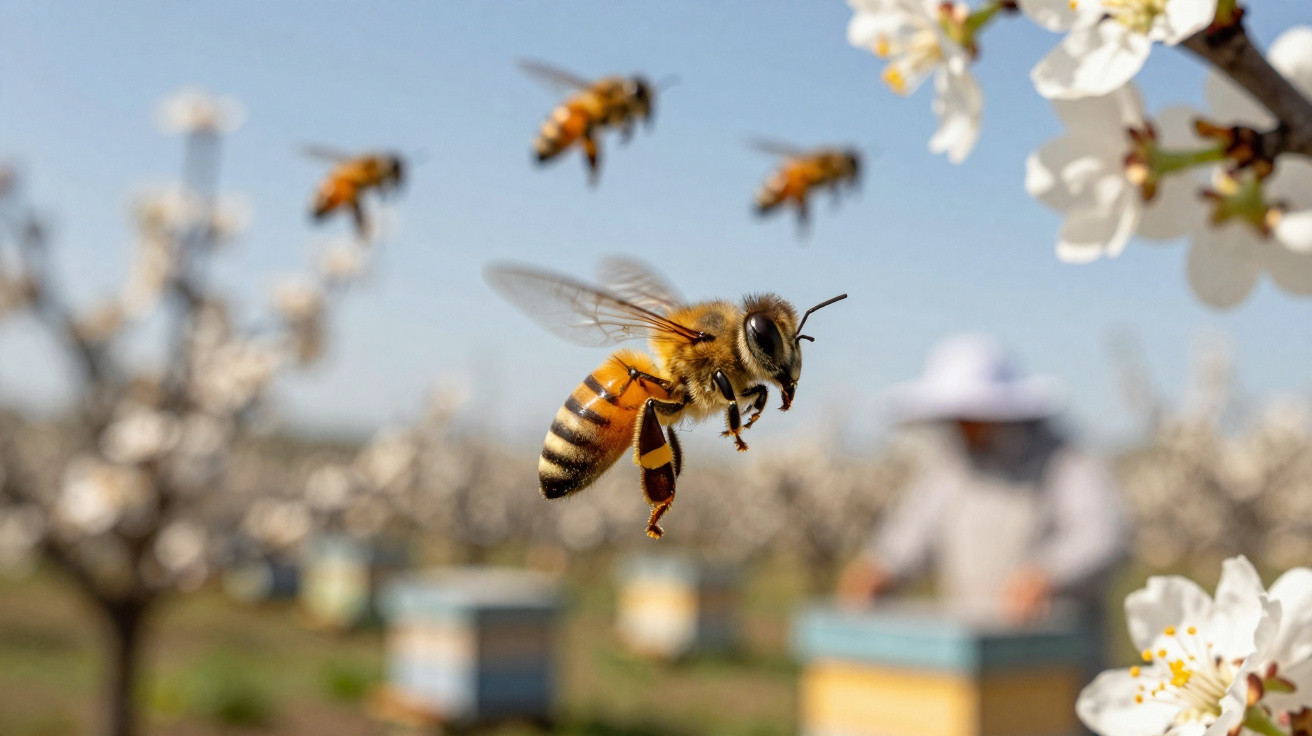
Beyond the honeycomb, reproduction follows rigid rules and startling compromises that influence the colony’s future.
Look inside the hive and you find bees with sharply different roles. Workers collect food and protect the nest. One queen lays eggs at an extraordinary rate. Males, known as drones, wait for a short flight that determines their entire purpose.
What makes a drone
Drones emerge from unfertilised eggs, so they are haploid. They have a single set of chromosomes, inherited entirely from the queen. This genetic arrangement reduces the colony’s cost while creating a supply of mates for virgin queens.
Drones neither forage nor feed themselves; workers provide their food. They cannot sting, because only female bees have stingers. Built broad and powerful for flight, they have large eyes suited to tracking a swiftly moving queen. They survive for weeks through spring and summer before disappearing as the season changes. Once nectar becomes scarce, workers commonly force them from the hive to save food.
| Role | Key traits | Primary job |
|---|---|---|
| Queen | Diploid; long lifespan; stores sperm | Lay eggs; maintain colony pheromones |
| Worker | Diploid; has sting; forages and nurses | Collect food; build, clean, defend |
| Drone | Haploid; no sting; large eyes | Mate with virgin queens |
A single mission in the sky
A virgin queen becomes sexually mature roughly a week after she emerges. She then flies to drone congregation areas: reliable sections of air where thousands of drones gather, usually over hedgerows or clearings. The queen releases pheromones that act like a beacon through the swarm. Drones detect the scent and rush towards her.
In quick succession, single drones seize the queen while both are airborne. Every drone has one aim: delivering semen into the queen’s oviducts. Speed is vital, as rivals fill the chase. Within minutes, the queen mates with numerous drones, commonly a dozen or more. The genetic variety she gathers makes the colony more resilient to disease and changing food sources.
How the “explosion” happens
Once a drone makes contact with the queen, his endophallus everts-turns inside out-and is forced forwards under pressure. The eversion is powered by muscles and haemolymph. A distinct pop may occur. The noise signals tissue rupture as the organ becomes lodged in the queen’s chamber close to her sting.
Semen enters the queen, while the drone’s endophallus breaks off and remains as a “mating sign”. Paralysed by the rupture, the drone drops limp and dies shortly afterwards in flight. A following drone removes the sign before mating himself. The queen flies back to the hive carrying sperm, which she keeps in a specialised organ, the spermatheca. That single store can fertilise eggs for years.
Male honeybees die after mating because the endophallus everts and tears, leaving a mating sign while the queen continues to the next partner.
Heat can trigger the same ending
In 2022, researchers reported that high temperatures can cause drones to ejaculate fatally even when no queen is present. In laboratory experiments designed to replicate heatwaves, drones convulsed and everted their endophallus after prolonged heat exposure, before dying. The response increased dramatically at extreme temperatures.
Heat stress threatens more than drone survival. It may also harm sperm quality in drones that survive, as well as sperm stored by queens. As a result, colonies can later struggle to raise sufficient female workers. This delay conceals the harm until brood patterns become sparse and pressure for supersedure increases.
Heat stress can trigger the same mechanism that kills drones after mating, risking both male survival and the queen’s long-term fertility.
Why nature built such a risky system
A drone’s death appears harsh, but the process provides important benefits for colony genetics. Pressure-driven eversion rapidly sends semen deep into the queen’s oviducts. For a short time, the broken organ also obstructs competing drones and aids transfer. Polyandry-having multiple mates-then balances any temporary advantage and broadens genetic diversity. Colonies gain greater disease tolerance, more adaptable worker behaviour and more reliable brood rearing during stressful conditions.
Haplodiploidy adds another dimension to this arrangement. As drones possess only the queen’s genes, harmful recessive alleles are exposed and removed quickly. Queens that mate with many drones reduce those risks even more. The burden falls on drones, which colonies can produce at low cost when nectar is flowing.
Impacts for beekeepers and crops
Beekeepers cannot alter this biology, but they can reduce its effects. Heat can now endanger drones during warm periods and transport. Colonies must also have the appropriate age balance to raise drones when queens require mates.
- Place hives near shade and water during hot spells to lower thermal stress.
- Do not keep colonies sealed in hot vehicles; ensure ventilation and move them at cooler times.
- Retain drone brood in at least some colonies throughout queen-rearing periods.
- Follow local mating timings; queens commonly fly on warm, calm afternoons with good light.
- Check brood patterns two to three months after heatwaves for evidence of sperm damage.
The colony treats drones as seasonal investments: abundant when nectar flows, expendable when stores run low.
Frequently asked points
Do bees actually explode?
A drone’s whole body does not burst. Instead, the endophallus everts under pressure and tears. The resulting injury kills the drone rapidly. Its body stays intact as it falls away.
How many drones mate with a queen?
The total depends on weather and drone numbers. Across one or two flights, many queens mate with 10 to 20 drones. In poor conditions, some queens mate fewer times. A sufficient number of mates creates a broad genetic mixture among worker offspring.
Where do drones gather?
Drone congregation areas form around dependable landmarks and air conditions year after year. They are often found 10 to 40 metres above the ground, over open spaces or along tree lines. Drones use visual markers and wind patterns to locate them, then fly looping patrols for hours on warm days.
Key terms and extra context
Haplodiploidy: a system of sex determination in which unfertilised eggs develop into males and fertilised eggs develop into females. It influences social organisation and relatedness among bees, ants and wasps.
Mating sign: the section of a drone’s endophallus that remains lodged in the queen after mating. During his own mating attempt, the next drone removes it.
Spermatheca: the queen’s sperm-storage organ, allowing her to fertilise eggs as needed long after her nuptial flight.
When rearing queens, approach the task like a scheduler. Match drone availability to queen emergence. Early in the season, give strong colonies plenty of drone comb. Arrange the apiary so queens can access productive drone areas during dependable afternoon conditions. During hot summers, schedule mating flights for cooler periods and ensure water is available to help colonies remain within a safe temperature range.
For gardeners and growers, this issue extends beyond the hive. Heat that kills local drones may reduce mating success across a district for weeks. Fewer adequately mated queens lead to weaker worker populations later in the season. Pollination can then decline just when fruit set depends on regular flight activity. Establish windbreaks, provide water and avoid broad insecticide applications during peak flights, allowing colonies to complete this delicate, high-risk stage of their life cycle.





Comments
No comments yet. Be the first to comment!
Leave a Comment