
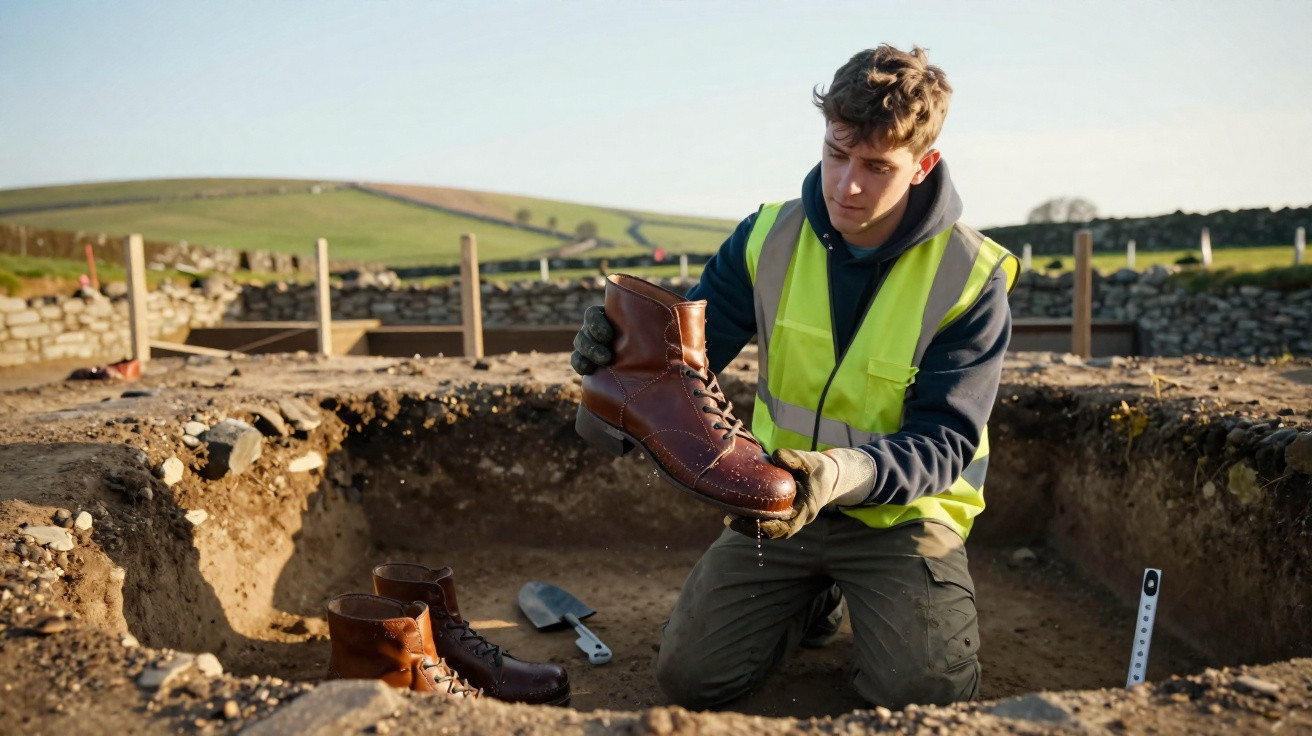
At the Roman fort of Magna, near Hadrian’s Wall, archaeologists expected to uncover well-preserved leather. What stood out was the scale of the finds: in a recent group, eight shoes measured 30 centimetres or more, a far higher proportion than in the vast collection from Vindolanda, another Roman site in the area.
Why did leather survive at Magna?
Magna, which is also called Carvoran, lies in northern England and contains waterlogged, oxygen-poor deposits. In these layers, the microorganisms that normally break down materials such as leather and wood operate more slowly. Once archaeologists reached an old ditch at the fort, they began recovering shoes that still retained their shape, stitching and signs of wear.
The Vindolanda Trust team must work carefully because leather changes rapidly once it is removed from an oxygen-free setting. Each item has to be cleaned, documented and conserved. This preservation makes it possible to investigate more than shoe sizes, including repairs, wear patterns and how each shoe fitted its wearer’s foot.
How many large shoes were found at Magna?
The first group announced in 2025 contained 32 shoes, with the total increasing as excavation work continued. Eight were at least 30 centimetres long, while the largest measured about 32.6 centimetres. As a result, roughly one quarter of the initial sample fell into the exceptionally large-size category.
Comparison with Vindolanda is what makes the discovery particularly unusual. At that site, only a few kilometres away, thousands of Roman shoes have been recovered over several decades, yet only a very small proportion of measurable examples reach this length. Magna appears to have an unusual concentration of large feet, although the reason has yet to be established.
- The first analysed group from Magna included dozens of shoes preserved in a waterlogged ditch.
- Eight examples were at least 30 centimetres long.
- The largest shoe announced measured around 32.6 centimetres.
- At Vindolanda, shoes of this size account for only a small share of the measurable collection.
Were they simply very tall men?
That is the most straightforward explanation, but it is not the only one. Tall soldiers and labourers may have worn larger shoes, and the team plans to compare lengths, shapes and internal marks to estimate the wearers’ actual foot sizes more accurately. A long shoe, however, does not necessarily indicate an equally long foot.
Researchers are also considering whether extra room was needed for thick socks or padding during winter. Northern Roman Britain was cold, and layers of fabric may have required larger footwear. Swollen, injured or bandaged feet are another possibility being considered while the collection undergoes conservation.
Watch the video shared by the VindolandaTrust YouTube channel, which provides updates on discoveries at the Roman fort of Magna.
https://www.youtube.com/watch?v=2Kde75jgGes
What does Vindolanda provide for comparison?
Vindolanda, close to Magna, holds one of the world’s largest collections of Roman footwear. Its proximity makes it an exceptional comparison group. Shoes from Vindolanda represent men, women and children, as well as a range of military and domestic uses.
Elizabeth Greene, a Roman footwear specialist at Western University, is involved in analysing the Magna finds. The work is not limited to measuring soles: researchers are also looking for pressure marks and wear that could indicate where the wearer’s foot truly ended. That distinction may separate the shoe of a very tall man from a loose boot packed with insulation.
When might the mystery of the giant shoes be solved?
The team must still complete the conservation and cataloguing process, then compare the items with material from other areas of the fort. Pottery and archaeological layers can help date when the shoes were discarded, while wear patterns may reveal how they were used. Further excavations could also change the current proportion of shoe sizes.
For now, Magna presents a better question than an answer. Why did a single fort contain so many enormous shoes? The explanation may lie in the height of its occupants, the climate, injuries, or a combination of these factors. Every preserved sole brings archaeologists closer to the everyday lives of those who lived there almost two thousand years ago.






Comments
No comments yet. Be the first to comment!
Leave a Comment