
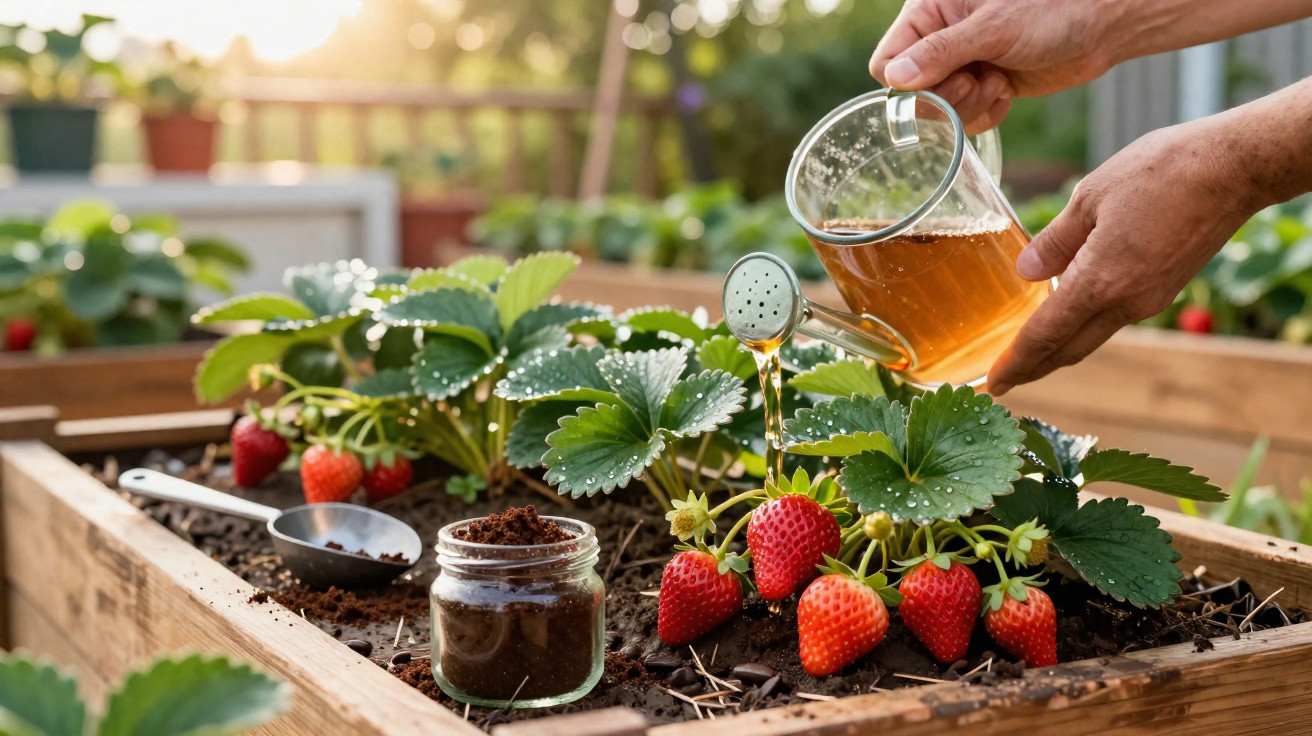
A simple kitchen trick can make all the difference.
Anyone who spots the first white blossoms above their strawberry beds in March dreams of plump, sweet fruit in summer. Yet in reality, the berries often stay small and dry. The foundations for a successful crop are laid early in the year – and, surprisingly, depend greatly on what goes into the watering can.
Why a kitchen waste product makes strawberries stronger
Strawberry plants thrive in loose, slightly acidic soil that is full of life. A pH level between 5.5 and 6.5 is ideal, placing it in the mildly acidic range. Under these conditions, roots can absorb nutrients particularly effectively and quickly produce fresh growth.
To develop large fruit, plants need one thing above all else: a strong canopy of leaves in spring. These leaves later provide the sugars and other substances that are transported directly into the berries. This is where an often-overlooked kitchen leftover comes in: dried coffee grounds.
Coffee grounds contain around two per cent nitrogen, along with smaller quantities of phosphorus and potassium. With an average pH of approximately 6.2, they are well suited to the needs of strawberries. Nitrogen acts, in effect, as the engine behind leaf growth, while phosphorus and potassium support flower formation and fruit quality.
“Anyone who waters their strawberries with a mild coffee-ground solution in spring specifically encourages leaf growth – and in doing so lays the foundation for larger, juicier fruit.”
Gardeners have reported more vigorous plants for years when they use coffee grounds sparingly in early spring. The key factors are the amount applied and how the coffee grounds reach the plants.
Liquid “coffee fertiliser”: how the watering method works
Rather than tipping thick layers of coffee grounds straight onto the soil, it is better to make a type of “coffee tea” for watering. The reason is simple: pure, wet coffee grounds quickly clump together, form a hard crust and can go mouldy. When diluted in water, they work far more gently.
Step-by-step guide to a coffee-ground infusion
Regular coffee drinkers will already have the basic ingredient at home. It is important to allow the grounds to dry thoroughly before using them. This prevents mould and unpleasant smells in the bucket or watering can.
- Collect dried coffee grounds, ideally spread out on a plate or baking tray.
- Add around 40–50 grams of coffee grounds to 1 litre of water, or 200 grams to a 5-litre watering can.
- Fill a bucket, or the watering can itself, with water.
- Leave the mixture to stand for 24 to 48 hours, stirring it from time to time.
- Strain it before watering so that coarse particles do not block the rose of the watering can.
- Water only the soil around the plants, rather than pouring it over the foliage.
Around 250 millilitres of this infusion is enough for each strawberry plant. One application every three weeks is entirely sufficient. In practice, this means applying it once or twice to the beds between March and the end of May – generally earlier in the south, and later in northern or higher-altitude areas.
“Less is more: one or two applications in spring are enough to improve the plants’ start significantly.”
When coffee grounds harm strawberries
Although coffee grounds can be useful in moderation, too much quickly becomes problematic. Excess nitrogen makes strawberry plants produce abundant leafy growth. This results in lush foliage but few flowers, and therefore fewer fruits.
Anyone who waters generously every two weeks or piles large quantities of dry grounds onto the beds risks several consequences:
- The soil may become too acidic.
- Fine roots can be “burnt”, especially in pots and balcony planters.
- The plants put most of their energy into leaves instead of flowers.
Gardeners should be especially cautious on heavy clay soils, which already tend to become acidic and compacted. In these conditions, a single coffee-ground application in spring is usually enough, combined with plenty of well-rotted compost. Compost supplies extra nutrients such as phosphorus and potassium while improving soil structure over the long term.
“Anyone who ‘fattened up’ their strawberries with nitrogen as though they were lettuce will end up harvesting plenty of leaf mass – but far fewer sweet fruits.”
Practical tips for strawberry beds, raised beds and balconies
Strawberries do not grow only in traditional garden beds; they also perform well in raised beds, pots and balcony planters. The coffee-ground method can be used in all of these places, although it requires a little more care in containers.
In an outdoor bed
- A light mulch layer of straw protects both the soil and the fruit.
- Pour the coffee-ground infusion directly onto the uncovered soil around each plant.
- On sandy soils, plan for two spring applications, as nutrients are washed out more quickly.
In a pot or balcony planter
- Apply it only sparingly, as nutrients become more concentrated in a restricted volume of compost.
- A single watering with coffee-ground infusion in April or May is often entirely adequate.
- Continue watering regularly with plain water so that nothing accumulates in concentrated form around the roots.
When planting new strawberries, coffee grounds can be worked very lightly into the top layer of soil after mixing them with compost. The main applications should still be made with a watering can, so that roots do not encounter a direct “coffee hotspot”.
An additional benefit: coffee grounds as natural pest protection
Alongside their fertilising effect, this kitchen leftover offers another advantage: many insects and small mammals dislike the smell of coffee. A faint coffee scent around strawberry plants can deter some unwelcome visitors.
Gardeners’ experiences suggest that certain animals are particularly sensitive to it:
- Mosquitoes and other biting insects
- Ants
- Slugs
- Wasps
- Mice and rats
This effect is no replacement for a sturdy slug barrier or other protective measures, but it may provide additional help. Important: never leave coffee grounds in piles, especially if dogs or cats have access to the garden. Swallowed coffee grounds can be toxic to pets.
“Coffee grounds around the plants act like a light scented barrier: many small pests keep their distance – and the strawberries can ripen undisturbed.”
When is the right time for the first “coffee watering”?
The best period is between March and May, depending on the region and the weather. As soon as strawberry plants are visibly growing and producing new leaves, the first application is worthwhile. In very mild locations, this may be as early as the beginning of March, while cooler areas often do not reach this point until April.
If you are unsure, look for two signs:
- The plants are showing fresh, light-green leaves.
- The first flower buds are becoming visible.
Very early applications, while the soil is still freezing cold, offer little benefit because the roots remain sluggish. Applications made too late, when there are already many flowers or fruits, are more likely to stimulate leaf growth than improve fruit size.
Further ways to improve the strawberry harvest
Coffee grounds are only one element of strawberry care. Anyone aiming to get the most from their plants can combine several simple measures:
- Work in a thin layer of well-rotted compost each year, either in autumn or very early spring.
- Regularly remove old, diseased leaves from the plants.
- Do not keep beds in the same location permanently; move them after three to four years.
- Plant strawberries with enough spacing for them to dry out well and develop less mould.
Many home gardeners are surprised by how greatly fruit size can change when well-rotted compost is combined with carefully targeted coffee-ground infusion. Paying attention to consistent watering also helps prevent dry, tough or split berries.
One term that often comes up in this context is the so-called “heavy feeder”. Strawberries do not belong in the highest heavy-feeder category, unlike cabbages, but they need considerably more nutrients than herbs, for example. Coffee grounds provide a moderate addition that can be controlled easily, without immediately needing specialist fertilisers.
The cumulative effect is also interesting: using coffee grounds and compost moderately year after year gradually builds fertile, loose soil. This benefits not only strawberries, but also other berry shrubs, ornamental plants and even some houseplants – provided the basic rule is followed: small amounts at longer intervals are better than rushed “nutrient shocks” shortly before harvest.





Comments
No comments yet. Be the first to comment!
Leave a Comment