
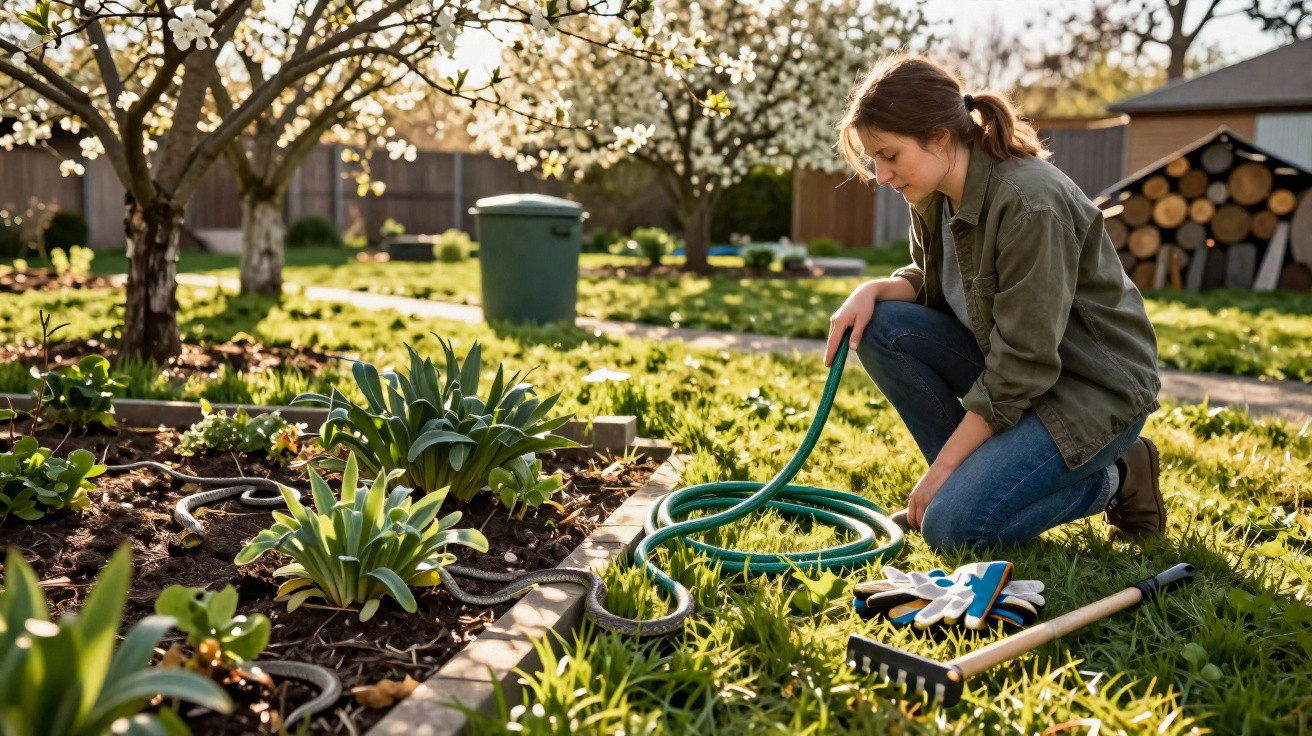
Many keen gardeners bring out their tools enthusiastically in spring, thinking about fresh greenery rather than snakes. Yet this is precisely the time when some everyday garden items become ideal hiding places for reptiles. Avoiding certain mistakes can substantially reduce the likelihood of unpleasant encounters.
When spring wakes the snakes
From around March, snakes emerge from their winter dormancy and gradually become active again. What they need above all is warmth. As they cannot regulate their own body temperature, they rely on their surroundings. Sunny, sheltered spots in the garden can therefore attract them like a magnet.
Typical refuges include hedges, wood piles, dry-stone walls and strips of long grass. Snakes are also a normal part of wildlife in Central Europe. Around a thousand bite incidents are reported in France each year, mostly involving vipers. Heatwaves and changing landscapes are helping them spread closer to residential areas. Specialists observe similar trends in Germany, Austria and Switzerland.
“Snakes are not looking for people, but for warmth and cover – yet an unthinking reach into the wrong place is enough to create a dangerous situation.”
Anyone who understands the conditions snakes favour can organise their garden to make it less appealing to them – without turning it into a barren expanse of stone.
The unassuming tool that magically attracts snakes
Among lawnmowers, rakes and hedge trimmers, one item hardly stands out, despite offering snakes an almost perfect refuge: the garden hose. This is especially true when it is tightly coiled and left on the ground.
The reason is a combination of material, shape and location. A hose is often left in the sun, and because it is made of plastic, it retains warmth for hours. Residual moisture remains both inside and outside after watering. This creates a small, sheltered microclimate directly at ground level.
“A coiled garden hose on the ground can be to a snake what a heated cabin is to us: warm, confined and safe.”
Snakes readily use such artificial niches to warm themselves while remaining concealed from predators. Anyone who suddenly lifts the hose later risks startling the animal. Many bites result from defensive reactions rather than attacks.
How to make a garden hose less appealing to snakes
Rather than treating the item as a problem in itself, a few changes of habit can make it considerably safer to use:
- Always hang the hose on a wall-mounted holder after use.
- Do not leave it permanently in long grass or beside walls.
- Before winding it up, tap it briefly or move it with a stick.
- Choose a storage place in partial shade rather than full sun.
Snakes will quickly lose interest because the spot is no longer consistently warm or undisturbed.
Other snake magnets in the garden
The garden hose is only one example. Many everyday materials provide similar benefits: warmth, cover and little disturbance. Dark, flat objects lying close to the ground are particularly problematic.
These include:
- dark covering sheets and tarpaulins
- metal sheets or old corrugated sheeting
- leftover fibre-cement or roofing sheets
- unsecured wooden pallets and piles of boards
- old carpet remnants, rubber mats or OSB boards left outdoors
These objects heat up quickly in the sun. Warm air gathers beneath them, often alongside some moisture. This is exactly the climate many reptile species prefer.
“Flat, dark materials on the ground act like heated lofts for snakes: warm above, safe below.”
How to make your garden plot safer from snakes when tidying up
Anyone who needs these materials does not have to throw them away. Storage is what matters. This simple table shows common problem areas and better alternatives:
| Item | Problematic storage | Better solution |
|---|---|---|
| Garden hose | Coiled on the ground in the sun | Hung on a wall or stored in a shed |
| Tarpaulin | Flat on the soil, weighed down with stones | Stretched over a frame, with corners well ventilated |
| Metal or fibre-cement sheets | Stacked flat on the ground | Stored upright, raised clear of the ground |
| Wood pile | Directly on the soil, in an untidy heap | Kept on pallets, loosely stacked for airflow |
Even minor adjustments can greatly reduce the number of potential hiding places without the garden losing its structure.
How snakes behave – and why that is reassuring
Snakes are often considered threatening, but their behaviour follows straightforward patterns. They avoid vibrations, loud sounds and open spaces. They do not want to attack either pets or people. When faced with conflict, they have three strategies: fleeing, camouflaging themselves or biting when touched.
Working in the garden naturally creates vibrations and noise. Many animals will therefore retreat before you even see them. The main risk arises when someone reaches into dark gaps with their hand or abruptly lifts heavy objects.
“The most dangerous moment is often the careless reach into a gap you cannot see.”
One simple approach helps: never reach in blindly. Wear gloves, probe ahead with a stick and stamp your foot briefly – gestures such as these tell animals that someone is approaching and that it is better to move away.
Practical scenarios from everyday garden life
For example, it is late afternoon, the lawn has been mown and the hose is still lying coiled in the sun beside the flower bed. You want to put it away quickly, so you spontaneously grab the coil and lift it – that exact moment can be risky if a snake is underneath.
In another scenario, a dark tarpaulin covers an old sandpit. Over several weeks, warmth has built up underneath, leaves have collected and perhaps mice have even moved in. During the spring tidy-up, you pull the tarpaulin away abruptly. Reptiles may be lying there too, irritated by the sudden light and movement.
A better method is this: before moving the tarpaulin, tap it several times with a broom handle, wait briefly, then slowly lift one corner. Any animals beneath it are given time to escape.
Risks and opportunities in a wildlife-friendly garden
A natural garden with deadwood, dense hedges and stone walls attracts more wildlife – insects, lizards, hedgehogs and sometimes snakes. On the one hand, this increases the chance of encounters; on the other, it reduces pests such as mice and slugs. Snakes mainly eat small mammals, including mice that can transmit diseases.
If children use the garden, clear rules can be introduced: do not climb on wood piles, do not crawl beneath tarpaulins, and keep your distance if you spot an unfamiliar animal before calling an adult. In this way, the garden remains a habitat for many species without causing panic.
A useful rule of thumb is that the tidier and more elevated materials are in the garden, the fewer hiding places exist at ground level. A garden hose does not belong in a remote, sunny corner on the ground, but in a visible, raised position. This considerably reduces the risk – and makes the next watering session far more relaxed.


Comments
No comments yet. Be the first to comment!
Leave a Comment