
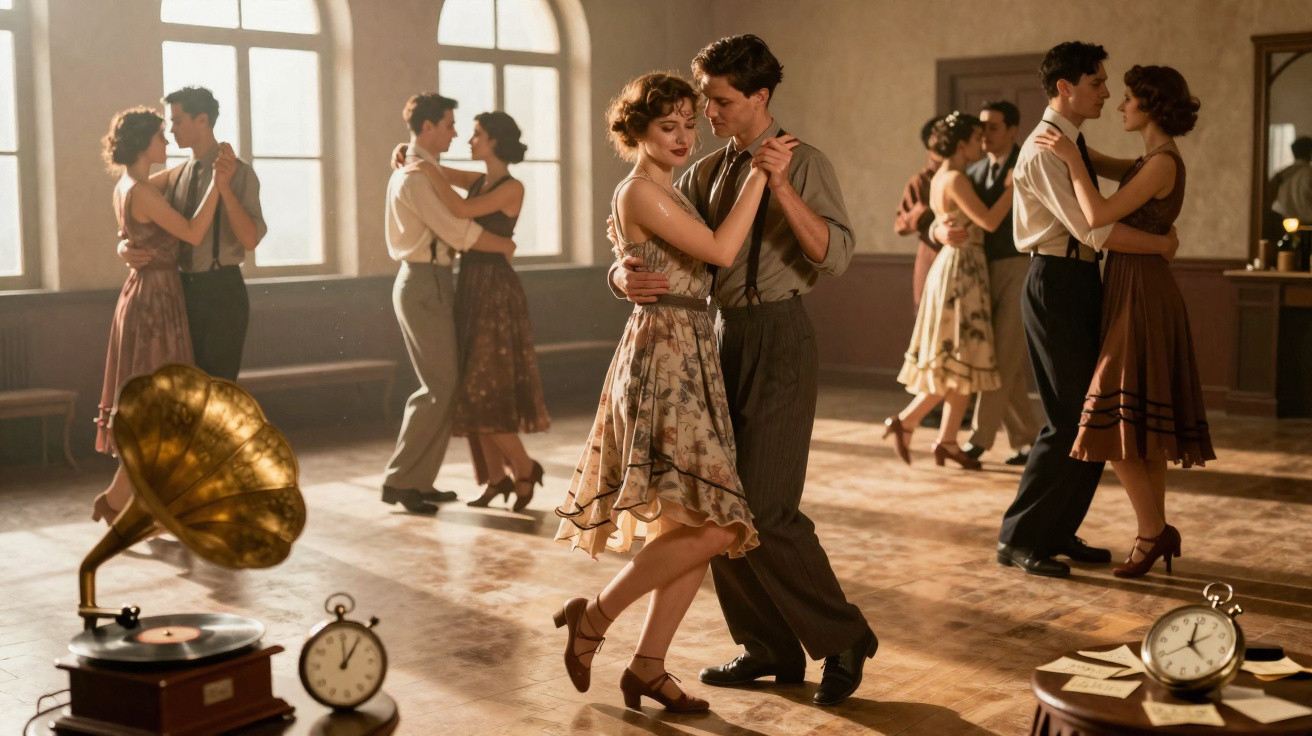
In 1923, Alma Cummings walked into a New York ballroom and kept dancing for 27 hours, changing partners as each man dropped out. Within weeks, her record was being challenged time and again. What had been a leisure activity became an endurance contest, sparking the dance marathons that would fill American ballrooms.
How did Alma Cummings begin the race for records?
Cummings began her attempt at the Audubon Ballroom on 31 March 1923. Over 27 hours, she danced with six partners, switching between popular styles including the waltz, foxtrot and one-step. The achievement drew attention by turning an ordinary social pastime into a measurable test of endurance.
Guinness records that her mark was surpassed repeatedly in the following weeks. Newspapers helped circulate every new duration, while the contest adopted the same pattern as other record-setting crazes of the era: someone exceeded the previous limit, made the headlines and instantly set a higher target for the next challenger.
How did an extended dance become an organised spectacle?
Promoters realised that audiences wanted more than simply hearing the final result. People would pay to watch exhausted competitors struggle to stay in motion, so events began to include music, masters of ceremonies, rules and entertainment acts. The dance floor effectively became the stage for an uninterrupted show.
Over time, the format moved far beyond Cummings’s spontaneous challenge. Contests could run for hundreds of hours, with short breaks and their own rules defining what counted as continuing to dance. Couples had to show enough movement to remain in the competition, even when the pace bore little resemblance to an ordinary evening in a ballroom.
Why did so many people want to watch?
A dance marathon offered a story that constantly renewed itself. Every hour, the audience could find out who had withdrawn, who could still smile and which pair seemed most likely to break the record. Relatively cheap admission allowed people to arrive at different times and follow a contest that did not end in a single night.
The format combined endurance sport, social dancing and vaudeville. No complicated rules needed to be understood: viewers only had to watch the clock. The longer competitors stayed on the floor, the more remarkable the feat appeared, encouraging promoters to pursue even greater durations.
- Alma Cummings danced for 27 hours and used six partners during her 1923 attempt.
- The record was broken several times in the weeks that followed, fuelling a national race.
- Promoters began selling tickets for audiences to watch competitors’ endurance.
- The format blended dance, record attempts, music and stage acts in extended sessions.
Watch the video shared by the YouTube channel O Covil, which recounts a similar case involving the “dance epidemic” of 1518.
What did the 1920s have to do with this obsession?
The decade was rich in fads centred on endurance, speed and public feats. Staying-power records, contests and unusual challenges made headlines because they produced figures that were easy to compare. Dance marathons fitted naturally into this climate as an especially visual version, since audiences could watch the exertion unfold in a brightly lit ballroom.
There was also an important social development: popular dances already occupied urban life and ballrooms. Turning that habit into a competition required no strange new invention, only a clock, a prize and an audience. The contest expanded precisely because it was built around something millions of people already knew.
Why does the craze still seem so strange a century later?
Today, even dancing for a few hours can seem exhausting. Picturing competitors trying to remain in motion for days or weeks reveals how far record culture could push an everyday activity. The initial idea was simple, but the drive for bigger marks rapidly transformed the scale of the events.
Alma Cummings’s story helps show the point at which the trend began. One woman danced for 27 hours and, rather than ending the conversation, started a competition. The episode demonstrates that, long before digital trends, a feat that was easy to measure could already be enough to trigger a succession of imitations.





Comments
No comments yet. Be the first to comment!
Leave a Comment