
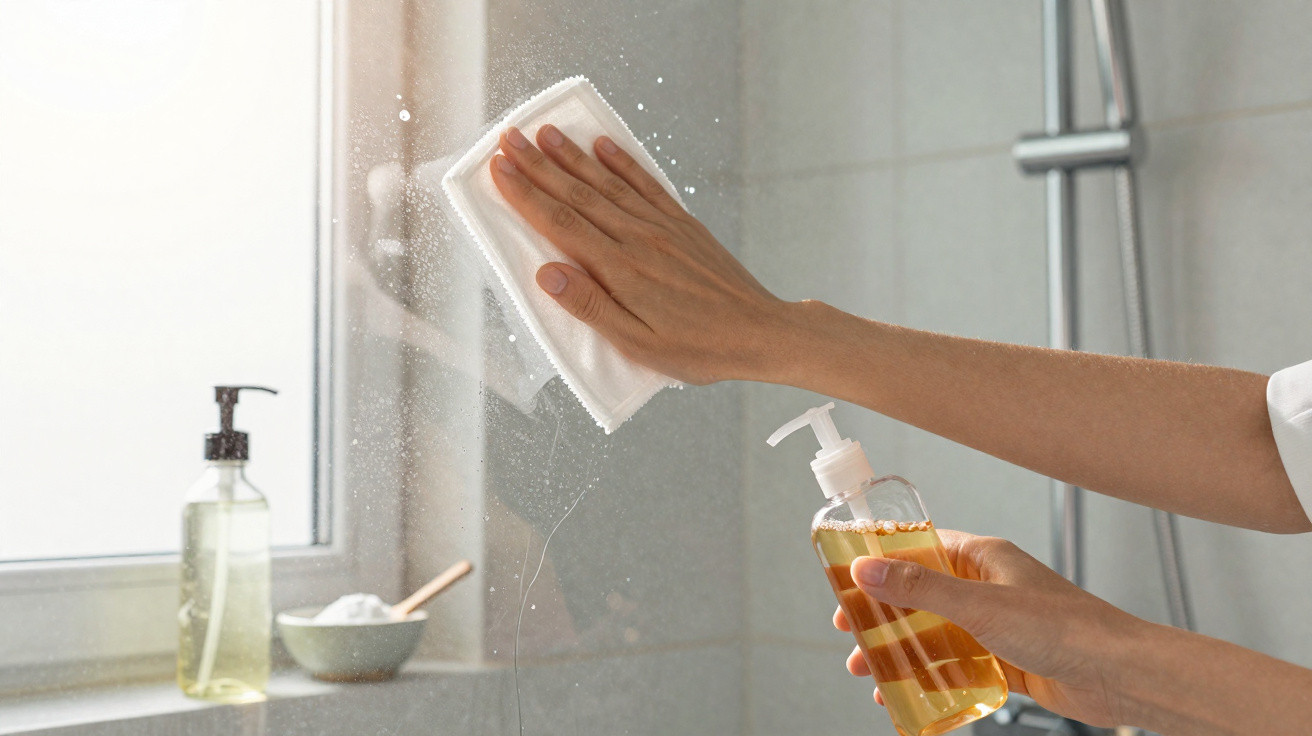
Anyone wanting to clean their glass shower screen with household remedies will quickly come across bicarbonate of soda.
But one expert is clear: this is precisely what makes the job unnecessarily complicated.
In cleaning videos, it looks effortless: sprinkle on some powder, give it a quick scrub and everything shines. In a real bathroom, however, it is often rather different. Streaks, limescale marks and droplets remain, raising the question of what really cleans a shower screen without turning every clean into a lengthy chore.
Why so many people swear by bicarbonate of soda in the shower
Bicarbonate of soda is regarded as a household all-rounder. It is inexpensive, appears in countless DIY recipes and avoids harsh chemicals. Many cleaning guides promote it as a miracle solution for grease, dirt and odours.
It can indeed do quite a lot on a glass shower screen:
- Its fine particles act as a very mild abrasive.
- It loosens soap residue and grime that can settle as a cloudy film.
- Mineral deposits left by water are easier to rub away.
- When used correctly, it will not scratch glass or most tiles.
The paste version is especially popular: mix bicarbonate of soda with a little water, apply it, leave it to work, wipe it away and the job is done. For heavier dirt, mixtures containing vinegar are often recommended, as they are said to clean particularly thoroughly.
“Bicarbonate of soda works powerfully against limescale, but it requires plenty of time, patience and water – so it fits only to a limited extent into a busy everyday life.”
Where bicarbonate of soda becomes frustrating in everyday shower cleaning
The theory sounds ideal, but the reality in the bathroom is different. A shower screen is large, smooth and vertical, which is exactly what makes applying bicarbonate of soda laborious.
The usual cleaning reality on a glass screen
Anyone mixing up a bicarbonate of soda paste soon encounters several issues:
- The paste slides down the vertical surface.
- Covering everything evenly takes time – often with a step ladder or stool.
- It drips while it is left to work, making the floor slippery and greasy.
- It then needs thorough rinsing, otherwise a white film remains.
This film develops when residue from the paste dries on the glass. The screen can then look dull despite all the cleaning. Anyone hoping to give the shower a quick clean after work will usually have neither the patience nor the inclination for that.
The problem with a bicarbonate of soda and vinegar mix
Combining bicarbonate of soda with vinegar is often advised. It fizzes impressively and looks effective on social media, but professionally its effect is limited. The acid and alkaline powder partly neutralise one another. The result is a mixture that is less powerful than using vinegar or bicarbonate of soda separately.
For this reason, many cleaning professionals use bicarbonate of soda selectively rather than applying it in the shower all the time. Typical uses include:
- very dirty grout
- corners with stubborn deposits
- shower screens that have not been cleaned for weeks
For routine weekly care, another solution is much more suitable.
Vinegar as a gel: the far more convenient method
For regularly cleaning a glass shower screen, many household experts recommend vinegar. The reason is simple: vinegar reliably dissolves limescale, costs little and is straightforward to use. Its weakness is that it barely clings to a vertical surface and runs off too quickly.
That is where a trick already common in France comes in, and it works just as well in UK households: turn vinegar into a gel.
How vinegar gel works for a shower screen
The principle is to thicken ordinary household vinegar with a plant-based gelling agent so it adheres to glass and can work for longer. A neutral food-grade gelling agent, such as agar-agar, is suitable.
A typical method is:
- Pour around 500 millilitres of household vinegar into a saucepan.
- Stir in about 2 grams of agar-agar powder.
- Briefly bring the mixture to the boil, then allow it to cool again.
- Transfer the now gel-like mixture to a bottle or jar.
This creates a soft gel that can be spread over the glass shower screen and into the grout. Its key advantage is that it does not immediately run down the surface, instead staying in place as a thin, damp layer.
“Thanks to its gel structure, vinegar stays on the limescale long enough for chemistry, rather than muscle power, to do the work.”
Using vinegar gel on the shower screen
In everyday use, proceed as follows:
- Apply the gel to the dry glass surface and spread it with a sponge.
- Leave it to work for 15 to 20 minutes.
- Rinse with warm water.
- Wipe over with a microfibre cloth or remove the water with a squeegee.
The basic mixture can be adjusted for particularly stubborn areas:
- A splash of washing-up liquid helps tackle greasy soap residue.
- A few drops of lemon juice boost shine on the glass.
The effort remains manageable: apply the gel, do something else while it works, then simply rinse it away. This makes the method more practical for everyday life than a full bicarbonate of soda scrubbing treatment, which demands far more active time.
When each cleaning product makes sense
Anyone aiming to care for a shower screen realistically should not choose “the one miracle product”, but rather the right solution for the situation. Broadly, there are three cases:
| Condition of the shower screen | Recommended method | Effort |
|---|---|---|
| Light water marks, normal use | Vinegar gel or a shop-bought limescale-removing spray | Low |
| Noticeable limescale marks, dull surfaces | Vinegar gel with a longer contact time | Medium |
| Not cleaned for months, heavy deposits, dirty grout | Use bicarbonate of soda specifically for grout and stubborn areas, then vinegar gel | High |
How to prevent dirt building up on a shower screen
Those who want to scrub less should make small adjustments to how they use the shower each day. A number of simple habits can prevent major cleaning sessions later.
- After showering, pull the water from the glass surface with a squeegee.
- Briefly dry the screen with a microfibre cloth, especially in the splash zone.
- Once a week, give it a quick clean with vinegar gel or limescale-removing spray.
- Replace soap bars that leave heavy residue with products that leave fewer deposits.
Using a squeegee after showering significantly reduces limescale marks because less water is left to evaporate on the surface. Once this becomes routine, bicarbonate of soda is practically needed only for exceptional cases.
What to consider when using vinegar and bicarbonate of soda
Useful as household remedies may be, they are not suitable for every surface. Vinegar can damage natural stone, including marble and limestone. Some sensitive plastics also react badly to acids. These surfaces are better cleaned with specially labelled mild cleaners.
Bicarbonate of soda can likewise leave unwanted marks on very soft or high-quality coatings if scrubbed too firmly. It is best to test it in an inconspicuous spot before treating the entire shower screen.
Ventilation is another consideration: when using vinegar extensively in the bathroom, ventilate well so the smell can disperse. Anyone who dislikes the scent of vinegar can improve it slightly by adding a few drops of essential oil to the gel.
Why the smart combination makes everyday life easier
Household remedies do not need to be perfect; above all, they need to work without making everyday life more complicated. Bicarbonate of soda remains effective for encrusted grout and stubborn dirt. For normal shower screen care, a vinegar gel that adheres well is usually entirely sufficient.
Those who let go of the idea that a single miracle product must solve everything can take a more relaxed approach: bicarbonate of soda for major cleaning sessions, vinegar gel for a quick routine, and a squeegee that achieves more each day in a few seconds than any trendy cleaning challenge on social media promises.





Comments
No comments yet. Be the first to comment!
Leave a Comment