
The jar looked harmless enough on the worktop, washed out and catching the morning sun. The tomato sauce had been used, its lid was sitting in washing-up water, and you could already imagine the jar becoming a smart home for rice or homemade granola. Then your fingertips found the mark left by the label. It was neither paper nor ordinary glue, but a stubborn grey film that collected crumbs, fingerprints and every speck of dust nearby. You attacked it with washing-up liquid. You picked at it with a fingernail. You reached for the abrasive side of the sponge and heard that faint sound of glass protesting.
Before long, your “zero-waste project” had become a sticky disappointment.
Fortunately, there is a gentler way to deal with it.
Why label residue sticks so stubbornly
The first time you really notice the tacky ring a label leaves behind, it can be surprisingly striking. The jar itself is washed and gleaming, yet the sticker’s ghost seems fused to the glass. Run a thumb across it and your skin drags immediately, rather like brakes gripping on wet tarmac.
Oddly, plain water and soap often make the problem appear worse. You end up with little clumps of rolled glue, paper fibres and a cloudy area where the glass had previously shone.
Imagine it is Sunday evening: you have just made a large batch of Bolognese and are rinsing out jars, feeling productive and well organised. One jar, then another, then a third. Next comes the one with the promotional sticker. You pull it away in one determined motion and feel strangely pleased with yourself.
Five minutes afterwards, sticky fibres have clogged the sponge, your fingers feel squeaky, and the jar attracts every fragment of onion skin on the worktop. You start thinking about putting it in the recycling and buying a “nice” jar from the shop instead. So much for making use of what you already own.
This residue is not simply random grime. It is adhesive designed to withstand moisture, transport, chilled shop shelves and impatient hands. Standard washing-up liquid is made to tackle grease rather than dissolve particular glues. As a result, it softens the top layer slightly, causing the adhesive to clump and spread, while its real bond with the glass remains intact.
What is needed instead is something that can work between the adhesive and the glass to weaken that connection. It should be mild, affordable and liquid - and it is likely already in your kitchen, perhaps just two shelves away from those jars.
The vinegar trick for clean jars
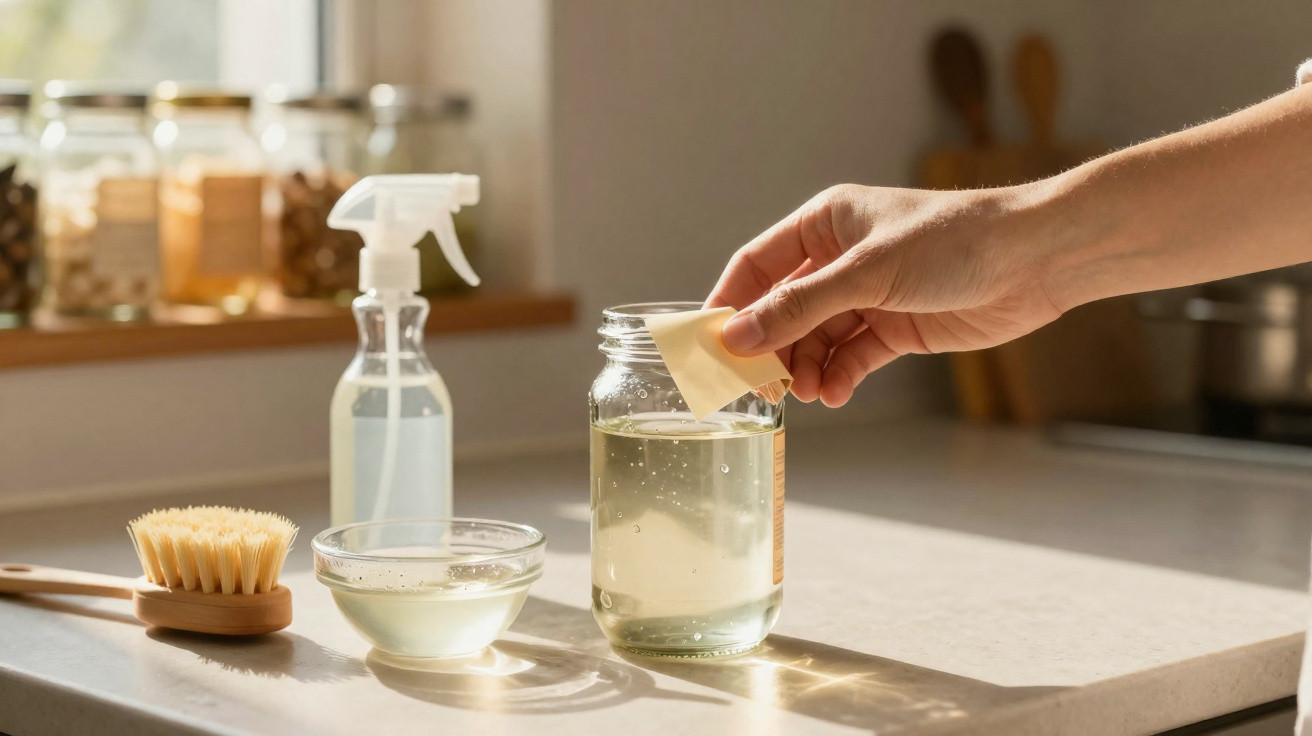
This straightforward approach can feel almost too easy. First, remove as much of the label as possible without struggling with it. Ignore the furry paper remnants and the sticky outline for now. Soak a clean cloth or a piece of kitchen roll in white vinegar, then press it firmly over the residue.
Leave it in place for at least 10 to 15 minutes. This is the unexciting stage, but it is also where the useful work happens. The vinegar’s acetic acid penetrates the glue and reduces its hold, which you should notice when you return to it.
Once the waiting time has passed, move the vinegar-soaked cloth across the sticky area using gentle pressure. When conditions are favourable, the residue will come away in soft grey rolls. If a few sections remain stuck, soak only those persistent areas again.
For especially stubborn commercial labels, some people gently warm the vinegar before soaking the cloth, or pour a small amount onto the jar and cover it with cling film to prevent evaporation. It may look a little like a DIY experiment on the worktop, but the outcome is unchanged: glass that looks new, without the need to purchase specialist products.
There are a few pitfalls to avoid. Vigorous scraping with knives, metal scouring pads or razor blades may create fine marks in the glass. They might barely be visible at first, but they can later hold stains and leave the jar looking permanently dull. Strong chemical solvents act quickly, but they have an unpleasant smell, cost more, and are not ideal around surfaces intended for food.
In truth, hardly anyone tackles this task every day. Most of us pile up “gross” jars beneath the sink and promise to sort them out “one day”. This is precisely why a technique based largely on waiting and ordinary vinegar is so useful. Set it up, leave it alone, return later, and most of the work is already finished.
Making vinegar a more effective label residue remover
For the tidiest finish, break the method into three easy stages: peel, soak and slide. Start by lifting the label gently, even if it tears away in strips. There is no need to remove every fibre. Next, wet the area with white vinegar using a cloth, cotton pad or even a section of an old T-shirt. Press it on, wrap it around the jar, or tape it in place to keep the surface damp.
After 10–20 minutes, use the same fabric to wipe the released adhesive away. Finish by rinsing the jar in warm, soapy water to get rid of the vinegar scent and any tiny fragments of glue.
When residue is exceptionally difficult to shift, sprinkle a light coating of bicarbonate of soda over the vinegar-soaked patch. The resulting paste provides mild abrasion, helping to lift final traces without damaging the glass. Work slowly in small circles and stop as soon as the surface feels smooth.
People often accuse the vinegar of being ineffective when this method fails, but impatience is nearly always the actual issue. Vinegar is not a power tool; it works quietly. Allow it the time it needs rather than scrubbing more and more forcefully.
Sometimes the biggest difference between a frustrating kitchen task and a satisfying one is simply learning to let a humble ingredient take its time.
- Choose plain white vinegar. Coloured or flavoured vinegars may leave unwanted marks or odours on the glass.
- Allow enough soaking time. Five minutes is often too short; 15–20 minutes can transform the result completely.
- Test plastic lids or painted surfaces first. Vinegar is mild, but certain finishes and adhesives on lids or labels may respond differently.
- Finish with soap and hot water. This clears away any remaining adhesive film and prepares the jar for storing food.
- Reuse the vinegar-soaked cloth. A single damp rag can clean several jars in succession, so there is no need for a fresh dose each time.
From “sticky mess” to satisfying storage jars
After seeing how readily vinegar can remove label residue, you may view your recycling bin differently. A pesto jar can become a spice container. A salsa jar can serve as a pen pot on your desk. Branded glass starts to look less like waste and more like a collection of neutral, clean containers suited to the perfectly arranged cupboards you see online.
The action is small and nearly unnoticed on a busy day, but it can alter the way you think about the things you already have.
This simple method can also change your idea of what a cleaning product needs to be. Rather than relying on a specialist remover in a fluorescent bottle, you use the same inexpensive liquid that goes on a salad. It is not glamorous, and it does not smell like a citrus rainforest. Yet it is effective, already in the cupboard, and quietly shows that less can do more.
The moment your finger runs across smooth, label-free glass is not heroic. It is simply quietly satisfying. Sometimes that is exactly the sort of success a kitchen needs.
| Key point | Detail | Value for the reader |
|---|---|---|
| Vinegar dissolves glue bonds | Acetic acid weakens the adhesive’s grip on glass after a short soak | Removes sticky residue without expensive specialist products |
| Time beats force | Leaving a vinegar-soaked cloth on the label mark works better than hard scrubbing | Less effort, fewer scratches, more reliable results |
| Simple routine: peel, soak, slide | Peel label, apply vinegar, wait, wipe, then wash with hot soapy water | Easy-to-remember method that fits naturally into kitchen habits |
FAQ:
- Question 1 Can I use apple cider vinegar instead of white vinegar?
- Question 2 How long should I leave the vinegar on the sticky residue?
- Question 3 Will vinegar damage plastic lids or metal caps?
- Question 4 What if the glue still doesn’t come off after the first try?
- Question 5 Is it safe to store food in jars cleaned this way?




Comments
No comments yet. Be the first to comment!
Leave a Comment