
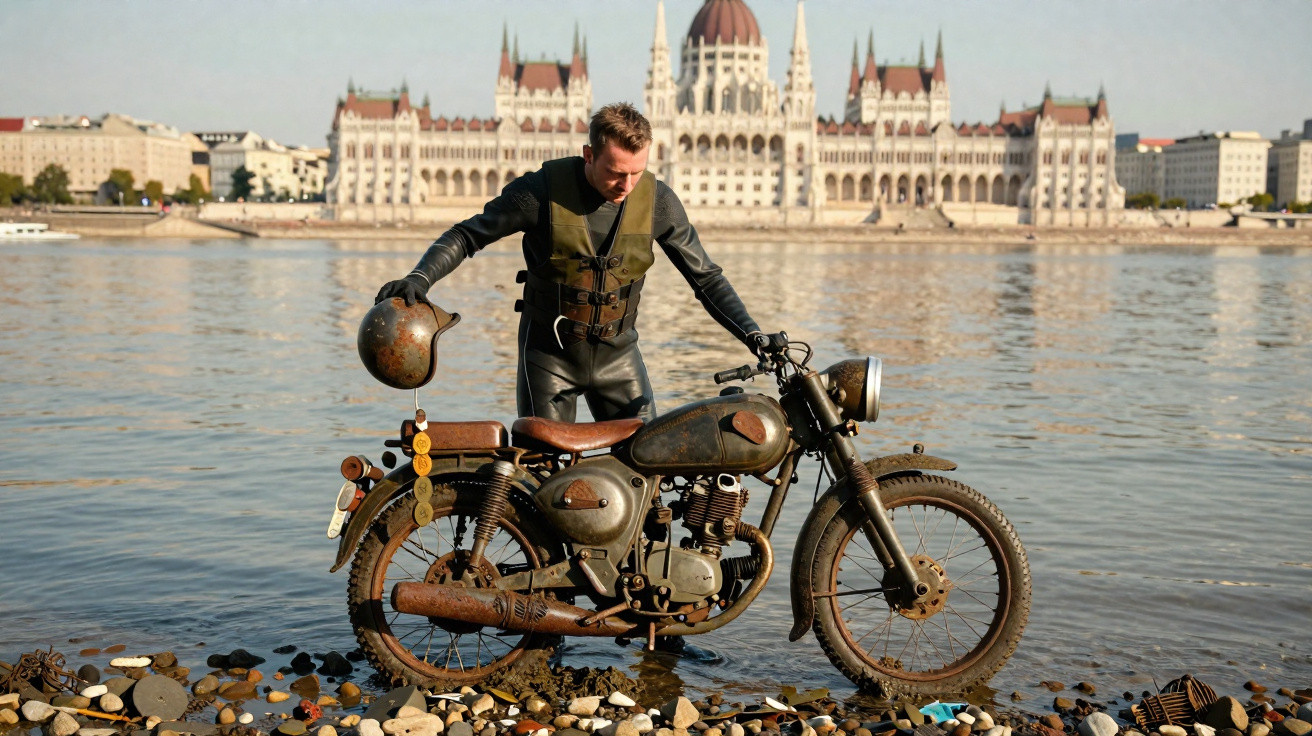
When the Danube fell to an exceptional low level in 2026, mud in Budapest began yielding objects concealed for more than 80 years. Near Batthyány Square, a German military motorcycle, the remains of two soldiers and Second World War anti-tank mines emerged. The bed of Europe’s second-longest river was suddenly turned into an unexpected time capsule.
What was found on the Danube riverbed?
According to the Volksbund Deutsche Kriegsgräberfürsorge, the German organisation that locates and identifies war dead, teams recovered the remains of two Wehrmacht personnel alongside military items. The objects included still-legible identification discs, which are important in efforts to establish the soldiers’ identities.
Specialists from Hungary also removed a motorcycle from the site, provisionally identifying it as a DKW NZ 350-1, a model used by German forces during the conflict. Its condition attracted attention because mud and oily deposits in the former harbour limited some materials’ exposure to the conditions that would usually speed up deterioration.
Why did the soldiers’ identification discs attract attention?
The identification discs were recovered with both sections still joined together. Under the system used by German forces, the disc could be split after a serviceman’s death: one half remained with the body, while the other was sent to the office responsible for recording casualty information. Finding the discs intact provides a possible clue to what happened.
The Volksbund believes it is possible that the procedure for registering the deaths was never completed at the time. Information retained on the discs may now support historical research and identification attempts. Once this work has been carried out, the remains are expected to be buried at the military cemetery in Budaörs, near Budapest.
- A German military motorcycle remained preserved beneath river sediment.
- The remains of two soldiers were recovered with identification discs that were still legible.
- German Tellermine 35 anti-tank mines were also found in the same area.
- The material had remained hidden in the Danube riverbed for roughly eight decades.
How did these objects end up in the river?
Budapest saw fierce fighting towards the end of the Second World War. Soviet and Romanian forces encircled the city in late 1944 as German and Hungarian troops attempted to hold their positions. The siege continued until February 1945, leaving deep scars on the capital, including around the Danube’s banks and crossings.
This background helps explain why military equipment and human remains can still surface in the area, although every discovery must be examined separately. The items also included Tellermine 35 anti-tank mines, which require expert handling because they remain potentially dangerous devices even many decades after the war.
Watch the video shared by the YouTube channel Sean Staunton, showing a DKW NZ 350-1, the model used by German forces during the war.
Why does the Danube continue to reveal wartime relics?
The phenomenon is not confined to Budapest. In 2024, extremely low water levels exposed German Second World War vessels near Prahovo in Serbia. Reuters reported that the ships belonged to a fleet deliberately sunk in 1944 during the German retreat before the Soviet advance, with some still posing hazards to navigation.
In July 2026, the retreating Danube again exposed wrecks in Serbia and Croatia. Reuters linked the exceptionally low levels to extended periods of heat and drought, which also affected river transport and energy supplies. The river is about 2,857 kilometres long and passes through a region shaped by centuries of conflict and human movement.
How many more traces could still be hidden?
There is no way to know precisely. Sediment, mud and water can conceal vehicles, vessels and objects for decades, until a shift in river levels makes some of them visible again. Along the Danube, every spell of extreme drought may uncover forgotten chapters, while also bringing environmental, historical and safety risks.
The motorcycle recovered in Budapest illustrates how a seemingly familiar landscape can hold stories only a few metres beneath the surface. When a river nearly 3,000 kilometres long recedes, the past can reappear where nobody expects it. Monitoring and preserving these discoveries is essential, because the next drop in water levels may reveal another piece of a story lost since 1945.




Comments
No comments yet. Be the first to comment!
Leave a Comment