
Last Tuesday, in my utility room, I picked up what had once been my favourite white cotton shirt. Only three months earlier, it had been brilliantly crisp-the sort of white that helped me feel polished before an important meeting. Now, despite my strict adherence to the care label, it resembled fabric steeped in milky coffee. My white socks had taken on the same disappointing grey cast, while even my supposedly “premium” bed sheets appeared dull and worn. For years, I had used the identical detergent and temperature settings. Somehow, though, every wash seemed to drain a little more brightness from my whites. The reason was not what I had assumed.
Why white laundry gradually turns grey
A tiny struggle takes place in the suds whenever you put white garments in the washing machine. Body oils, shed skin, deodorant traces and pollution are not simply washed away; they are moved around the load. Your machine is rather like a mixing bowl: everything is agitated together, leaving those grey particles with nowhere to settle except back on to the textiles.
After I mentioned my greying towels over coffee, my neighbour Sarah, a microbiologist, explained what was happening. Most detergents are able to loosen grime and stains, she said, but they are not formulated to remove them entirely from the wash water. Instead, dirt and oils remain suspended before settling on any material that will take them in. As the most absorbent items, white clothes become reluctant magnets for this debris floating in the water.
Because it develops little by little, the problem is easy to overlook at first. Every cycle leaves behind a fine grey residue that accumulates over time, much like dust gathering on an ignored shelf. Hard water intensifies the effect, as mineral deposits form a coating that holds on to dirt more readily. Water that looks completely clean can still contain unseen particles that eventually return to your clothes.
Oxygen bleach for brighter white laundry
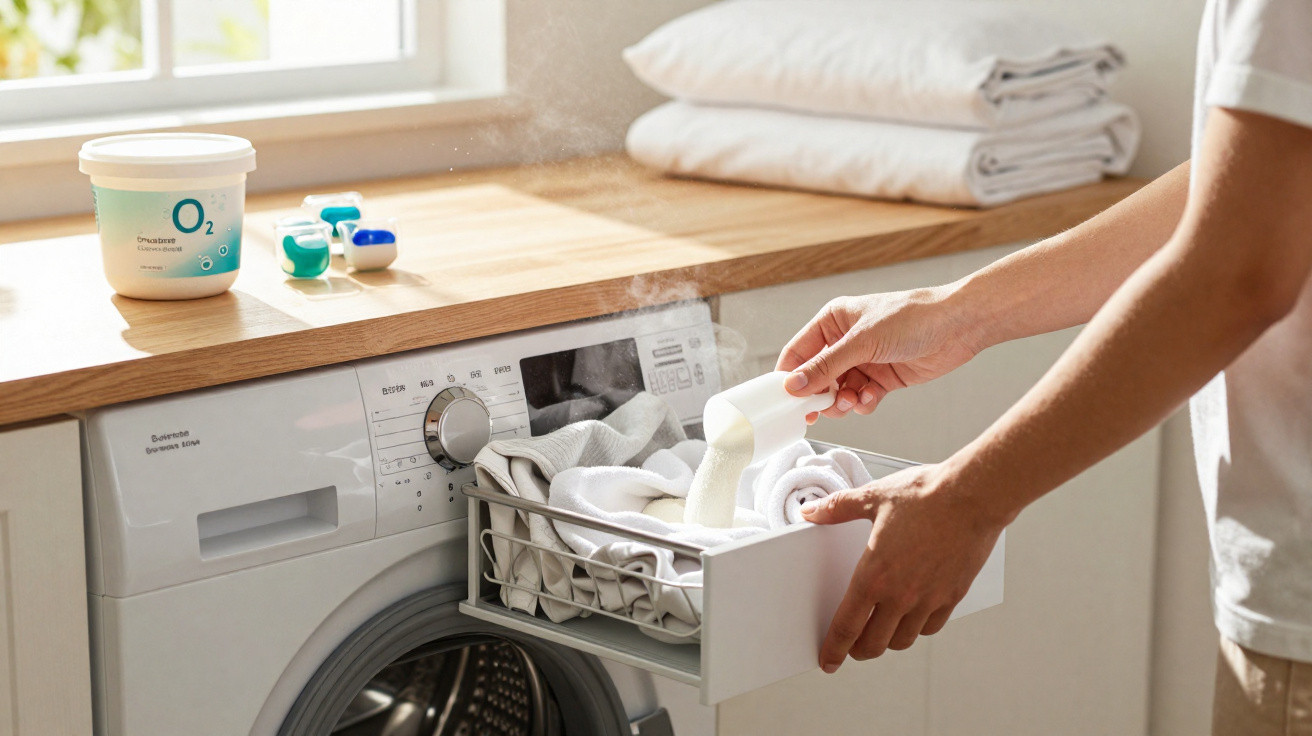
Oxygen bleach powder is the product your white washing has been missing. In contrast to chlorine bleach, which may damage fibres and leaves a strong chemical odour, oxygen bleach breaks apart the molecular bonds in stains and soil. Put one scoop in each white load and the change should be noticeable within three washes.
You may be thinking that it means buying yet another product and remembering one more task. Most of us know the feeling of standing in the detergent aisle, overwhelmed by countless choices and advertising claims. Usually, we pick up the same familiar brand and simply hope it works. This is not a costly solution dressed up with clever marketing, however: oxygen bleach costs around US$12 and will last for months.
What laundry specialists do not always spell out is that the answer lies not only in using oxygen bleach, but in using it correctly.
“The key is consistency and water temperature,” explains textile care specialist Maria Rodriguez. “Oxygen bleach activates best in warm water, around 104-140°F. Cold water won’t trigger the chemical reaction you need.”
- Put the oxygen bleach straight into the drum before loading the clothes.
- Choose warm rather than hot water, as hot water can set some stains.
- Allow the garments to soak for 15 minutes before beginning the wash cycle.
- Never mix with chlorine bleach.
More than a short-term solution
Your approach to laundry may resemble the way you handle many household jobs: you want it completed quickly, efficiently and with as little effort as possible. White clothing is different, though, because it reflects the way we live. Its grey tone is not solely a matter of chemistry; it is also shaped by everyday habits, skin, surroundings and even the water travelling through local pipes. Restoring that clean brightness is about more than washing fabric-it means taking back a small measure of control over the way you appear to others.
| Key point | Detail | Value for the reader |
|---|---|---|
| Soil redistribution | During washing, dirt particles settle back on to the fabric. | Understanding this helps prevent future greying. |
| Oxygen bleach | It breaks the molecular bonds of stains without aggressive chemicals. | A gentle but effective whitening option. |
| Water temperature | Warm water (40–60°C) activates oxygen bleach correctly. | Maximises the product’s effectiveness. |
FAQ:
- Can I use oxygen bleach on coloured clothes? Yes, oxygen bleach is safe for colours and will not fade or harm coloured fabrics in the way chlorine bleach can.
- How much oxygen bleach should I use per load? Use one scoop (about 60 ml) for a standard load, or two scoops for an extra-large or heavily soiled load.
- Will this work on clothes that are already grey? Yes, although badly greyed items may require 3–4 treatment cycles before there is a marked improvement.
- Is oxygen bleach safe for septic systems? Absolutely. Oxygen bleach breaks down into water and oxygen, so it is environmentally friendly and safe for septic systems.
- Can I use it with my regular detergent? Yes, oxygen bleach works with ordinary detergent-add both to the drum before putting in the clothes.






Comments
No comments yet. Be the first to comment!
Leave a Comment