
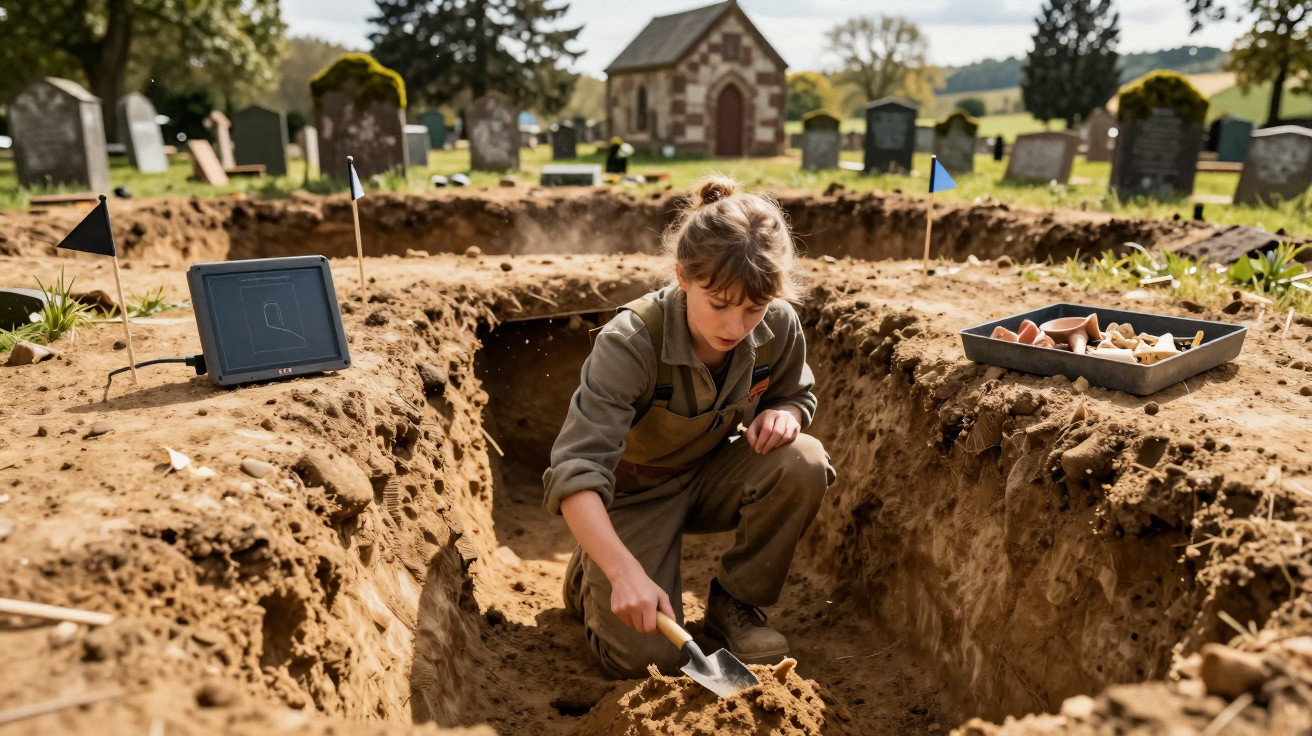
Routine surveys before a wind farm development have uncovered an archaeological narrative running from the Stone Age to the Middle Ages, all focused on one ridge above the Harz region.
A medieval tunnel concealed in plain sight
The unexpected discovery was made on Dornberg hill in central Germany’s Harz district, during precautionary excavations before wind turbines were installed. Archaeologists anticipated finding evidence of ancient burials. What they found instead was more unusual: a hand-cut, twisting underground passage descending into the ground.
The feature is part of the enigmatic class of artificial tunnels called an “Erdstall” in German. These cramped, low passageways can lead to small chamber-like spaces and are generally associated with the medieval era.
From the surface, the entrance looked like a simple Stone Age grave. Only careful digging revealed that it formed the top of a much longer underground system.
Initially, the excavation team believed it had found another Neolithic burial. An elongated hollow roughly two metres long was covered by a large stone slab, closely matching the form of an ancient grave. That interpretation seemed particularly plausible because Dornberg was already recognised as a site containing prehistoric remains.
However, this interpretation changed as the dig went deeper. The supposed “grave” continued far beyond its expected endpoint. Its shaft curved downwards into a low passage. Subsequent excavation exposed additional galleries, small voids and shaped stones that plainly were not components of a Stone Age burial.
Evidence dating to the Middle Ages
A collection of small pottery fragments provided the decisive evidence. The sherds corresponded to ceramics from the late Middle Ages, making them many centuries more recent than the prehistoric features around them. Combined with the passage’s construction, these finds enabled specialists to associate the tunnel with medieval use.
The corridors are not wide enough for normal walking. Numerous Erdstall tunnels force visitors to crawl or wriggle through them, passing tight “bottle necks” and sharp turns that resemble barriers rather than useful entrances.
Nothing suggests a practical cellar or storage room – this layout seems designed for secrecy, ritual, or both.
A cemetery in use for six millennia
The German tunnel is especially remarkable because of where it was built. It runs directly through a funerary landscape that had already been used for about 6,000 years before the Middle Ages.
Dornberg hill contains successive layers of human history:
- A Neolithic ditch complex associated with the Baalberge culture, among central Germany’s earliest farming communities.
- Late Neolithic graves, showing that generations used the hill as a burial ground.
- Evidence of a Bronze Age burial mound, indicating that later groups returned to this same sacred location.
- And now a medieval tunnel cut through the older burial landscape.
Such long-term continuity is unusual for archaeologists. The hill repeatedly appears in the archaeological record, with every era assigning it a fresh purpose while retaining an awareness of its exceptional place in the landscape.
Why construct tunnels beneath a cemetery?
The medieval gallery’s purpose remains the central mystery. It is absent from written records, while no clear artefacts reveal an obvious use. Archaeologists are considering two principal explanations.
| Hypothesis | Possible role of the tunnel |
|---|---|
| Hideout | A refuge during conflict or raids, using the hill’s natural characteristics as protection. |
| Ritual space | A confined subterranean environment for religious or symbolic activity, potentially connected with the ancient graves. |
Dornberg’s terrain supports the first explanation. The naturally prominent hill, with its ditches and gentle variations in height, would have been easier to monitor or defend. During unsettled periods, a concealed passage beneath a cemetery may have served as a secret shelter.
Alternatively, the landscape’s extensive funerary past may have made it seem distinctive or spiritually charged. Medieval people may have regarded the ancient graves as both sacred and unsettling. Such an atmosphere could discourage inquisitive neighbours, making the site well suited to a small group seeking privacy for rituals or gatherings.
The same features that marked Dornberg as a place of the dead in prehistory may have turned it into a discreet sanctuary or hideout in the Middle Ages.
Within the constricted Erdstall tunnels
Erdstall systems occur across several areas of central Europe, particularly Germany and Austria. They are commonly dated to between the 10th and 13th centuries, although many cannot be dated precisely. Medieval writings rarely refer to them, and the few references that do exist usually describe them indistinctly or present them as frightening places.
Most have several unusual characteristics in common:
- Extremely low roofs that frequently require people to crawl.
- Tight squeeze sections where the passage narrows abruptly.
- Small rooms branching from the main corridor, at times only large enough for one person.
- Entrances concealed under buildings or fields, or, as at Dornberg, within apparently unremarkable features.
These features are inconsistent with ordinary cellars or mine workings. Indeed, they appear intentionally uncomfortable. For researchers, the physical feeling of confinement strengthens the argument for a spiritual or symbolic role, in which travelling through darkness and narrow spaces was part of a ritual experience.
How archaeologists interpret a buried landscape
The Dornberg discovery also demonstrates how experts assemble evidence from multiple eras at a single location. Their work combines stratigraphy, artefact dating, soil analysis and spatial mapping.
At this hill, earlier features, including the Neolithic ditch and Bronze Age mound, either lie lower down or survive as separate cuts in the soil. The medieval tunnel cut through some of those layers, confirming that it belongs later in the sequence. Pottery and organic material such as charcoal can refine the chronology through typology and radiocarbon testing.
This kind of “vertical timeline” allows archaeologists to establish not simply what was constructed, but also how later generations interpreted the remains left by earlier people.
What Dornberg reveals about memory and sacred places
Dornberg reflects a recurring pattern in European archaeology: some locations continue to attract people for thousands of years. A conspicuous hill, a striking outlook or a connection with death can retain meaning across different ages. Communities reshape such places to reflect their own beliefs and anxieties, without entirely removing the significance attached to them before.
For prehistoric farming communities, the hill was both a cemetery and a ceremonial centre. Bronze Age groups later used it for a burial mound marking people of higher status. Many centuries afterwards, medieval villagers or local elites excavated a secretive passage in the same ground, perhaps to seek a link with ancestors or perhaps merely to exploit a place that others already avoided.
Dornberg’s story is less about a single tunnel and more about how landscapes store memories, layer after layer.
Key terms behind the headlines
This discovery involves several technical terms that frequently occur in reporting on ancient sites:
- Neolithic: The final phase of the Stone Age, when agriculture and permanent villages spread across Europe. In central Germany, this began around 5500 BCE.
- Baalberge culture: An early Neolithic culture in central Germany, recognised for burial sites, pottery and earthworks including ditches and enclosures.
- Tumulus: An artificial burial mound, commonly constructed above an important grave in the Bronze Age and Iron Age.
- Erdstall: A narrow medieval underground passage whose precise purpose remains disputed among historians and archaeologists.
Knowing these terms helps position Dornberg hill within a broader European context. Comparable patterns of repeatedly used cemeteries, overlapping monuments and concealed medieval structures occur from France to the Czech Republic, although every site has its own distinctive features.
For those visiting the Harz region, the discovery also encourages a different perspective on the countryside. An unassuming field, a modest rise in the distance or a group of old stones may conceal centuries of activity. Most tunnels of this kind remain closed for safety, but local museums and information boards often offer reconstructions, enabling visitors to imagine squeezing along a dark corridor dug hundreds of years ago beneath ground that had already held the dead for millennia.





Comments
No comments yet. Be the first to comment!
Leave a Comment