
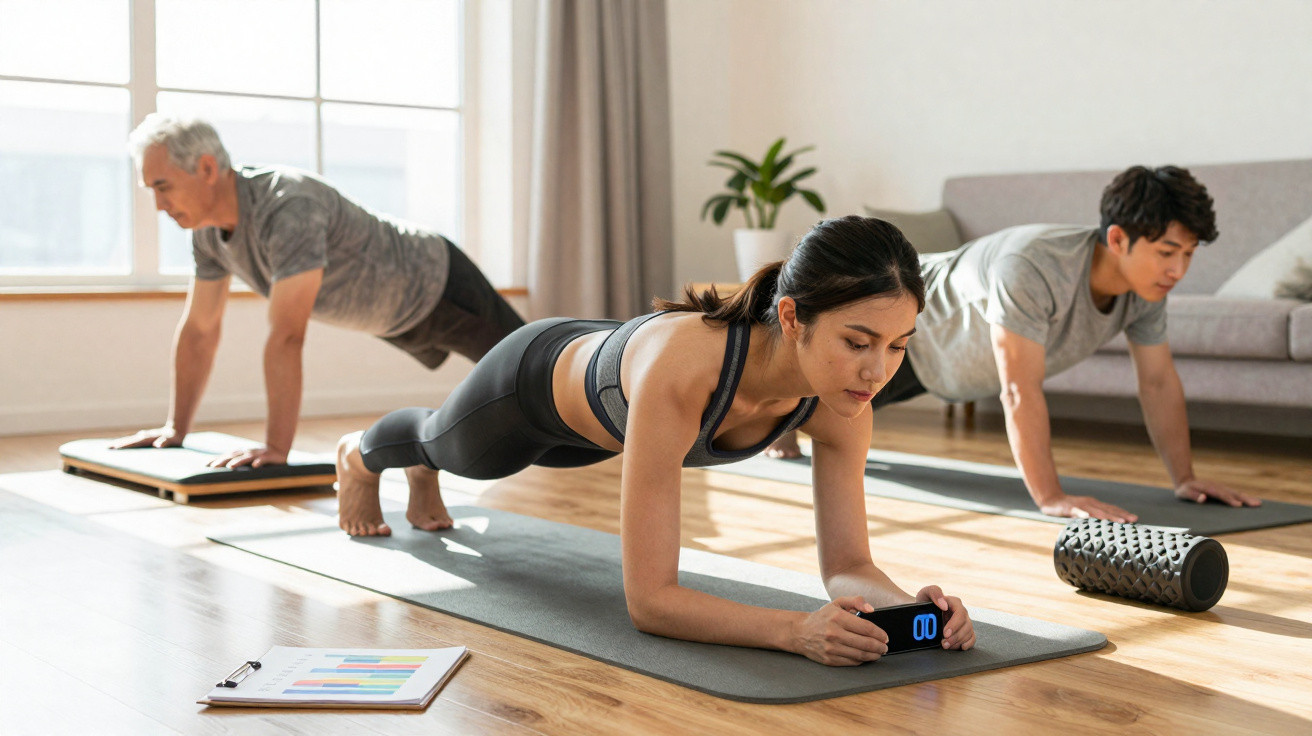
Fitness fanatics on Instagram seem to hold the plank position forever. In everyday life, the more down-to-earth question is this: how many seconds are healthy and realistic for an ordinary person with a job, family and limited time? This is where exercise science offers useful guidance: the record is not what matters, but the right balance of technique, duration and age.
Why the plank is more than an abdominal-muscle gimmick
The plank is an isometric exercise. In other words, the muscles work without any visible movement. While the body appears still, it is working hard internally.
It is not just the rectus abdominis muscles that are engaged. The following muscles work at the same time:
- oblique and deep abdominal muscles
- gluteal muscles
- spinal erectors and deep back muscles
- shoulders and thighs
This combined effort stabilises the spine. Regular planking can therefore protect the lumbar spine, whether you are lifting shopping bags or doing deadlifts at the gym.
“A stable core lowers the risk of back pain in everyday life, improves balance and makes movement more efficient – especially as we get older.”
Research shows that a strong core acts like internal support. People aged 60 and over benefit in particular, as falls and uncertainty while walking may become less common.
No seconds count without proper technique
Many people try to hold on for as long as possible, even with a sagging back or raised hips. This removes the intended benefit and shifts the strain to the wrong areas, particularly the lumbar spine and shoulders.
This simple checklist can help:
- Position your elbows directly beneath your shoulders, keep your forearms parallel and relax your hands.
- Keep your head in line with your spine and look slightly downwards.
- Draw your shoulders away from your ears and actively pull your shoulder blades back and down.
- Aim to create a straight line from your torso and pelvis to your heels.
- Keep your abdominal muscles, glutes and thighs engaged.
- Maintain a neutral back: no excessive arching and no rounded cat-back position.
- Breathe calmly and evenly; never hold your breath.
End the set as soon as your lower back begins to arch, your shoulders collapse forwards or your body starts shaking heavily, regardless of what the timer says.
The self-test: how fit is your core really?
For a quick check, you need only an exercise mat and a timer:
- Warm up gently for 50 to 60 seconds, for example by marching on the spot and circling your shoulders.
- Move into a forearm plank and adopt the position described above.
- Start the timer and hold the position only for as long as you can control the technique properly.
- Stop at the first clear loss of form.
Most people can place their result roughly within these categories:
| Duration | Assessment |
|---|---|
| under 15 seconds | starting level; build stability |
| 15–30 seconds | beginner; a good basis for progress |
| 30–60 seconds | practical everyday core strength |
| 60–90 seconds | a very solid level of fitness |
| over 90 seconds (proper technique) | advanced; time for variations |
The more interesting question comes next: how does your result compare within your age group?
How long you should hold a plank for your age
The following ranges are realistic targets for healthy adults without acute symptoms. They do not replace medical advice, but they provide useful guidance.
Ages 18 to 39
- Goal: “Stay healthy”: 30 to 45 seconds per set, for two to three sets
- Goal: “Improve fitness”: 60 to 90 seconds; those who are very well trained can progress to around 120 seconds – but only with proper technique
If you can maintain clean form for around 60 seconds in your mid-thirties, you are already in the “fit” range. At this point, the benefit for everyday physical demands is generally maximised.
Ages 40 to 59
- Goal: “Stay healthy”: 30 to 45 seconds – very good for posture and back health
- Goal: “Improve fitness”: 45 to 75 seconds, up to approximately 90 seconds at most with regular training and healthy joints
At age 50, 45 to 60 seconds is considered a strong result. Maintaining this level reduces the risk of back problems and helps you remain resilient in daily life.
Aged 60 and over
- Goal: “Stay healthy”: 20 to 30 seconds
- Goal: “Improve fitness”: 30 to 60 seconds, ideally divided into several shorter sets
At age 70, holding a plank for 30 to 40 seconds with good form is a clear sign that the body still has considerable strength and stability. This becomes noticeable when climbing stairs, bending down and walking safely.
“Your own progress matters more than comparison with younger people. Anyone who improves gradually within their age group is doing everything right for their health.”
Training plan: increase your plank time gently
Core strength develops more effectively through consistency than through heroic one-off efforts. One possible plan for adults up to around age 59 is:
- Week 1: three times per week, three sets of 20 seconds each
- Week 2: three times per week, three sets of 30 seconds each
- Week 3: three times per week, three sets of 35–40 seconds each
- Week 4: three times per week, three sets of 45–60 seconds each – adjusted to how you feel
A 30 to 60-second rest between sets is enough. If you experience clear pain in your back or shoulders, stop and discuss it with a doctor or physiotherapy practice.
Gentler plank variations for older people and those with back problems
Anyone over 60, returning after a long break from exercise or dealing with a sensitive back should begin more gently:
- Do the plank with your knees on the floor rather than your legs straight.
- Place your forearms on a bench, sofa or table, creating an incline rather than a horizontal position.
- Complete two to three sets of 10–15 seconds.
- Increase by 5-second intervals once the current duration feels secure.
Sharp pain, stabbing sensations in the lower back or numbness are warning signs. These require professional assessment.
When to stop chasing plank seconds
Beyond around 90 to 120 seconds of uninterrupted planking, the additional benefit becomes very small. For everyday life, an endlessly long hold usually offers no extra advantage.
“Quality over duration: several sets in the 30 to 60-second range with strong body tension deliver more on average than one strained three-minute effort.”
Once you reach this point, vary the exercise instead of simply holding on for longer:
- side plank for the oblique abdominal muscles and lateral core stability
- plank with alternating leg lifts
- plank with shoulder taps, moving one hand at a time to the opposite shoulder
- plank on an unstable surface, such as a balance pad or gym ball, for experienced exercisers only
How to fit the plank into everyday life
For many people, the obstacle is not motivation but time and routine. One practical method is to attach the plank to an established habit, such as after brushing your teeth in the evening or immediately after getting up. Two to three minutes in total, including rests, is enough.
If you already do other sports, add the plank at the end of your workout. It is an ideal finish after a run, a cycle ride or a short home workout.
What terms such as “core” and “isometric” actually mean
The widely used term “core” does not refer only to visible abdominal muscles. It means the entire midsection: the stomach, back, pelvic floor, gluteal muscles and deep stabilising muscles along the spine. This area keeps the body stable, transfers force between the arms and legs, and protects the spinal joints.
“Isometric” describes how the muscles work. They contract against resistance without changing the angle of a joint. Rather than moving up and down as in sit-ups, the body remains fixed in one position. This partly reduces stress on the joints while still challenging the muscles intensely.
Well-trained core muscles also benefit other sports: runners move more steadily, tennis players can absorb shots more effectively, and even long periods sitting at a desk become easier because the spine is better supported.
By adapting your plank duration sensibly to your age, previous history and everyday workload, you can use this very simple exercise as a powerful tool for health and physical performance – without a gym membership or complicated equipment.
Comments
No comments yet. Be the first to comment!
Leave a Comment