
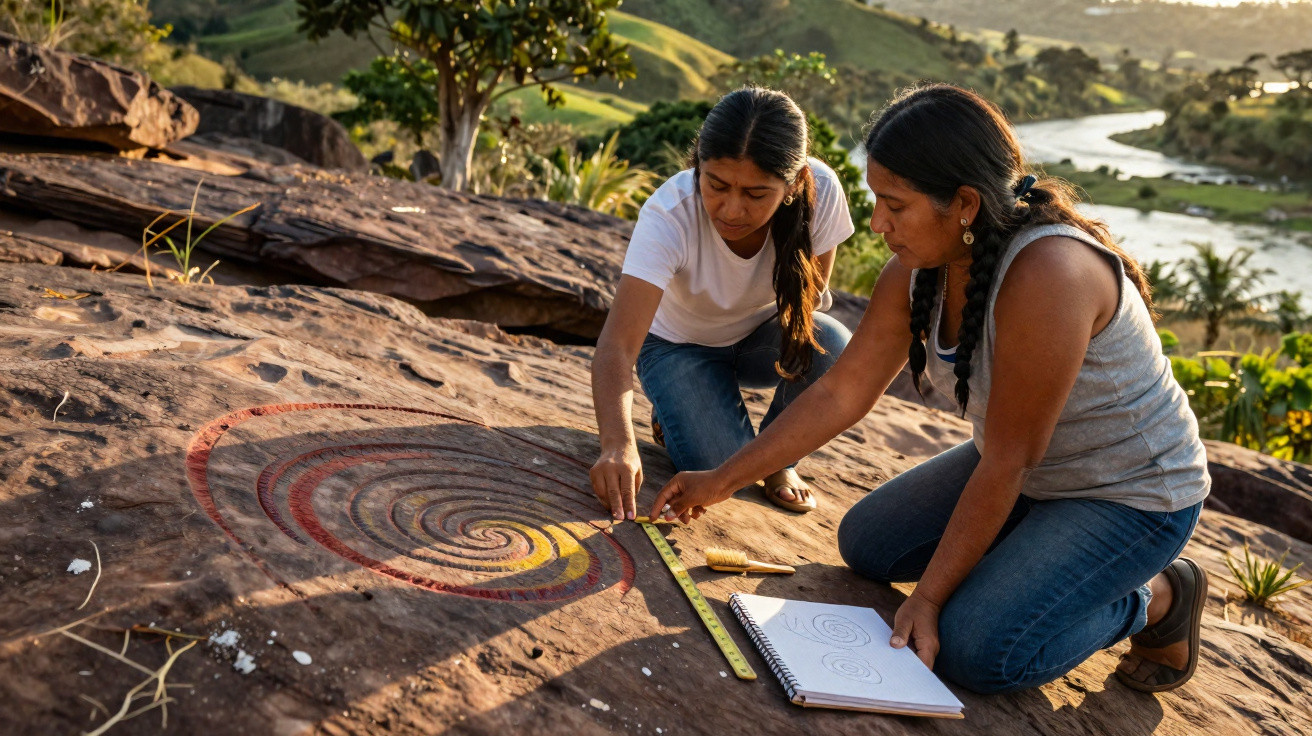
A carved boulder in eastern Venezuela has been identified as one of the nation’s oldest known rock engravings, and specialists place it between 4,000 and 8,000 years old.
This estimate extends the history of human expression in Monagas, Venezuela much further back and casts the area as an early centre of symbolic culture.
Carvings above Quebrada Seca
The engraved boulder lies on an upland hillside close to Quebrada Seca in Monagas state, where wind and rain reach its exposed surface. Spirals and human forms have been cut straight into the rock.
Luis Rafael Peñalver Bermúdez traced the marks across the boulder and recorded designs he associated with enduring Indigenous beliefs concerning nature and ancestral presence.
In his role as Monagas state historian, Peñalver said the proposed age was exceptionally early for Venezuela, although he stressed that formal dating research has yet to be carried out.
Until physical evidence from those tests establishes the chronology, the engraving remains a striking yet tentative indication of the region’s ancient human history.
Estimating the stone’s age
Unlike bone or pottery, a rock engraving seldom contains organic material that laboratories can date directly.
Researchers therefore use comparisons between motif styles, surface weathering and surrounding sediments to establish when people may have carved the stone.
Mineral deposits and buried soil layers can help fix the sequence, as they may have developed either before or after the grooves were made.
In the absence of such evidence, the earliest estimate may prove sound, or it may quickly be overturned.
Meaning behind the spirals
The spirals and concentric circles indicate that their makers may have valued cycles, movement and recurring returns through generations and seasonal change.
In numerous Indigenous traditions, cosmology – a culture’s ideas about the universe and spirits – determines the symbols that communities reproduce.
Local interpretations have associated the designs with the sun, water cycles and ancestral spirits that influenced everyday life.
Interpretation remains uncertain when images are assessed by outsiders alone, meaning future research must involve local knowledge holders.
Chaima and Kariña legacies
Rock carvings occur in such large numbers across Cedeño municipality, whose administrative centre is Caicara de Maturin, that the district is notable within Monagas state.
In relation to Chaima and Kariña heritage, many residents identify petroglyphs, rock engravings carved into stone surfaces, as evidence of a longstanding presence.
“These engravings demonstrate that Cedeño was a crucial transit and settlement corridor in the region,” said Peñalver.
Attributing the work to a particular maker can be problematic, as present-day Indigenous communities may not wish outsiders to assign ownership.
Making grooves in stone
The shallow incisions indicate that the creator drew lines across the boulder’s hard surface rather than making deep holes.
Known as linear low relief, grooves cut shallowly into rock so shapes stay flat, the engraving had an average depth of about 1.24 centimetres.
Broader marks, measuring roughly 1.7 centimetres wide, point to repeated, controlled grinding using abrasive stone, sand and water.
Even when stone chisels and hammers are used, shallow incisions deteriorate over centuries, so preservation matters as much as discovery.
Pigments in the grooves
In some cases, pigments, coloured minerals rubbed into lines, remain inside the grooves, suggesting that carving was only one stage of the process.
Colour would have made the images more visible from a distance and may have been reapplied over time.
Rain, heat and vegetation can obscure shallow cuts, while later human scratches can introduce marks that complicate the archaeological record.
Documenting the details early preserves a record before they disappear and enables future teams to monitor changes without handling the boulder.
Scientific verification ahead
Estimates based on style can offer a useful direction, but they may be unreliable when separate groups produced similar motifs.
A critique published in 2002 maintained that dates need to be connected to the mark by physical, testable evidence that others can later verify.
Mineral skins formed above a groove can provide a minimum age, whereas buried deposits below it can establish a maximum age.
At Quebrada Seca, this requires careful sampling and contextual investigation before the earliest age claim can be regarded as conclusive.
Protecting a fragile site
Rock art in the open air may endure for thousands of years, but one thoughtless visit can cause lasting harm.
A UNESCO booklet warned that rock art on exposed rock faces is vulnerable to damage from natural forces and people, including vandalism.
Older sites throughout Monagas have already shown signs of weathering and human scratching, leaving any newly identified location vulnerable.
Safeguarding should begin with controlled access and clear local supervision, rather than merely putting up signs once the discovery becomes public.
Tourism and local safeguards
On 30 January, officials confirmed that the boulder was located around 3.5 kilometres from San Felix at an elevation of nearly 647 metres above sea level.
To reduce the risk of damage, they started geolocation work, recording precise coordinates so the site could be monitored, and contacted the Institute of Cultural Heritage (IPC).
An archaeological route was proposed to support sustainable tourism, although the attention generated by such plans could also attract vandalism.
“The Quebrada Seca petroglyph will eventually tell its story,” Peñalver remarked, underscoring the urgency of systematic fieldwork to protect this irreplaceable cultural legacy.
A cautious path forward
Rigorous research can assess the age estimates while the community determines how the carvings relate to its living traditions.
Robust protection, unambiguous visitor rules and open research plans could preserve the Quebrada Seca stone for decades.






Comments
No comments yet. Be the first to comment!
Leave a Comment