
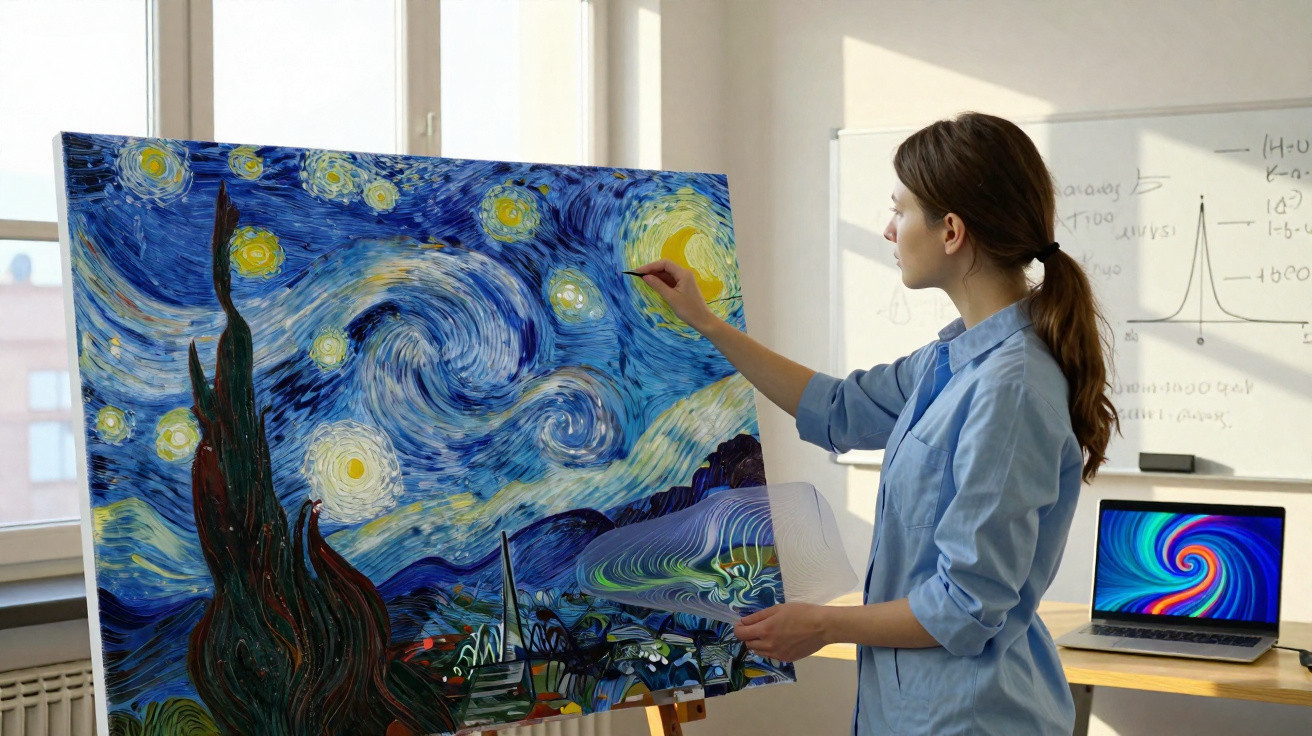
Created by the Dutch painter Vincent van Gogh in 1889, The Starry Night ranks among the art world's most captivating creations. As well as being strikingly evocative, its churning, spiralling sky appears to convey a sophisticated grasp of the physics behind turbulence.
A fresh and detailed study has now supported that idea. The brushwork in van Gogh's masterpiece aligns with the fluid dynamics of Earth's atmosphere - and perhaps those of the wider Universe too.
"[The painting] reveals a deep and intuitive understanding of natural phenomena," says physicist Yongxiang Huang of Xiamen University in China.
"Van Gogh's precise representation of turbulence might be from studying the movement of clouds and the atmosphere or an innate sense of how to capture the dynamism of the sky."
The Starry Night and atmospheric turbulence
Although it is largely imperceptible to the naked eye, Earth's atmosphere is a constantly shifting, roiling body of fluid. Clouds can make this ceaseless motion visible, yet gaining a close understanding of atmospheric turbulence normally calls for instruments that precisely chart movements that would otherwise remain unseen.
Naturally, there is no way to measure the atmospheric turbulence depicted by van Gogh in The Starry Night. However, a scientific team led by Xiamen University physicist Yinxiang Ma was able to measure the painting's brushstrokes and compare them with earlier research. That work had concluded that the turbulence shown in the artwork agrees with the theory developed by Soviet mathematician Andrey Kolmogorov during the 1940s.
"In contrast to previous studies that examined only part of this painting, all and only the whirls/eddies in the painting are taken into account in this work, following Richardson-Kolmogorov's cascade picture of turbulence," the researchers write in their paper.
"[Our] result suggests that van Gogh had a very careful observation of real flows, so that not only the sizes of whirls/eddies in The Starry Night but also their relative distances and intensity follow the physical law that governs turbulent flows."
Measuring van Gogh's swirling brushwork
Using a high-resolution digital image of the painting, the researchers investigated brushstrokes across 14 swirls and eddies in its sky. These features served as markers for atmospheric turbulence, much as leaves moving through an autumn eddy can reveal its flow.
For every brushstroke, the team closely assessed its spatial characteristics and the paint's luminance. They then compared these measurements with Kolmogorov's theory of turbulence, which explains how energy continuously passes from larger eddies to smaller ones before it dissipates.
The analysis showed that the painting's eddies met the conditions of Kolmogorov's law of turbulence scaling, matching the conclusions reached by previous researchers.
Kolmogorov's law and Batchelor's power spectrum
When the team examined the smallest brushstroke scales, they also found agreement with the power spectrum of scalars defined in 1959 by Australian mathematician George Batchelor. His work established that scalars - or scaled elements within turbulence, meaning eddies of varying sizes - should exhibit a power spectrum related to their size.
An earlier study had likewise identified the turbulence visible in The Starry Night within molecular clouds in space, where stars themselves are formed. This latest work indicates that the artist's instinctive knowledge of nature's physics may have extended further than previously thought.
"Vincent van Gogh, as one of the most notable post-impressionist painters, had a very careful observation of turbulent flows: he was able to reproduce not only the size of whirls/eddies, but also their relative distance and intensity in his painting," the researchers write.
Future experimental studies of painting turbulent flows may help explain how van Gogh captured turbulence not only in his portrayal of the sky, but also through the physical process of applying paint.
The research was published in Physics of Fluids.






Comments
No comments yet. Be the first to comment!
Leave a Comment