
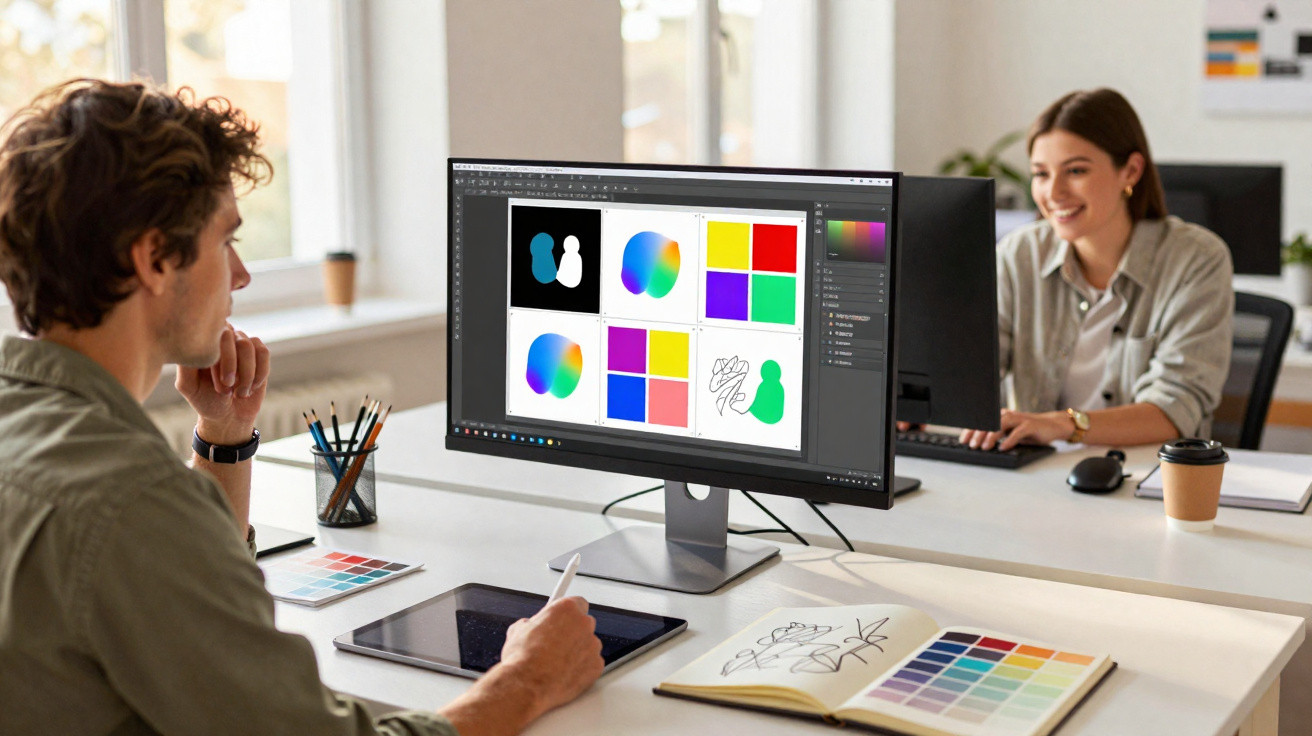
Generative AI has become a potent trigger for creative brainstorming, but it may hinder experienced designers when they begin completing a piece.
This result casts AI as more than a productivity aid: it is a collaborator whose advantages and disadvantages vary according to a creator’s position in the creative process.
Generative AI slows experts
In poster-design assignments that progressed from initial concepts to finished artwork, the clash between inspiration and execution came into view.
Jinghui Hou, an assistant professor at the University of Houston (UH), associated the slowdown with the established habits of experts.
Designers with less experience could use AI-generated material and continue, whereas seasoned practitioners commonly paused to alter, refine and reconstruct it.
This additional tidying is significant, as creative work seldom finishes with an initial idea; the paper examined what occurs after that point.
Using AI for brainstorming
The researchers defined ideation as the creative phase in which people produce numerous possibilities before selecting a direction.
It is followed by the more demanding work of picking one possibility, developing it and ensuring that it meets the brief.
The team observed that AI increased scores at the early stage by 76% for novelty, 24% for relevance and 97% for complexity.
These improvements are understandable: plentiful options are useful while people are exploring, but the same abundance may turn into distraction during completion.
Experts spend time editing
Extensive training may develop into expertise fixation, causing experts to rely repeatedly on familiar processes.
When AI generated imagery according to its own logic, professionals often needed to convert that output into their well-practised ways of working.
Screen recordings revealed more intensive revision, as expert designers more frequently inserted elements and modified existing ones before reaching a final choice.
In the student study, experts who used AI during implementation spent 57% more time while achieving comparable creativity scores.
Beginners gain more help
Those without substantial design training continued to benefit because AI took on production tasks that they had not yet learnt to master.
Rather than protecting an individual working routine, they could take up suggestions, adopt structure and continue towards a viable outcome.
For students with lower levels of expertise, implementation increased novelty, relevance and complexity when AI was introduced exclusively at this later phase.
This trend indicates that AI can reduce entry barriers for beginners, even as it proves frustrating for people with deeply ingrained working habits.
Designers tested with experiments
The findings drew on two experiments: 192 students undertook a laboratory poster assignment, while 120 professionals worked on a genuine advertising brief.
One experiment controlled conditions closely enough to distinguish idea generation from execution, whereas the other examined actual professional practice.
The field study also employed Midjourney V6.1, a text-to-image generative AI system that produces detailed images from written prompts, enabling the authors to assess whether newer models altered the underlying pattern.
Professional designers nevertheless became slower in implementation, using around 14.6 additional minutes when AI was introduced only at that stage.
AI boosts mental stimulation
AI noticeably increased the number of ideas participants explored, without leaving them stuck in continual indecision.
Although they first considered several machine-generated possibilities, most participants still took approximately one option into the final stage.
Professionals likewise described greater mental stimulation while brainstorming, whereas their sense of overload changed very little.
This balance clarifies why early experimentation broadened the process rather than paralysing it with excessive choices.
Designing better tools
Hou maintained that the next advance should be made in the interface rather than solely in the underlying image generator.
“We would suggest that all people embrace AI in the brainstorming stage. In the implementation stage, we find that AI is still very helpful for those ordinary people, but it creates more work for expert designers,” Hou said.
This recommendation favours systems that adjust to their users, rather than requiring every user to adjust to the system.
Beyond graphic design
The reasoning of the paper reaches beyond posters, since many creative professions also shift from broad exploration to controlled execution.
Writing, advertising and product work each require people to create options before reducing them to something practical.
When AI widens the search without interrupting an established routine, people are more likely to experience it as support rather than disruption.
After the tool starts influencing the final form, the issue becomes less one of talent and more one of control.
Limitations and future research directions
The results were obtained from graphic-design tasks and therefore do not determine how musicians, filmmakers or architects might react.
Since real projects may cycle through multiple drafts, the paper reduced that complexity to two distinct stages for comparison.
Nevertheless, the recurring result among both students and practising professionals makes the central divide difficult to dismiss.
Future research must establish whether improved controls, other media or team-based settings can reduce the slowdown experienced by experts.
AI appeared most effective when broadening possibilities and least effective when it conflicted with trained routines, reframing creativity as a sequence of stages.
Tools may be most useful when beginners are able to rely on automation and experts can choose precisely when assistance is introduced.




Comments
No comments yet. Be the first to comment!
Leave a Comment