
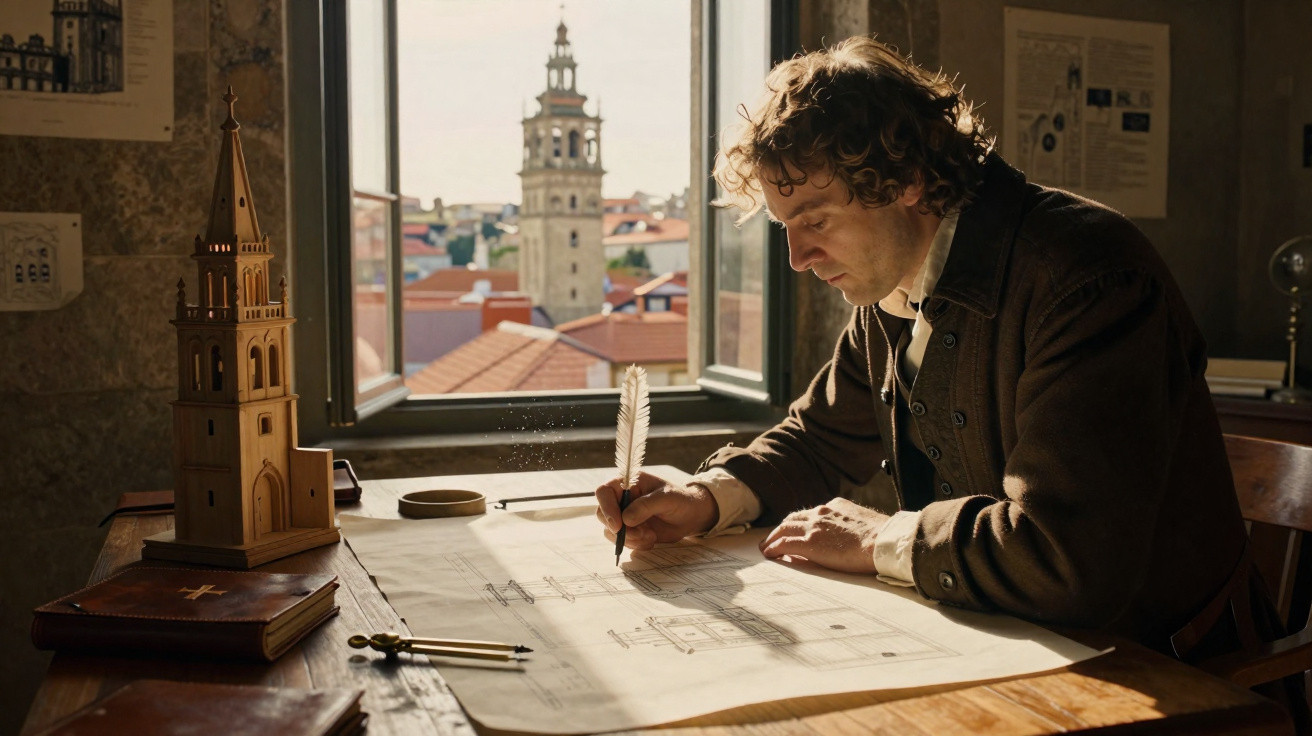
Like every clever, memorable saying that is sooner or later credited to Winston Churchill, Mark Twain, George Bernard Shaw or Oscar Wilde - a genuine magic square of aphorisms - every striking, vaguely Baroque building in northern Portugal will eventually find someone attributing it to Nicolau Nasoni, the Tuscan artist, born in San Giovanni Valdarno in 1691, who lived and worked in Porto for more than half his life.
The British writer Nigel Rees gave the first phenomenon the name “Churchillian drift”. The second has never been christened, but we might call it “Nasonian drift”, which is hardly very inventive; or, using an energy-related metaphor while paying tribute to all the architects whose place in art history was eclipsed by the Italian’s pull, something along the lines of “the great blackout”.
Curiously, this excessive and inaccurate dominance of authorship is not only misleading and unfair to forgotten artists whose credit has been erased from collective memory. It can also encourage the assumption that Nasoni enjoyed a long and ancient critical reputation, perhaps beginning as early as the 18th century, when he pursued his career and produced his work. In truth, however, this creator was only consecrated much later, in the 20th century, largely through the research of another foreigner: an American who fell in love with the art and architecture, especially the Baroque, that he encountered in Portugal and Brazil.
His name was Robert C. Smith. Born in Cranford, New Jersey, in 1912, he did not arrive in Portugal by the most direct route - in a straight line, as it were, from Harvard, where he studied, to the port of Lisbon or Leixões. Instead, he came by more circuitous paths, after a significant detour through Naples. There, his encounter with Luigi Vanvitelli’s drawings for the Chapel of St John the Baptist - a commission from the magnanimous King João V for Lisbon’s Church of São Roque - opened the way, in Smith’s own words, to Portugal.
It was the mid-1930s, in the early years of the Estado Novo, and this marked the beginning of an exceptionally long connection between an academic from America’s east coast and the heritage of Europe’s western tip: the Camõesian nation “where the land ends and the sea begins”. Driven by a desire to follow clues, and animated, according to those who knew him, by a hunter’s instinct, Smith naturally moved far beyond his initial aim of investigating the life and work of João Frederico Ludovice, architect of the Mafra Convent. His work prompted countless journeys and investigations from Minho to the Algarve. The triggers of his interest in Portugal - São Roque and the vast complex at Mafra - were ultimately overtaken, in terms of curiosity, by artistic expression in the north of the country, particularly work born of the creative genius of Braga’s André Soares (1720–1769) and Nicolau Nasoni.
By the end of 1725, Nasoni was already working for Porto Cathedral, decorating it with frescoes and contributing to the “Italianisation” that the times demanded of the medieval cathedral
Smith dubbed the former, responsible among many other projects for the design of the admirable Church of Santa Maria Madalena, on the border between Braga and Guimarães, and the lavish altarpiece at the Church of São Domingos in Viana do Castelo, the “architect of Minho”. He called the latter the “architect of Porto”, paying little heed either to Nasoni’s native Italy or to the constitutional complications of granting him Portuguese nationality. As both men were then forgotten, if not entirely ignored, in the latter half of the 20th century, the circumstances soon arose that can sometimes turn scarcity into abundance - or, in this case, into “Nasonian drift”.
From Malta to Porto
One peculiarity followed another. The “architect of Porto”, who was not from Porto, did not even arrive in the Invicta city as an architect, but as a painter. In a sense, Nicolau Nasoni was architecturally “constructing” Portugal while Portugal, in turn, was “constructing” the architect Nicolau Nasoni.
In the summer of 1725, he was still in Valletta, painting the galleries and corridors of the palace of the Order of the Knights of Malta. By the end of that same year - whose 300th anniversary fell in 2025 - he was already employed by Porto Cathedral, embellishing it with frescoes and helping to modernise and “Italianise” the medieval building as the period required.
What kind of period was this? In brief, King João V had been on the throne for almost two decades; Mafra, turned into a gargantuan building site from 1717 onwards, was on its way to becoming one of the greatest displays of Italian art ever assembled outside Italy; and Baroque expression, once the issues that had delayed its arrival in Portugal had been resolved, was finally becoming close to indispensable. Yet above all this, two misfortunes that proved beneficial - one concerning the artist and the other the city that received him - lay within the tangled sequence of events that brought Nasoni to Porto.
It appears that the painter - and here we come to the misfortune that befell him - may have concluded his stay on Malta with an unpleasant visit, accepted at the irresistible invitation of Inquisitor Antonio Maria Ruffo, to some dungeon of the Holy Office. According to accounts, the matter involved debts for artistic work supplied to the powerful and controversial organisation. Nicolau Nasoni had demanded payment from its senior figure: a mighty cardinal with a bad temper who apparently had little appetite for being challenged by the men he hired.
That account must, however, be balanced against other evidence that has survived concerning Nasoni’s character. Blinded by a love of money comparable in intensity to that of Gordon Gekko or Scrooge McDuck, the Italian had a habit of relentlessly wearing down his clients over fees. He was not always in the right, but he was always persistently insistent, and this complaining manner earned him the nickname “Piangoleggio” - a name suggesting a whiner devoted to lamenting trifles and minor grievances. If any quiet, ordinary citizen faced with a bore can find themselves fantasising about that person disappearing, it is hardly surprising that a commanding Inquisitor, with his patience being tested, promptly acted upon the fantasy.
The setback affecting Porto in the years before Nasoni’s arrival, meanwhile, was the absence of a bishop from the city since 1716, when Tomás de Almeida exchanged the episcopal seat of Porto Cathedral for the post of Patriarch of Lisbon. We do not know whether this prompted local resentment, as when a football manager swaps the dugout at the Dragão for the one at the Luz, but the fact remains that the northern diocese stood vacant for more than two decades. The term is amusing, seeming to suggest some connection with cattle or the drinks trade, but when a vacancy persists for too long it is really a revealing sign of dysfunction. That was precisely what occurred here: Porto remained without a bishop for a quarter of a century, while the dean, Jerónimo de Távora e Noronha, took charge of the cathedral’s affairs.
Given the nature of the role, this accidental leader could have confined himself to routine matters, much as a caretaker government in today’s democratic system does little more than keep things running until a new administration takes office. Dean Jerónimo, however, did not merely maintain the cathedral by fixing a latch here or replacing a pane of glass there. Instead, he embarked on a substantial programme of works both inside and outside it. Since he was the brother of a Knight of Malta and also related to that order’s Grand Master, the right conditions emerged to move Nasoni from the cells of the Maltese Inquisition to the right bank of the Douro - a distinctly more pleasant setting, even allowing for the familiar mist and the notorious greyish light.
No doubt overwhelmed by conflicting emotions - free at last, yet still without the money he believed he was owed - Nasoni began a new phase of life in Porto, although his professional category did not immediately change. As a master painter, he decorated pilasters, large windows, vaults and walls. At Porto Cathedral, he left not only a fine body of “illusionistic” painting, but also a series of informative inscriptions. This was a habit he had brought from Malta, and it now helps identify both the artist and those responsible for the commissions. It can even reveal the painter’s state of mind while at work, as Nasoni left clues to his own feelings carved in stone.
The illusion created by these early works came from trompe l’oeil - “deceiving the eye” in plain English - an art full of visual tricks which the Italian mastered and which surely eased his move into architecture. The relative obscurity to which he was condemned in his native land was, indeed, connected to the limited value historically attached to quadratura, the technique through which he brilliantly used perspective to create a three-dimensional effect on ceilings or walls. Nasoni was a master of this craft, “opening up” imaginary spaces with brush and paint that deceived even the most attentive observer, and simulating doors, staircases and windows that an unsuspecting person might wish to enter, climb or open for fresh air. Yet if, in the land of the blind, the one-eyed man is king, then on Krypton, Clark Kent’s home, a human being with two perfectly sound eyes is little more than blind. Beneath the Apennines, to Nicolau’s misfortune in artistic terms, supermen were everywhere.
In Portugal, by contrast, recognition came swiftly. Unlike the Italian peninsula, where interpreters of the “Italianised” style fashionable throughout Europe and beyond were naturally plentiful, Portugal had few people capable of designing and executing the lavish aesthetic drama that defines Baroque buildings. High demand and limited supply - a principle studied earnestly in economics courses and learned painfully in estate agents’ offices - sends prices soaring, and that was music to the eager ears of our greedy “Piangoleggio”.
The ideal circumstances were therefore in place for Nasoni’s transition: from painting, which he already practised through the three-dimensional logic inherent in quadratura, to architectural design, where three-dimensionality ceased to be a mere sensory deception and became material reality in the landscape through the joining of thousands of stones, pieces of iron and lengths of timber.
Clerigos first
Because there is inevitably a time gap between the design of a building and its opening - one that, for the countless projects never built, can extend to mathematical infinity - it is always difficult to arrange an architect’s works in chronological order. Yet this task matters when assessing development, influences and changes of mind. Even if Nasoni sketched some of the structures he left at Porto Cathedral while he was first painting there, it would not be far wrong to say that the first project of his life was also the one that became the great project of his life: Porto’s incomparable landmark and, apparently, Portugal’s tallest building for around 200 years, surpassed only by the Sheraton hotel in Picoas during the 1970s.
This is, of course, the Clérigos complex. Its still-prominent presence in the city skyline not only reveals Portugal’s historic prejudice against verticality - even in the Gothic period, with full religious backing, the trauma of Icarus could not be overcome - but also shows urbi et orbi what the Nasonian style consisted of: a broad fusion of inspirations, ranging from Roman Baroque to Portuguese architectural tradition, adapted and constrained by the dominant building material, the one most readily available and the reason Orlando Ribeiro called northern Portugal the “civilisation of granite”.
How such a hard stone can be shaped for so many different purposes is one of those paradoxes that fascinates scholars and must surely have impressed the Italian. It is true that his buildings cannot arouse an emotional vertigo comparable, for example, to that created by San Carlino in Rome, by the architect Francesco Borromini (1599–1667). But that inventive and brilliant artist - unquestionably a true genius - formed the undulating complexity of his curves and counter-curves using pliable, cooperative brickwork, render and stucco, travertine and some marble. Nicolau Nasoni, on the other hand, had to learn through practice rather than at any engineering faculty the hard, laborious meaning of “strength of materials”.
Further south, in the “civilisation of clay” - an expression that might have seemed provocative had it come from a Porto native rather than the Lisbon-born Orlando Ribeiro - the Italian’s Baroque might have been more distinctly concave and convex, more dynamic and theatrical. That does not diminish his achievement in working small miracles under stony constraints, or in giving his buildings such a consistent visual identity that a major northern paint manufacturer named one granite-inspired shade in its catalogue “Nasoni grey”. It remains another exaggeration, since Porto already had the “face of masonry” sung of by Rui Veloso before 1725 and before Nicolau arrived. Still, if the excess helps increase exports of colourants, the trade balance will offer no objections.
What is hidden
“Soft water on hard stone, dripping long enough, will make a hole” was, by all accounts, the working method of the architect and the hundreds of skilled stonemasons and carvers who, chisel and mallet in hand, transformed rough stone into defiant towers, church façades, estate gateways, houses and palaces that proclaimed wealth and power.
Beyond the Clérigos complex, where Nasoni was eventually buried as a “poor brother” - he had belonged to the Brotherhood of the Clerics since 1743, though there is still debate about whether “poor” referred to his status within the brotherhood or whether Nasoni truly managed to squander his entire fortune before dying - a number of other churches enriched by the maestro’s hand also stand out. Some are in Porto, such as the Misericórdia, filled with flaming urns, festoons, volutes and coats of arms. Others lie near the Invicta city, notably Bom Jesus de Matosinhos, which delighted José Saramago in his Journey to Portugal. Others are farther away, including Lamego Cathedral, extensively renewed during the reign of João V, where the Italian played a decisive role, spectacularly completed by decorative paintings on the vaults of the cathedral’s three naves.
From 1716 onwards, Porto remained without a bishop for a quarter of a century, while the dean, Jerónimo de Távora e Noronha, managed the city’s cathedral
All these works are, however, very well known to both local people and tourists. They do not need to catch the train of celebrations marking 300 years of Nasoni in Portugal in order to become famous. Those celebrations may be better used to reveal what is more concealed, or even forgotten: above all, the traces of a wider old Porto, where secular or religious, aristocratic or bourgeois elites used the peace of undeveloped land to establish their extensive and tranquil estates - or, in the language of the man who embellished them, their tenute di campagna.
“Alfoz”, a term that today might bring to mind some pizzeria in western Porto, is seldom used now, but it was once highly significant. In the past, a municipality could extend beyond the town or city that gave it its name into surrounding territory, often of immense size and diversity. Porto’s alfoz stretched from the sea to Penafiel and from Gaia to the River Ave, encompassing land that now belongs, among other places, to the municipalities of Vila do Conde, Gondomar, Maia and Matosinhos. It is mainly in the last two, together with the boundary areas of Porto itself, which retained a strongly rural character until quite recently, that these Nasonian estates can be found: expansive properties worked on by Nicolau Nasoni, or else built in a style so similar that they are still wrongly attributed to him in the “drift” described at the beginning of this article.
Some, such as Prelada - a major landscape project, generously supplied with statues, fountains, stairways, a castellated tower and even a Kubrick-like boxwood maze, though without snow - or Freixo, with its extraordinary palace of four distinct façades, one facing the Douro, are well known. This is partly because they are more or less freely accessible. Those with sufficient means can even sleep amid the Nasonian atmosphere of Freixo’s gardens, now home to a five-star hotel.
Others, though, remain relatively closed and out of sight. This is the case with the sister estates of Ramalde and São Gens, now considerably altered and occupied by public services. The latter, despite housing a rich collection of statuary and being one of the best examples of Nasoni’s skill as a sculptor, only occasionally offers guided visits.
Even more inaccessible to the public, unfortunately, are the interiors of the fabulous Quinta do Chantre - a strong contender in any contest for the “best Italian villa outside Italy” - an understandable restriction because it remains a private residence. The grounds of Quinta dos Bispos, near Francisco Sá Carneiro Airport, are similarly off limits. Probably the first property of this type on which he worked, it gave the princes of the Church, in an age before aircraft noise, every aesthetic condition for rest and reflection. The reason for its closure is equally easy to understand: since 1939, it has served as a prison.
It is a powerful sign of Portugal’s wealth of heritage that a Nasonian tenuta di campagna of dozens of hectares - the place where the Bishop of Porto gathered humanists and poets in a spirit of rural retreat, the “Parnassus of the River Leça”, and which was once regarded as one of the largest and finest leisure spaces on the Iberian Peninsula - should eventually have been turned into a nick, a jail, a lock-up, a prison, a cell: everyone may choose whichever term seems funniest, for they are all magnificent. Yet since a prison was, to a considerable extent, responsible for Nicolau Nasoni’s Portuguese adventure, perhaps this monumental absurdity should be regarded as a kind of tribute.





Comments
No comments yet. Be the first to comment!
Leave a Comment