
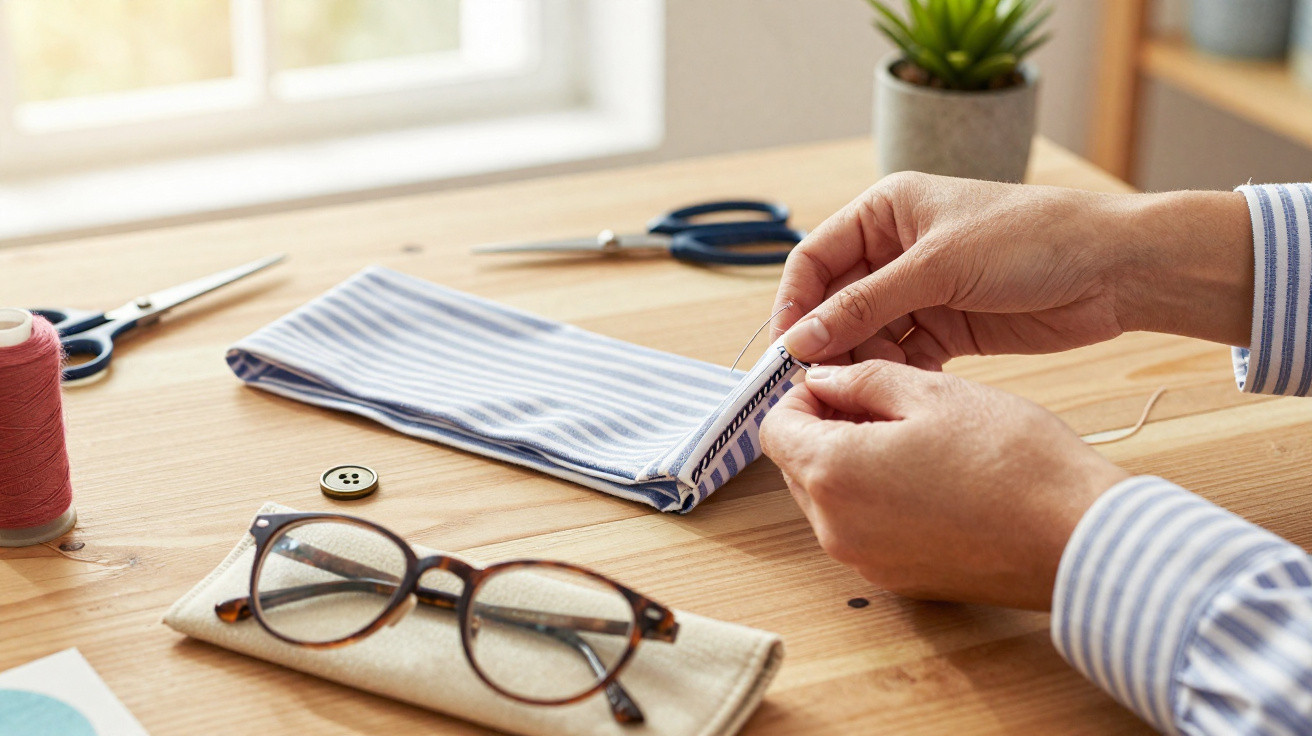
Countless shirts sit in wardrobes with greasy collars or elbows worn thin. Most end up in a textile recycling bank or straight in the bin. Yet every cuff contains a small piece of textile engineering that can be put to purposeful use: creating a glasses case that is not only useful, but also looks surprisingly premium.
Old shirt, new purpose: why the cuff is so valuable
When people pick up a shirt, the cuff is rarely the first feature they consider. However, it is precisely the key to this sewing project. Reinforced and neatly finished, the cuff already has everything a good case requires: structure, an opening, a button and a buttonhole.
“The wrist section already contains a ready-made miniature case – it simply needs to be cut away and sewn shut.”
Many shirt cuffs contain a special interfacing that gives them their shape and firmness. Acting like an integrated shock absorber, this layer helps protect delicate spectacle lenses from minor knocks in a handbag or rucksack. At the same time, the cotton remains soft enough to avoid scratching them.
This mix of firm interfacing and pleasant outer fabric is exactly what makes the material so appealing to upcycling enthusiasts. Rather than buying additional fabric, a fastening and reinforcement, you can use what is already there.
Step by step: from sleeve to glasses case in 15 minutes
This project is ideal for sewing beginners wanting to try something practical. A sewing machine is quicker, although a few hand stitches work just as well.
What you need
- 1 cuff from an old shirt sleeve, preferably cotton or poplin
- Scissors
- Sewing thread, a needle or a sewing machine
- Optional: a small piece of microfibre cloth
- Optional: thin lining fabric for delicate glasses
Turning a sleeve into a case
- Lay the shirt sleeve flat and slide the glasses into it as a test to estimate the required length.
- Cut straight across roughly 20 centimetres above the cuff. The sleeve now forms a fabric tube, with the cuff at one end.
- Turn the tube inside out, so the inner side faces outwards and the cut edge is exposed.
- Align the cut edges neatly and secure them with pins if necessary.
- Sew this edge closed with a straight seam, either by machine or using firm hand stitches.
- Finish the seam with a zigzag stitch or by hand to prevent fraying.
- Turn the tube right side out again: the cuff now becomes the opening of the glasses case, while the sewn section forms its base.
If you wish, sew a small microfibre cloth into the base seam before closing it. It will then be permanently held by the seam and hang inside the case – ideal for quickly cleaning lenses whenever needed, without ever misplacing the cloth.
Why the reinforced cuff protects glasses so well
The cuff section is considerably more robust than the rest of the sleeve. Its reinforced interfacing provides several benefits:
- Sturdy edge: The opening retains its shape, even when the case is carried in a bag every day.
- Gentle protection: The interfacing cushions light impacts, while the cotton sits softly against the lenses.
- Secure fastening: The button and buttonhole are already sewn on and ready to use.
- Easy care: The case can be machine-washed in exactly the same way as a shirt.
“Instead of an expensive hard case, an old shirt becomes lightweight, padded protection that is entirely sufficient for everyday use.”
Anyone carrying plenty of keys or hard objects in a bag benefits from this combined effect: the cuff keeps its shape, the fabric layers absorb impacts, and the glasses stay dependably in place.
Finishing touches: make your glasses case more individual
The real appeal of this project is not just the speedy result, but also the design possibilities. Hardly any two cases will look alike.
Small changes, big impact
- Replace the button: A metal button or one in a contrasting colour gives the case a more elevated appearance.
- Label or initials: A small woven label or embroidered letters make the item more personal.
- Adjust the width: For narrow frames, add a second seam along the long side to make the tube slimmer.
- Inner lining: Sew in a thin, especially soft lining for highly delicate glasses.
Using a shirt with stripes, checks or a bold print automatically creates an interesting look. Even formal shirts with subtle stripes suddenly appear far more fashionable in case form.
More than a gimmick: sustainability that is enjoyable
Textile waste is an increasing problem. Everyday life quickly produces clothes that are no longer worn but still contain perfectly good material. This idea starts there, allowing several useful items to be made from one shirt.
| Shirt section | Possible new use |
|---|---|
| First cuff | Glasses case with button fastening |
| Second cuff | A second case for sunglasses or as a gift |
| Body section | Flat zip pouch or tablet sleeve |
| Button placket | Pen case with a row of buttons as the fastening |
Projects of this small scale do more than reduce the pile of waste: they make the idea of a circular economy tangible. Instead of an abstract climate figure, you create something you hold in your hands every day. Many people report that visible results like these encourage them to reach for needle and thread more often.
Tips for everyday use and lasting durability
To ensure the case lasts for more than one summer, it is worth paying close attention to finishing and care:
- Sew the base truly straight, using a sufficiently short stitch length.
- Finish fraying edges consistently so that nothing comes undone.
- Use cotton thread that withstands washing temperatures as well as the shirt does.
- Wash the case regularly with delicate laundry so dust and dirt cannot cause fine scratches.
Those using particularly heavy frames or frequently carrying the case in a rucksack can also add a thin layer of felt between the inner and outer layers. This extra padding offers slightly more protection without making the case bulky.
Who benefits most from this project
Many people own several pairs of glasses: work glasses, sunglasses and reading glasses. Ready-made cases are often bulky, get lost or are simply dull. The shirt project produces several covers that are clearly different from one another.
The idea is also ideal for:
- Students who want fashionable cases without a large budget
- Families that regularly have old shirts available
- Sewing beginners who need a quick sense of achievement
- People who enjoy giving small handmade gifts
There is another side effect: once you have seen how much potential lies in a simple cuff, you begin to look at other old textiles differently. Future sewing projects almost suggest themselves – from a key lanyard made from a leftover tie to a cable pouch cut from a T-shirt.
A simple quarter-hour project therefore becomes more than an attractive accessory: it changes how you view clothing that appears to have reached the end of its life, and demonstrates how easily supposedly unwanted items can become practical objects for everyday use.






Comments
No comments yet. Be the first to comment!
Leave a Comment