
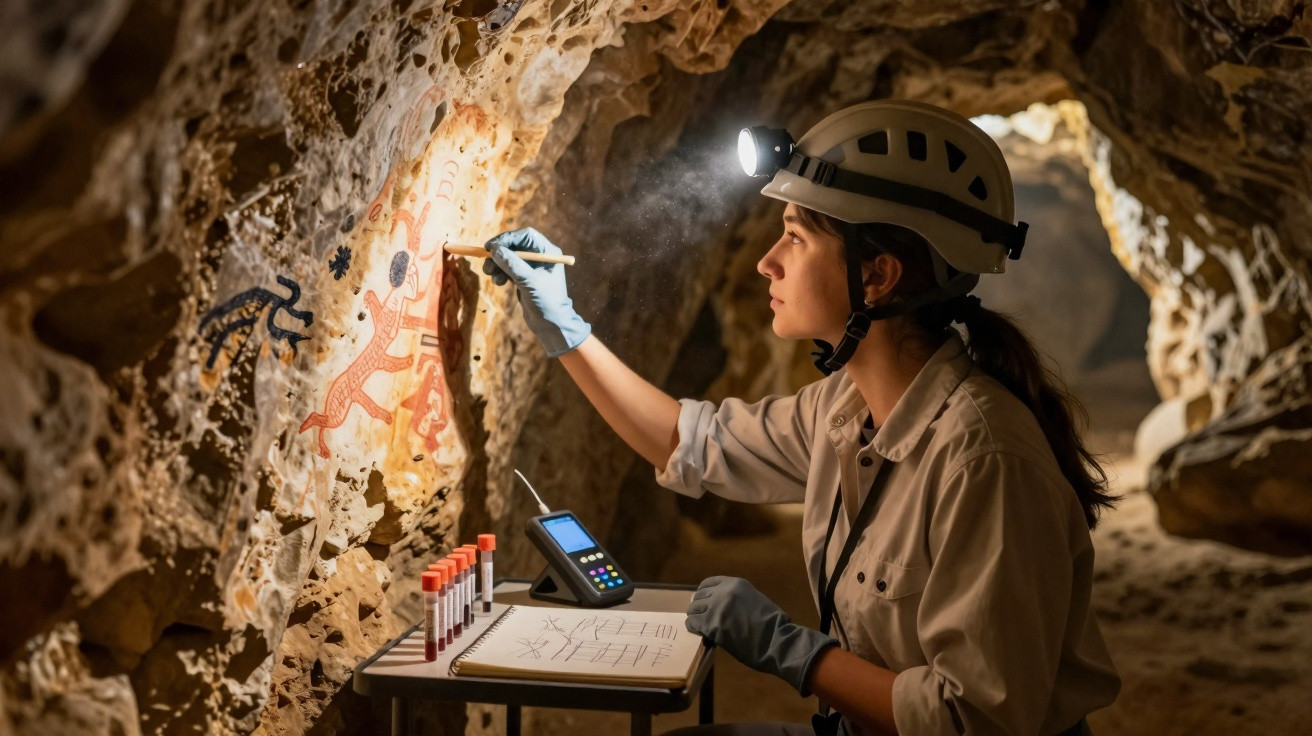
Painted caves have captivated the public for well over a century. Their animals, handprints and enigmatic symbols on exposed stone offer a glimpse of a world that is now almost impossible to imagine.
But the people who created this art have remained anonymous. We have been able to appreciate their images without knowing whose hands prepared and applied the pigment.
That gap may now be narrowing. Researchers working in Spain and Portugal have extracted ancient human DNA directly from cave walls, including areas that prehistoric people may once have touched.
DNA concealed within cave rock
The research emerged from the First Art project, which establishes dates for the earliest cave art and examines the composition of its pigments.
Experts from the Max Planck Institute for Evolutionary Anthropology (MPI-EVA) in Germany became involved to introduce genetic testing to the project.
Their central question was straightforward: might the rock itself have retained genetic evidence from the artists?
Hipólito Collado Giraldo, an archaeologist at Spain’s Extremadura Government, assembled the research team.
“We know that some of the art was applied to cave walls by blowing or rubbing pigment onto the surface,” said Collado Giraldo.
“‘Given the enormous sensitivity of current ancient DNA analysis techniques, we were eager to see if this type of contact could leave traces of DNA in the rock art, potentially allowing us to obtain genetic profiles from the makers of the art.”
Painted cave produces human DNA
Researchers examined 24 rock-art panels in 11 caves. Their samples included painted mineral crusts, unpainted wall sections, sediment, bones and even an uncommon bird-bone implement formerly used for spraying paint.
Most samples produced no helpful result. Of the 54 samples taken, just five contained authentic ancient human DNA.
A successful sample came from a pigmented calcite crust on Panel 11 in Portugal’s Escoural Cave. It contained human DNA and, unexpectedly, no animal DNA whatsoever.
This lack of animal DNA is more significant than it might appear. Cave sediment nearly always contains a mixture of animal DNA, meaning an uncontaminated human-only signal indicates direct human contact.
Bare cave walls also retained DNA
The more striking finding came from ordinary, unpainted rock. A number of bare-wall specimens from Escoural and Covarón Cave in northern Spain, originally collected as negative controls, likewise contained ancient human DNA.
“Although we cannot directly connect the traces of ancient human DNA we have found to the creation of rock art, this is the first evidence for human DNA preservation on cave walls for thousands of years,” said study first author Alba Bossoms Mesa, a doctoral researcher at MPI-EVA in Leipzig.
“It is exciting to think that we may have uncovered a new way to study prehistoric human presence.”
Human DNA without animal DNA was found in two of the five samples, strongly indicating that it was deposited by a person through saliva or another bodily fluid.
The remaining three samples combined human and animal DNA, suggesting an indirect source, such as sediment transferred by hands or flowing water.
Cave walls without visible traces of activity
Nuclear DNA from two Covarón specimens placed the individuals within the Western hunter-gatherer group, consistent with findings for other ancient people in the area.
The researchers were also able to identify biological sex in certain samples: three showed predominantly female DNA, while one showed predominantly male DNA.
“This study fundamentally changes how we think about where ancient DNA can be found. We were surprised to see that ancient DNA can be recovered not only from pigmented samples, but also from cave walls that show no visible evidence of past human activity,” said study senior author Matthias Meyer.
“We can now ask new questions: Who touched this wall? Was it a man or a woman? Which population did they belong to? How far did ancient humans venture into deep cave systems?”
Exploring how prehistoric people used caves
Because the DNA has not been dated directly, the team assessed its age through molecular damage and the history of each cave.
The DNA is at least 2,000 years old and is probably considerably older. At Escoural, the site’s history raises the minimum age to about 4,000 or 5,000 years.
One experiment failed in an informative manner. A prehistoric bird-bone airbrush from Altamira Cave, previously used to blow red ochre on to rock, yielded no ancient human DNA.
The likely reason is that decades of handling have obscured it with modern DNA.
“This is not just about rock art,” said Collado Giraldo. “It’s about understanding how people used caves and where they left their marks.”
Why ancient DNA seldom endured
Genuine DNA was detected on only one of the 24 painted panels, as well as at a few nearby locations.
It appears that painted areas rarely preserve DNA over millennia unless they are protected by a mineral crust or a sealed chamber.
“The preservation of human DNA on cave walls is highly variable,” said Bossoms Mesa.
“But when it does survive, it tells a powerful story. And while these first results are promising, I think our priority now should be to refine the methods and to understand under what conditions we can expect a higher success rate.”
Cave walls as archives of human presence
The broader potential extends far beyond rock art.
In future, cave walls may reveal which populations used a cave, how far inside they travelled, and whether particular areas were used by men or women - without disrupting the ground beneath them.
“This is just the beginning,” said Meyer. “We now know that cave walls are archives of past human presence.”
“The next step is to test more sites, art styles and techniques, especially hand stencils and figurative art in caves with good molecular preservation, as far as minimally invasive sampling allows.”
Image credit: © Matthias Meyer





Comments
No comments yet. Be the first to comment!
Leave a Comment