
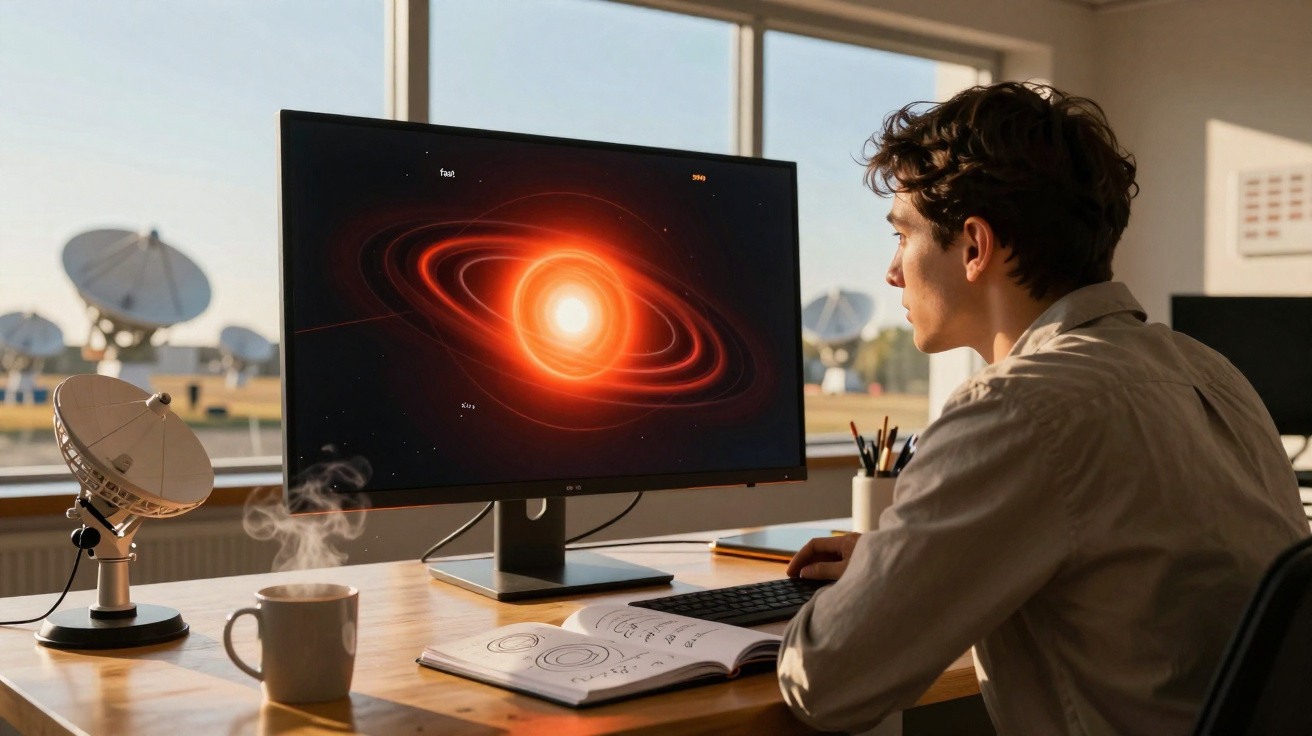
Photographs are generally understood as records of a single instant.
Whether it is a quick picture capturing a favourite memory or a long exposure following the gradual arc of stars through the night sky, an image usually has a simple connection to time.
Near black holes, though, that connection breaks down.
Because spacetime is warped so extremely in these environments, one image can contain light that departed its source at different times before reaching an observer. Physicists commonly account for this complication with “fast” and “slow” light models.
In a paper accepted for forthcoming publication in Physical Review D, physicists Daniel Rojas-Paternina of the National University of Colombia and Alejandro Cárdenas-Avendaño of Wake Forest University have established when these concealed differences in light-travel time are significant, and when they may be disregarded safely.
"A useful starting point is an ordinary photograph," Cárdenas-Avendaño told ScienceAlert.
"A camera records photons that arrive at the detector during a short exposure. Those photons did not all leave the object at exactly the same time… But because the speed of light is so large, we normally treat the photograph as a record of one instant."
Black holes and images across time
Scientists have so far succeeded in imaging two supermassive black holes: M87* in a faraway galaxy and Sgr A* at the centre of the Milky Way. Naturally, these pictures do not reveal the black holes themselves.
Instead, the images depict a dark shadow encircled by a bright orange halo. This luminous ring is produced by a whirlpool of superheated gas orbiting the black hole in an accretion disc, glowing strongly enough to be photographed from tens of millions of light-years away.
By pairing observations with advanced simulations, researchers can create models showing how this material evolves with time. They can then test observations against theory and even generate simulated films of matter and light moving around a black hole.
The speed of light in a vacuum remains one of the Universe’s fundamental constants; the new study does not alter it. The labels “fast” and “slow” light instead refer to models describing light’s journey around a black hole.
"The gravity of a black hole can bend light very strongly," Cárdenas-Avendaño said.
"Some photons can take nearly direct paths to us, while others can loop around the black hole before reaching the detector. This means that photons arriving in the same image frame may have left the emitting gas at different times."
Fast light and slow light models
The fast-light model approaches black-hole observations much as you would a photograph of your dog, overlooking the minute differences in when the photons started their journeys. Light from her snoot might have been emitted a fraction later than light from her tail, yet the picture is accepted as one instant.
By contrast, the slow-light model retains those delays.
Keeping the time-delay data in the slow-light model, however, has a price. It is much more computationally costly, meaning physicists can sometimes choose the fast-light model for greater simplicity and speed.
"In fast light, one takes one snapshot of the accretion flow and images it. Then one moves to the next snapshot and repeats the process," Cárdenas-Avendaño explained.
"In slow light, even one image frame may require many snapshots of the accretion flow, because different pixels correspond to different emission times."
Earlier research had indicated that the fast-light approximation was sufficiently accurate for numerous observations.
Consider an emitting accretion disc that barely changes from one moment to the next. In that case, it makes little difference if one photon was emitted slightly after another: in effect, the scene remains the same.
Now consider turbulent gas flashing violently, as clumps and eddies speed around the flow. A single frame could then contain photons from both before and after a flare, making the time difference suddenly highly important.
Ultimately, the issue is a contest between two clocks: the rate at which the glowing gas changes and the range of the photons’ travel times.
Brisk light and future black hole observatories
To close the divide between fast and slow light, the team proposed a compromise they call brisk light, which is neither entirely fast nor entirely slow.
"Fast light collapses the whole image to one source time. Slow light keeps the full time-delay map across the image. Brisk light is an intermediate prescription," Cárdenas-Avendaño said.
"It keeps the dominant time-delay structure while reducing the computational cost relative to full slow light. In some cases, it approaches the slow-light result without requiring the full expense."
Encouragingly, the celebrated images of M87* and Sgr A* do not need to be reconsidered. Those black holes were observed from angles for which the fast-light approximation remains effective in Event Horizon Telescope images.
The greater benefit could arrive with the next generation of black hole observatories, designed to work in conditions where fast-light timing may produce an image that looks correct but contains inaccurate timing information.
Future observatories, including the Black Hole Explorer, aim to investigate subtler structures such as photon rings, in which the relative photon arrival times form part of the signal.
The photon ring signal is governed chiefly by the geometry of spacetime surrounding the black hole rather than by the moving accretion material. Since the ring is created by photons following different routes around the black hole, preserving the hidden time delays becomes much more crucial.
"We would not be seeing the accretion flow at a single instant. Each frame would combine light emitted at several different times," Cárdenas-Avendaño said.
"In that limited but precise sense, a black-hole movie is stranger than an ordinary movie."
At present, the Event Horizon Telescope collaboration is attempting to make a film of M87*. Sharp, detailed observations of the activity around a black hole remain distant, but we are nearer than ever before to watching one at work.
When that moment arrives, every frame will contain far more than it seems: a time machine exposing several moments from the recent history of one of the Universe’s most unusual spacetime regimes.
The paper has been accepted for publication in a forthcoming issue of Physical Review D. In the meantime, the preprint is available on arXiv.
This article was fact-checked by Rebecca Dyer and edited by Michael Irving. While we pride ourselves on our process, we are only human. If you spot a mistake, please let us know.





Comments
No comments yet. Be the first to comment!
Leave a Comment