
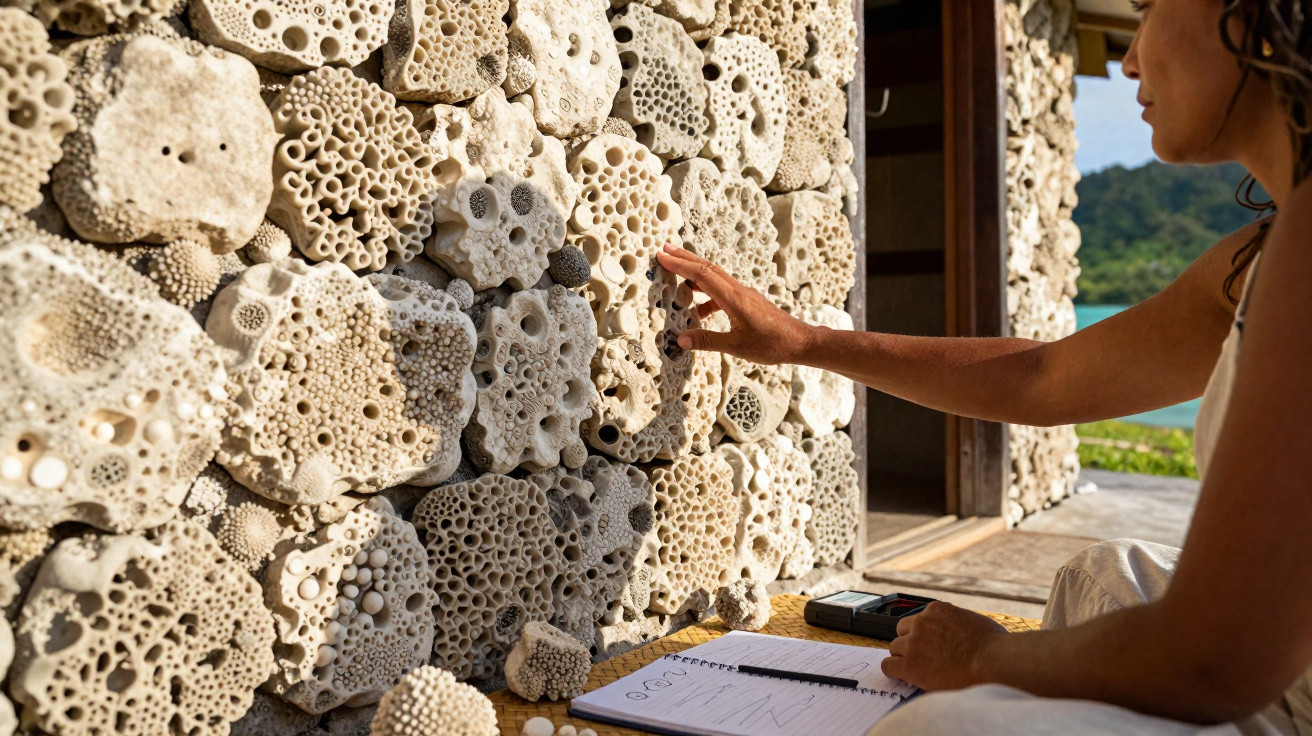
Coral houses in French Polynesia are enabling scientists to reveal previously unseen accounts of the past.
Using a contemporary dating technique, a team of archaeologists has established when these homes were constructed and explored how their residents lived.
The findings demonstrate how culture, everyday life and colonial influence moulded Pacific communities.
A new approach to studying historic homes
Researchers at the University of Sydney applied uranium-thorium dating, or U-Th dating, to establish the age of coral incorporated into buildings. The technique delivers highly precise results without the need for extensive excavations.
Previously, archaeologists commonly relied on finds such as coins and pottery to approximate dates. Such evidence was not invariably reliable, as these items may have reached a site years after they were produced.
By dating the construction material itself, the newer approach addresses this problem. It allows researchers to create a more dependable and clearly defined chronology.
Life in the Mangareva islands
The research examined Mangareva, an island group in French Polynesia encircled by coral reefs. Before a move towards timber during the late 19th century, coral was a principal construction material there.
“Mangarevan people learned the building technique from French Catholic missionaries who arrived on the island in the 1830s and commenced a large construction program,” said Professor Flexner, lead author of the study.
Historical sources indicate that missionaries arrived in 1834, after which they began constructing churches, schools and other buildings. They also taught local residents European building techniques.
Yet surviving written accounts largely focused on missionary structures, overlooking the ordinary homes occupied by local families.
How coral houses were constructed
Archaeological surveys indicate that compact stone cottages were Mangareva’s most widespread type of home. They accounted for over half of all structures identified across the islands.
Builders formed corners and door surrounds from durable beach rock or volcanic stone, with coral blocks used to fill the walls.
Building began in the late 1830s and continued until wooden homes gained popularity in the 1870s. This construction also altered the landscape, with builders sometimes repurposing materials from older sacred places known as marae.
This demonstrates the ways colonial influence transformed both the environment and culture.
Hidden accounts within coral walls
The team took coral samples from a range of buildings and analysed them at the University of Queensland’s Radiogenic Isotope Facility. Results indicated that numerous houses were built during the 1830s and 1840s.
“What surprised us was that several coral blocks returned dates earlier than expected,” Associate Professor Flexner said.
Certain pieces of coral predated the buildings because people had reused material or selected coral that had died before construction began.
Within the homes, archaeologists recovered artefacts including glassware, iron implements, bones and cooking materials. A pit in one house held a substantial quantity of food remains and objects, indicating that it was associated with a large feast.
Dating evidence established that the house was erected shortly after that event, creating a direct connection between building work and daily life.
“These coral cottages are a microcosm of life itself. They are a huge potential source of information on the social, cultural and cosmological ways of being for Pacific peoples,” said Associate Professor Flexner.
Interpreting dates and their limitations
Although U-Th dating produces exceptionally precise findings, it cannot always identify the precise year in which a house was constructed. Instead, it indicates when the coral ceased growing, which may have been years before it was used.
For instance, coral may have died and remained on the reef for a period before builders collected it. This can create a short interval between the coral’s age and the date of construction.
To develop a full picture, scientists assess the results alongside other evidence, including artefacts and written documents.
Despite this constraint, the technique remains highly valuable. It creates more accurate chronologies than earlier methods and enables researchers to assess how rapidly change occurred.
Culture and change after colonisation
Coral houses offer insights beyond construction practices, revealing how life altered following contact with Europeans.
Objects recovered from homes point to changes in cooking, eating and everyday habits. They also provide evidence of how residents used interior spaces and observed religious practices.
“Using the uranium-thorium dating method, we can date the construction materials used in the buildings with remarkable accuracy, giving us more clues to cultural and domestic life in the Pacific and deepening our understanding of colonial heritage,” said Professor Flexner.
“Smaller timescales can make a big difference for interpreting the past.” Even a difference of several years can assist historians in determining how swiftly cultural shifts occurred.
Coral as an environmental record
Coral blocks contain environmental evidence as well. Every piece preserves chemical traces of the sea conditions in which it developed, making coral buildings useful for investigating earlier reef environments.
“People think of coral mainly in the context of bleaching and climate change today, but each coral block used for the construction of these houses retains a chemical record of the environment in which the coral grew, offering a historical archive of coral reefs and past ecological change,” said Professor Flexner.
This link between environmental information and human history gives these buildings an additional level of significance.
A route for future research
The study demonstrates that U-Th dating can allow researchers to investigate historic buildings with far greater precision. It is particularly valuable in locations where written sources are absent or incomplete.
“Expanding the U-Th method to date coral houses as we have done in Mangareva could revolutionize the study of undocumented architecture and people in other pre-European as well as colonial contexts beyond Oceania, including Africa and the Caribbean,” noted Professor Flexner.
The research group intends to keep collaborating with local communities to safeguard the sites and gain further knowledge from them.
“We are actively partnering with communities and local authorities to strengthen conservation and heritage protection in these regions so we can continue to piece together the stories of the past and build a more informed and sustainable future,” said Professor Flexner.
Image credit: James Flexner




Comments
No comments yet. Be the first to comment!
Leave a Comment