
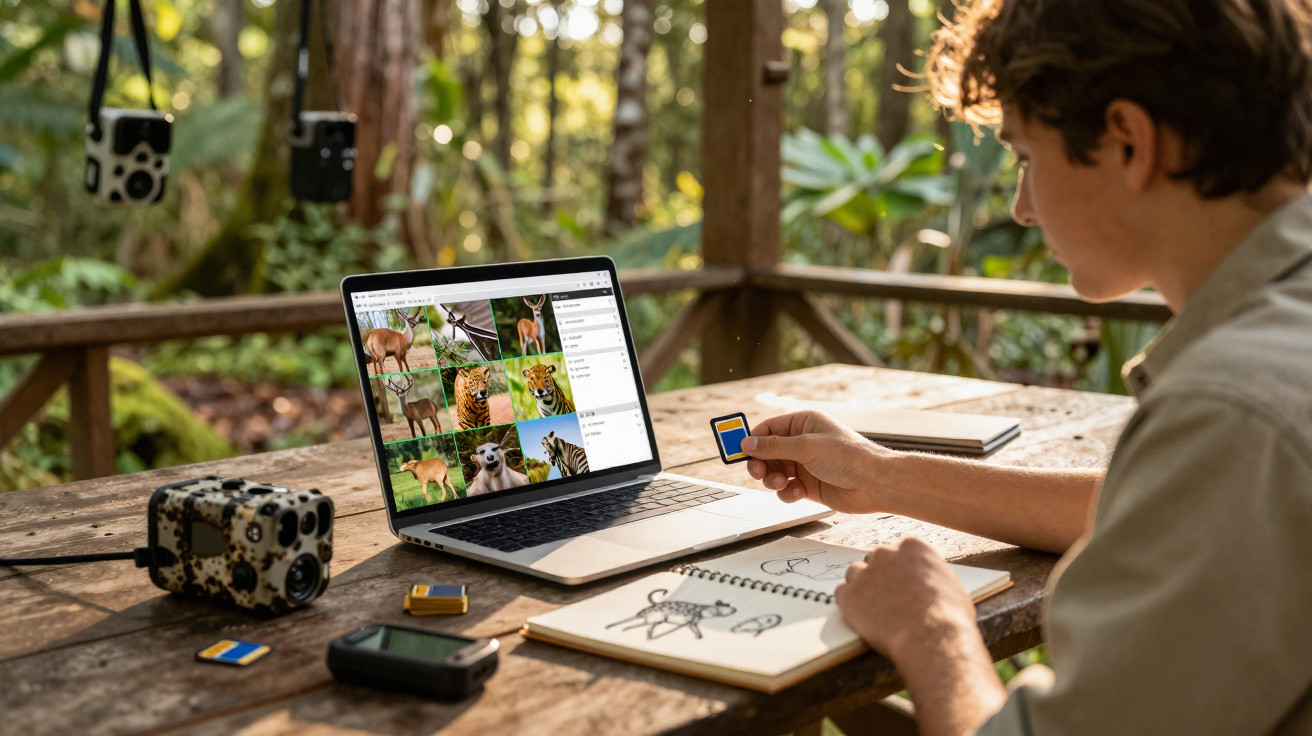
Tracking wildlife with remote cameras is among the most useful tools available to conservation scientists – and also among the most frustratingly slow.
One project alone may produce millions of photographs, and, until recently, every image needed to be examined by a person.
New research indicates that AI can now complete most of this work nearly as effectively as a trained human, reducing a task that once consumed much of a year to just days.
Daniel Thornton, a wildlife ecologist at Washington State University, led the study. Dan Morris, a senior staff research scientist at Google, co-authored it.
The researchers tested a fully automated AI system on camera-trap images collected in Washington state, Glacier National Park in Montana, and Guatemala’s Maya Biosphere Reserve.
Challenges with remote cameras
Camera traps are an ingenious concept: researchers enter a forest, attach a motion-triggered camera to a tree, leave it in place, then return several months later.
When used properly, they record animals that would never accept a researcher nearby – wolves, grizzly bears and jaguars travelling through darkness with no awareness of the camera.
The less appealing stage begins when the memory card is reviewed.
Most of the images show nothing at all. Around 60 to 70% are blank shots, activated by wind gusts, moving branches or leaves passing the lens. Removing these images is dull work, but relatively manageable.
The long wait for camera trap data
Even so, tens of thousands of remaining photographs still contain animals, and a human must inspect each one to determine the species shown.
Thornton is very familiar with this workflow. Typically, it involves hiring a group of undergraduates, asking a postgraduate student to verify their work, then labouring through the images for six to seven months before meaningful analysis can start.
That is an extended delay. Conservation managers deciding on land use, hunting rules or habitat protection require up-to-date information, rather than data from a field season that finished a year earlier.
What the scientists tested
Previous AI tools addressed only part of the issue, largely by removing blank images. Although useful, that did not fully resolve the problem.
Thornton and Morris instead investigated whether AI could also perform the species identification itself, without any human checking.
They processed the photographs through a fully automated system based on SpeciesNet, a general AI model created by Google, and directly compared its output with datasets painstakingly labelled by human specialists. They then considered the crucial issue: did the differences affect the outcome?
Useful results in days
The team assessed important measures, including where animals are found, which environmental conditions influence their presence and how they are distributed across a landscape.
Results produced by AI corresponded with human-reviewed findings in approximately 85 to 90% of cases.
As with any system, the AI made errors, occasionally identifying an animal incorrectly or failing to detect one.
However, the ecological findings researchers rely on remained sound. The statistical models used draw on patterns across numerous observations over time, rather than requiring every individual photograph to be flawless.
“The key question wasn’t whether the AI got every image right,” Morris said. “It was whether the ecological conclusions you care about would end up being basically the same.”
For most species, the conclusions were essentially the same. Processing also took days rather than months.
Who this system helps
At large, well-funded research institutions, quicker processing is beneficial but not transformative. Such organisations already have the personnel and infrastructure to work through the images in time.
The greater benefit is for others: smaller conservation organisations, poorly funded research teams and groups operating in remote regions of the world with scarce resources.
These groups may currently be left with months of camera-trap data that they cannot process quickly enough to act upon.
A tool that shortens the process from six months to several days does more than save time; it alters what can be achieved.
Researchers could also work on a larger scale. Once processing is no longer the limiting factor, they can install more cameras, survey wider areas and monitor additional species without being constrained by the time required to analyse the returned data.
“The big takeaway is that this doesn’t have to be a bottleneck anymore,” Thornton said. “If we can process data faster, we can respond faster, and that’s really what matters for conservation.”
Where the system still struggles
The paper does not exaggerate what the technology is currently capable of.
The 85 to 90% agreement is robust for common species and conventional ecological analyses, but becomes less reliable for rare animals or species that closely resemble others.
Such images still require human review, and are likely to do so for some time.
The research examined only one particular form of analysis. More in-depth work, including behavioural studies and population estimates for elusive species, continues to need human assessment.
“We’re not trying to replace people,” Thornton said. “The goal is to help researchers get to answers faster so they can make better decisions about managing and conserving wildlife.”






Comments
No comments yet. Be the first to comment!
Leave a Comment