
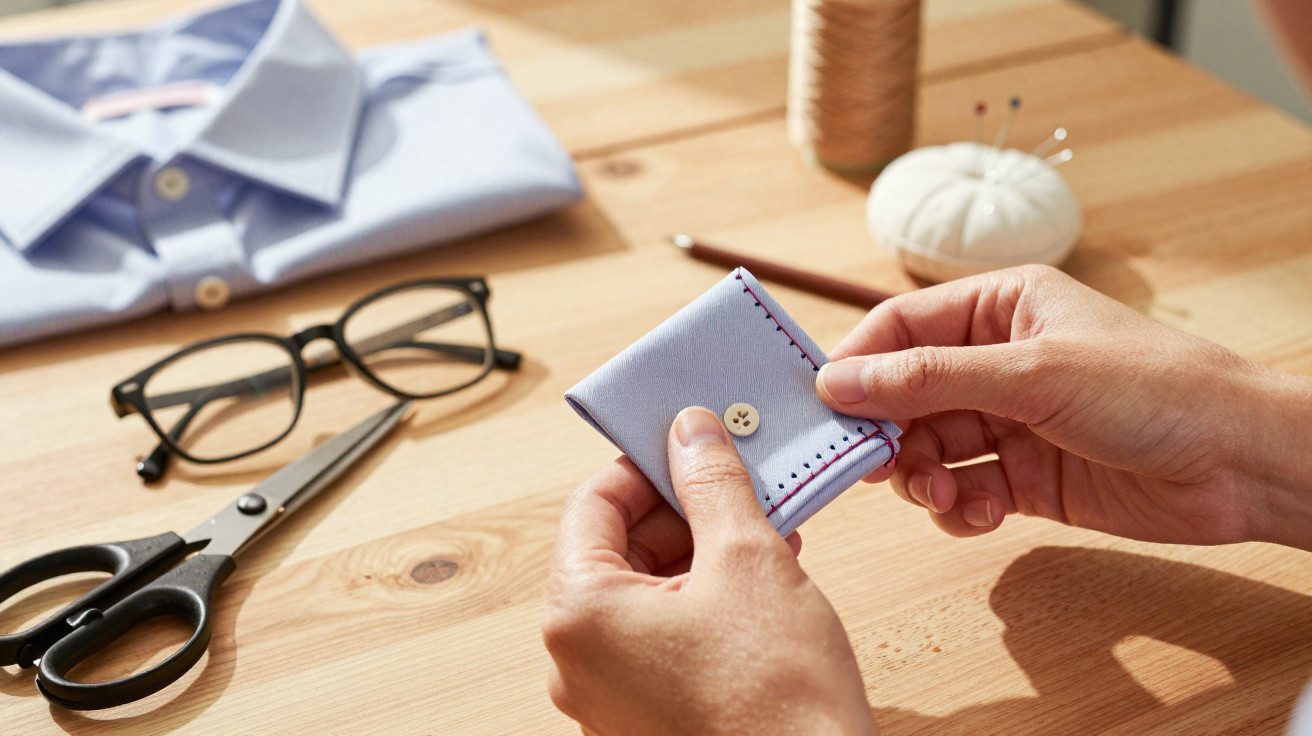
Many old shirts end up in textile recycling bins, even though they contain a small sewing marvel: the reinforced cuff. With just a few stitches, it can become a sturdy glasses case that costs nothing, uses hardly any extra material and helps clear out the wardrobe at the same time. This blend of practicality and creativity is currently generating enthusiasm in sewing forums and upcycling groups.
Why a shirt cuff is ideal for a glasses case
When holding a shirt, accessories are rarely the first thing that comes to mind. Yet the cuff already has almost everything a good glasses case needs: structure, a ready-made opening and a fastening.
“The cuff is essentially a pre-constructed mini case that simply needs closing in the right place.”
Its construction is the reason. On many shirts, the cuff is reinforced with a special fusible interfacing. This layer provides firmness and helps prevent creasing – precisely the quality that later cushions knocks when glasses are carried in a rucksack or handbag.
There is another advantage: the button and buttonhole are already present, neatly finished and matched exactly to one another. That eliminates the need for any extra fastener: no press studs, hook-and-loop tape or zip. For a zero-budget project, that is invaluable.
The 15-minute shirt-cuff glasses case: step by step
The appeal of this idea is its straightforward nature. Anyone who can thread a needle can make this project. A sewing machine makes it quicker, but hand sewing works just as well.
Materials and preparation
- 1 old shirt cuff, still attached to the sleeve or already cut off
- Fabric scissors
- A sewing machine, or a needle with matching thread
- Optional: a small microfibre cloth for an integrated glasses-cleaning solution
- Optional: a scrap of soft fabric for extra lining
First, place the glasses inside the sleeve as a test. This gives a rough indication of the space required. About 20 centimetres above the cuff is a useful guide, although slightly more or less may be needed depending on the size of the lenses.
Making the case in detail
- Test the sleeve: Put the glasses into the sleeve and mark the required length.
- Cut straight: Neatly cut the sleeve off around 20 centimetres above the cuff.
- Turn it inside out: Turn the resulting fabric tube so that the inner side faces outwards.
- Close the bottom edge: Align the newly cut edge carefully and sew straight across it, either by machine or by hand.
- Finish the seam: Prevent the lower edge from fraying, for example with a zigzag stitch or an overcast stitch.
- Turn it the right way out: Turn the tube back again, leaving the cuff as the upper opening.
- Finish the case: Insert the glasses, fasten the cuff and test the case.
“With a little practice, a genuine quarter of an hour is enough – including cutting, sewing and tidying the sewing area.”
There is also a clever extra touch: before sewing the bottom edge closed, catch a small piece of microfibre cloth in the seam. This creates a permanently integrated glasses-cleaning solution, so there is no more searching for a loose cloth at the bottom of a handbag.
Glasses protection: what makes the reinforced cuff special
Unlike a simple fabric pouch, the cuff comes with built-in impact protection. Its reinforced layer means that the material does not collapse in on itself and is better able to absorb light pressure.
The combination of firm interfacing and cotton fabric offers several benefits:
- Shock absorption: Minor bumps and knocks are cushioned.
- Shape retention: The opening keeps its form instead of folding in.
- Lens protection: There is no unnecessary bulk that could create pressure marks.
- Skin-friendly material: Cotton absorbs moisture and feels pleasant to the touch.
This construction also proves useful in everyday use. In well-filled bags, it retains its shape, glasses are less likely to slip out, and the button fastening is considerably more dependable than improvised ties or hook-and-loop strips.
Personalising a shirt-cuff glasses case into a one-off piece
Sewists and beginners who enjoy the idea can quickly turn the case into a fashionable statement. With striped or checked shirts in particular, the cuff takes on a graphic look that is rarely found in ready-made shop-bought products.
Small changes, big impact
- Replace the button: A metal button or small decorative button turns the case into an accessory with a recognisable character.
- Sew on a label: A small woven label or piece of cotton tape bearing initials looks remarkably professional.
- Adjust the width: Those with very narrow glasses can sew a second, slightly offset seam alongside the existing lengthwise seam. This makes the tube a little slimmer.
- Add a lining: A thin, soft fabric, such as material from an old T-shirt, provides extra protection for the lenses.
These alterations create a case that stands out clearly from mass-produced goods. Many people who make one end up sewing several versions straight away: one for sunglasses, one for a work bag and one as a gift.
Upcycling with an impact: other uses for the rest of the shirt
Once the first cuff has been sewn up, there is usually plenty of fabric remaining. The second cuff can, for example, be made into another case – ideal as a matching pair or a spare.
The remaining shirt fabric is suitable for small projects that usefully extend the life of the material:
- Flat zip pouches for cables or cosmetics
- Fabric bags for loose small items in a rucksack
- Slim covers for pens or knitting needles
- Patchwork pieces for cushions or quilts
Small projects such as these reduce textile waste without requiring major spending. They are especially appreciated by people who enjoy sewing but have limited time, as the projects are short and manageable.
How long does a handmade glasses case last?
Despite its simplicity, the cuff offers surprisingly good durability. With normal use – daily putting in and taking out of glasses, occasional washing, and carrying it in a bag or rucksack – it can readily last for several years.
Finishing the seams neatly greatly reduces the risk of fraying. The case can be machine-washed like a shirt, preferably in a laundry bag and at a low temperature. The reinforced cuff keeps its shape, while the cotton remains pleasantly soft.
Tips for sewing beginners and practical ways to use it
This project is an ideal introduction for anyone just starting to sew. It involves only two essential seams, no difficult curves and no zip, while delivering a visible result that proves useful straight away in daily life.
A few practical ideas include:
- As a sunglasses case in the car or beach bag
- As protection for reading glasses at the office or when working from home
- As a gift idea: turning the shirt of a loved one into a keepsake
- As a cover for small electronic devices, such as MP3 players or compact power banks
For households with children, the same idea can also be used for colouring pencils or small toy figures. The cuff feels sturdier than many basic fabric pouches, and smaller hands can open and close it easily.
At a time when the price of new goods is rising, it is worth taking a second look inside the wardrobe. An old shirt cuff may seem unremarkable, but a needle, thread and a quarter of an hour can turn it into an accessory that combines practical purpose with a small story – and that is exactly what makes this sewing hack so appealing.




Comments
No comments yet. Be the first to comment!
Leave a Comment