
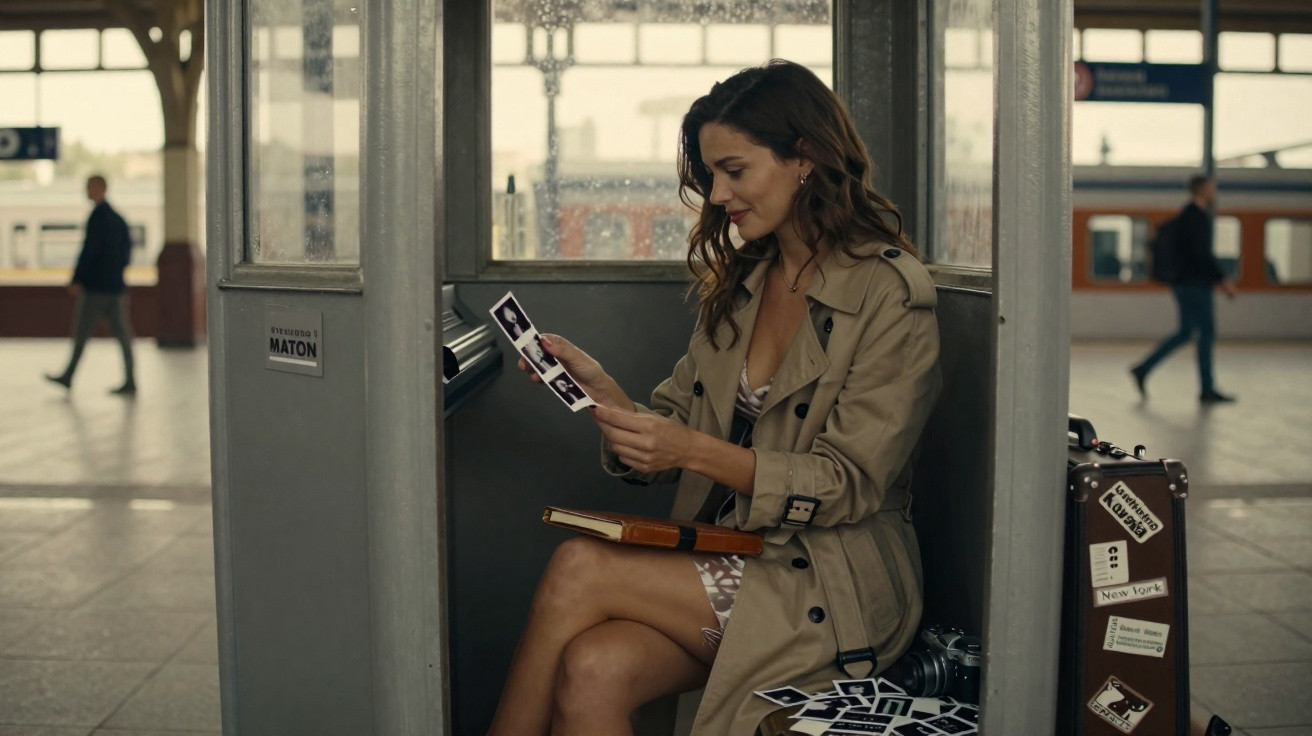
HAMBURG - KAVALA - NEW YORK
Perhaps death always catches us with our trousers down. However expected it may have been, it never seems as though it will happen just yet - right now, this very morning. Even when the person we loved was no longer truly present. Even when every medical sign pointed that way. Even when the recent period had been difficult, forcing us to search our memories for the good days, and the far better ones. They may be images from decades ago, or a sentence that stayed with us. What I always remember about my aunt Maria do Carmo are a few words she once said to me in passing, to give me strength. Perhaps memory has reshaped them. Yet they return every now and then, without asking permission.
Until 11 April 2027, the Hamburger Kunsthalle in Germany is exhibiting this coin, struck in the Greek city of Neapolis, now Kavala. It seems to be sticking its tongue out at death: a silver stater minted between 525 and 450 BC. Once a useful object, it now belongs to a major sculpture exhibition containing thousands of pieces. Alongside coins, it includes works by artists such as Marina Abramović, Hans Arp, Alberto Giacometti, Mona Hatoum, Käthe Kollwitz, Degas, Matisse, Picasso, Rodin and Constantin Brancusi.
Around 1913, Brancusi made the sculpture “Danaïde”, drawing on a Greek myth and on the contemporary beauty of painter Margit Pogany (1879-1964). Until 18 May, it can be seen at Christie’s in New York’s Rockefeller Center. It will then go under the hammer, perhaps reaching a record price.
More precious than any material possession, memory is what gives us life above all. People will tell you otherwise: intelligence, health, love and peace, among other things. Yes, all of that matters greatly. But without memory, we are lost; we are already gone without even knowing it. I remember those words from my aunt: words meant for me, but also for herself. In connection with those familiar words, I now - and always - recall the voice of my favourite Canadian poet, the Greek Leonard Cohen: “There is a crack in everything/ That’s how the light gets in”. In English, we might remember it this way:
“There's a flaw in everything/ That's where the light comes in”.
Eroticism on wheels
COMO
Since childhood, we have been told that curiosity killed the cat, and that lunch will be ‘Questioner’s Tongue Soup’. Yet the more something is concealed, the more we want to see it.
In 1999, photographer Helmut Newton presented a new Volkswagen model beneath a black satin cover that recalled women’s underwear. It was certainly an advertising device, but above all it was eroticism on wheels.
Over several decades, Helmut Newton combined human beauty with automotive aesthetics in fashion shoots. From 15 May to 30 June, these works by the German-born photographer are on display in Italy, at Villa Olmo in Como. Some images feature irony and banknotes. In others, the female body is presented chiefly as an object, intended to adorn cars and encourage consumption.
There is also Nicolas Cage in black and white, wearing a killer’s stare behind the wheel of a Lamborghini Miura. Isabella Rossellini appears in a stately pose on the rear seat of a black car. Princess Caroline of Monaco looks unnatural inside a white Mercedes-Benz 280 SL. There is an Alfa Romeo Spider 2.0, a red Fiat 1200 and a Mercedes-Benz 190c, as well as a Porsche 356 in Rome in 1956.
There is what we see. And, above all, there is what we imagine.
PHOTO MATON
In 1959, American photographer Lillian Bassman captured this dive, calling it “The Wonders of Water”. Until 26 July, Bassman’s work is at The Met in New York. And dives are wherever we can, and wherever we choose, always.




Comments
No comments yet. Be the first to comment!
Leave a Comment