
Lifelong affinities and poetic connections
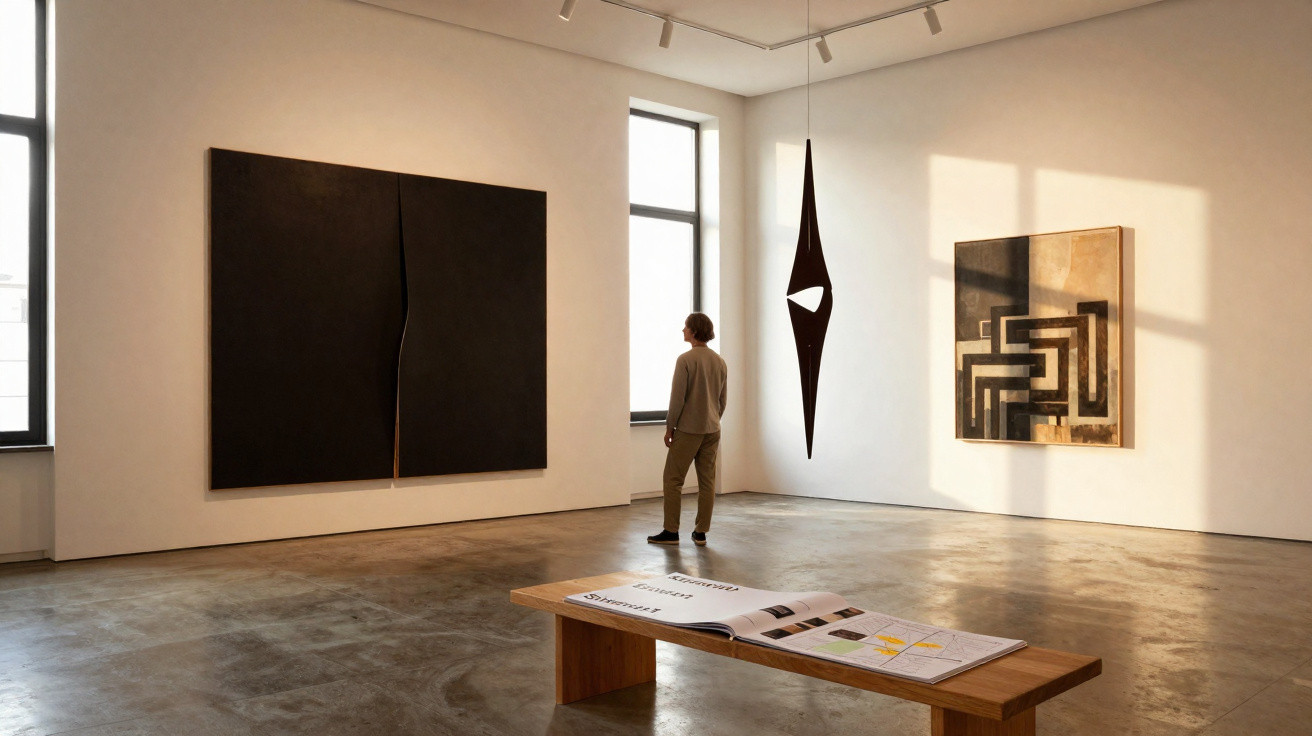
Some artistic affinities last a lifetime, as did the bond between Julião Sarmento (1948–2021) and Fernando Calhau (1948–2002). Others emerge alongside life itself: Calhau’s connection with the considerably younger artist Rui Chafes (born 1966) was founded on a shared poetic sensibility. Their meeting led to an invitation for Chafes to join him in “A Step into the Dark”, a two-person exhibition at the White Pavilion (2 May–30 June 2002). With a prophetic title, the exhibition would end after Calhau’s death. Sarmento, meanwhile, had always known, supported and collected work by younger colleagues, which is why these three artists now come together in “After Forever” at the Julião Sarmento Pavilion.
The exhibition is modest in scale but exceptionally powerful, owing to an intelligent and sensitive installation. Isabel Carlos has done excellent work in both selecting 32 works from a possible 80 and establishing a rhythm that moves between laughter, smiles, weight, lightness and drama.
Fernando Calhau and Rui Chafes in “After Forever”
Calhau’s 29 works dominate the selection, which opens with two jointly authored pieces from 1968 by Calhau and Sarmento. Three encounters between Rui Chafes and Calhau punctuate the display, and these are its strongest and most meaningful moments.
The route begins with works by Sarmento and Calhau when both were 20-year-old artists, playfully adopting pop idioms as a mental escape from the School of Fine Arts they attended. This is followed by a swift introduction to Fernando Calhau’s essential poetics, centred on the simplest and most elemental forms: the cross, the square, the sea and earth as fundamental textures; the memory of Warhol, with a screen-printed Marilyn on an envelope; and, always, black and white.
The first Calhau–Chafes encounter gives the exhibition its title: “After Forever” (Chafes, 1988). It takes place beside a wall sculpture that seems to project blade-like spikes, tearing into the surrounding space where it confronts a drawing of a wound or scar (2000). Here, Calhau faces-and makes us face-illness. Here, too, we find Chafes’s suspended, torn sculpture, entirely a wound “where light dies” (1996).
The second meeting follows immediately, within deep darkness. Chafes’s “Vertigo V” (1988/9) resembles a coat made from iron wire, partly penetrable to the eye. The gaze becomes lost in an inextricable labyrinth, before reaching an installation shaped as a room lined with steel plates. At its entrance, the word “Reason” appears in neon and mirror writing; at the far end is “Ratio”, its Latin version: “No. 166 Untitled (Reason/Ratio) 1991”. We enter another labyrinth, one belonging more to the body than to vision, a place in which we may lose ourselves like a bat flying into a house.
Wounds, vertigo and the final escape
Near the end comes the third encounter, preceded by “A Word… Falling Down!”, a playful 1969 screen print in which the same words slip through a square. It offers a brief pause before the confrontation between three drawings: “A Drawing of the Operation” (2001, Rui Chafes), alongside two works by Calhau that cut through a living tongue, “Untitled (Hard on Soft)” and “Untitled (Tongued)”, both from 1995. Pain, cutting and loss are invoked with unmistakable force in this final warning before the close.
And what is that ending? An unusually shaped Calhau painting (shaped canvas, Untitled, 1986): two triangles sit side by side, flying away-or perhaps fleeing-but to where? Beyond the vertigo and the labyrinth so carefully constructed by the exhibition, or further inward, towards the depths of that vertiginous place which inhabits, endures, tears and cuts through our memory “After Forever”.




Comments
No comments yet. Be the first to comment!
Leave a Comment