
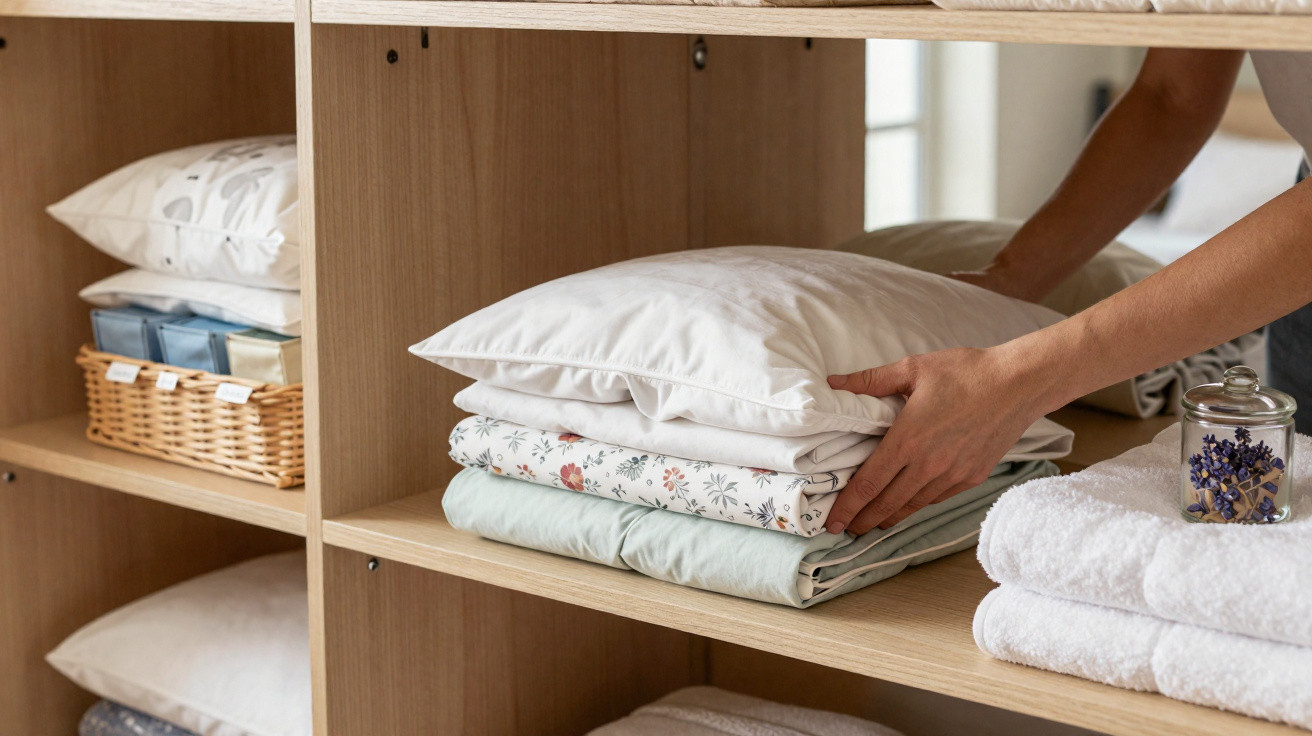
Many households know the problem: creased fitted sheets, stray pillowcases, and untidy piles of mixed sizes and patterns. One straightforward folding technique can turn complete bedding sets into compact “parcels” that take up very little room and are ready to use straight away. It saves time and stress, while also making the home feel noticeably calmer.
Why bedding so quickly becomes chaotic
Bedding seems manageable until the laundry basket is overflowing. That is when sorting it becomes frustrating. A fitted sheet slips to the back of the shelf, a pillowcase disappears somewhere in the middle, and you are left with three different shades of white but no complete matching set.
The main mistake is storing every item separately. Fitted sheets go in one compartment, covers in another and pillowcases somewhere else entirely. It may sound sensible, but in day-to-day life it leads to searching and piles being pulled apart.
“Treating every bedding set as a complete unit immediately creates more order and drastically reduces wardrobe chaos.”
Keeping everything together makes it less likely that sizes will be confused or clashing patterns combined. It also becomes much easier to spot, while tidying, which set is old, stained or stretched out.
The key idea: store bedding as a compact set
The solution follows one simple rule: rather than placing each item on the shelf individually, group every component of a set into one unit. This includes:
- fitted sheet
- flat sheet, if used
- duvet cover
- matching pillowcases
In the end, every item is placed inside one neatly folded pillowcase, which acts as a small cover. The result is a tidy parcel that can immediately be recognised as a complete bedding set.
The pillowcase method step by step
With a little practice, the entire process takes barely more than half a minute:
- Prepare the fitted sheet: Fold the corners into one another, shape the sheet into a rectangle and smooth it as much as possible.
- Fold the flat sheet or duvet cover: Fold this into a rectangle too, roughly the same size as the folded fitted sheet.
- Smooth the pillowcases: Neatly fold all matching pillowcases; one will later serve as the “cover”.
- Stack the items: Put the fitted sheet at the bottom, then the duvet cover or flat sheet, followed by the remaining pillowcases.
- Fold into thirds: Fold the stack lengthways or widthways into three even sections, as if folding a letter.
- Place it inside a pillowcase: Open the prepared pillowcase and push the folded stack completely inside.
- Pull the front taut: Smooth the fabric and fold over the opening – the compact parcel is complete.
The result is a rectangular bundle that stacks securely and makes it clear at a glance which bedding set is inside.
Arrange your cupboard like a small hotel
The pillowcase method automatically gives you more structure. It becomes especially useful when the parcels are sorted thoughtfully. Introducing a system here can make changing the bedding feel almost hotel-like.
The following organising principles work particularly well:
- By bed size: Single, double and children’s beds – each on its own row of stacked sets.
- By season: Keep winter bedding (flannel and dark tones) separate from summer sets (linen and light colours).
- By use: Place everyday sets at the front, with guest sets and rarely used bedding further back or higher up.
“When each finished parcel only needs to be picked up and put straight onto the bed, every change saves several minutes and plenty of swearing.”
It is also useful to allocate a separate shelf area to each family member. This allows everyone to find their own set quickly, without rummaging through the entire cupboard.
Keeping bedding fresh in the cupboard
Bedding often remains in the cupboard for longer periods, particularly where several sets are used in rotation. A few simple additions can help the textiles stay fresh:
- Put a small sachet of lavender or dried herbs inside the pillowcase.
- Alternatively, add a bar of soap for a subtle fragrance.
- It is better to avoid heavily perfumed chemical products, as these may irritate sensitive skin.
Paying regular attention to these small details means not only more orderly sleep, but also pleasantly scented bedding. This makes a noticeable difference in small flats especially, where the cupboard is close to the bedroom.
Common folding mistakes and how to avoid them
Many people eventually give up on folding bedding in frustration because the result always looks misshapen. Usually, a few simple pitfalls are responsible:
- Parcels that are too large: If the fitted sheet is only folded roughly, it creates a bulky shape that barely fits inside the pillowcase.
- Creased covers: Failing to smooth the pieces briefly creates deep creases that make the parcel look untidy.
- No cupboard system: Even the best folding technique achieves little if completed sets end up somewhere between towels and tablecloths.
Taking five minutes to create a clean basic system can provide peace of mind for months afterwards.
Who benefits most from the pillowcase method
The technique works in almost every household, but it is particularly worthwhile in certain living situations:
| Household type | Benefit of the pillowcase method |
|---|---|
| Small city flat | Maximum space saving in narrow cupboards and on shelves |
| Families with children | Quick access for nighttime “accidents” or an unexpected bed change |
| Households with a guest room | Guest sets are immediately to hand and look especially tidy |
| People with little time | Less searching, quicker changes and less evening frustration |
How often bedding should really be changed
Once you start thinking about folding bedding, another question quickly arises: how often should bedding actually be washed? Many experts recommend changing it every one to two weeks. In summer, when sweating heavily, or if pets sleep in the bed, weekly changes are more suitable.
Ready-made bedding parcels make this routine easier to maintain. Take one bundle from the shelf, remove the old set and put on the new one – everything is done within minutes. Anyone with several identical sets can even make the change during a busy week without needing to plan ahead.
Practical ways to bring even more order to the home
The principle behind the pillowcase method can easily be applied elsewhere. Towels can be grouped by size and where they are used, tablecloths can be folded with their matching napkins, and even sportswear can be stored in the cupboard as ready-made outfit parcels.
Thinking in complete sets rather than categories such as “all T-shirts together” saves time every time items are put away. Families with lots of overlapping appointments in particular quickly notice how freeing it feels when certain things are simply “ready to go” on the shelf.
For people who would not describe themselves as especially tidy, this approach can be a pleasant introduction to a more organised home: it is not about perfectionism, but one easy-to-copy trick with an immediate visible effect whenever the cupboard door is opened.




Comments
No comments yet. Be the first to comment!
Leave a Comment