
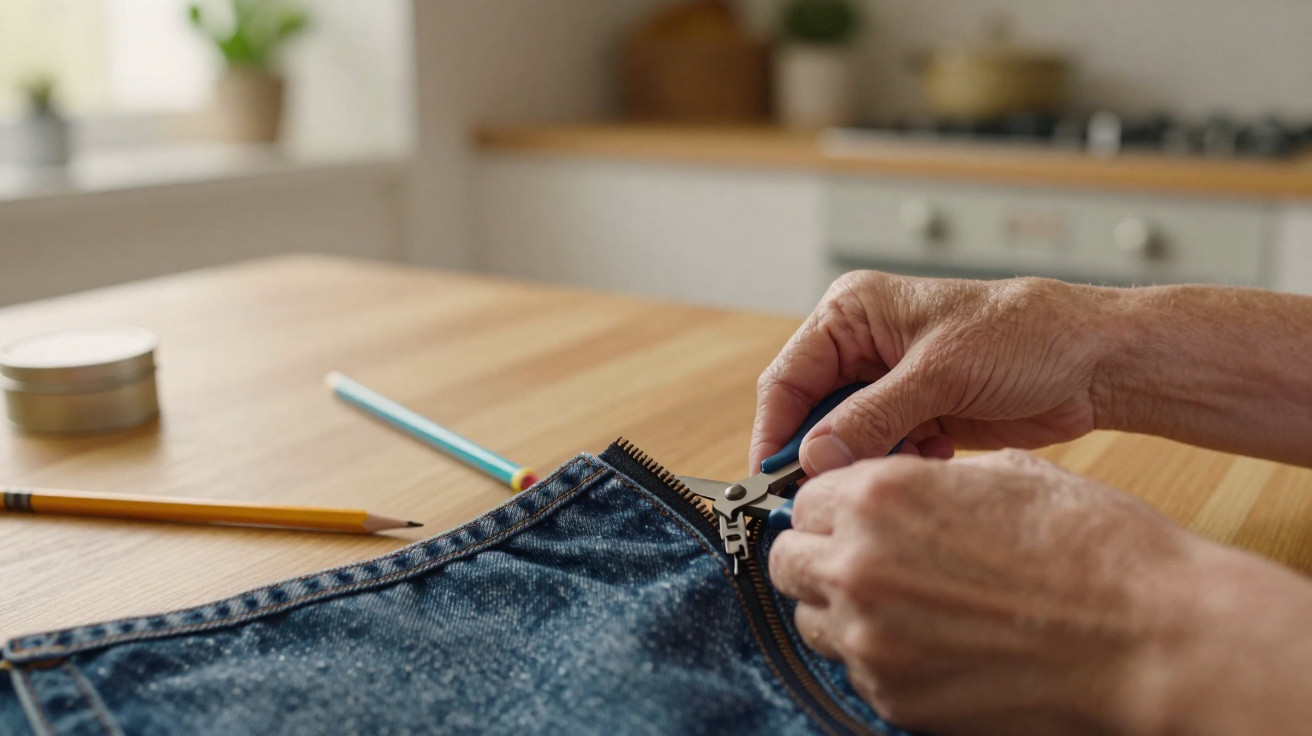
A coat that simply will not fasten in the morning, or a handbag whose zip keeps coming open: many people immediately assume they will need an expensive alteration service or that the item is beyond saving. Older generations, however, knew a quick, almost cheeky repair method that needs neither needle nor thread. It relies on a tool found in most homes and can rescue a surprising number of zips.
Why so many zips seem to fail “suddenly”
Zips may look sturdy, but they are small precision mechanisms. The slider – the part you pull – works like a miniature vice. It presses the two rows of teeth or coils together so that they interlock properly.
Over time, constant pulling, tugging, trapped fabric and heavy strain can make the slider widen slightly. Even an extra tenth of a millimetre of play is often enough. The teeth then no longer grip as they should.
Typical: the zip appears to close normally at the front, but immediately opens again behind the slider, or it feels loose and unreliable.
Tailors report that a large proportion of supposedly broken zips have not failed because of the teeth at all, but because the slider has become stretched. The good news is that this is often corrected with one straightforward movement – quite literally by bending it back into shape.
The grandma trick: readjusting the zip slider with pliers
This classic fix from the older generation’s toolbox involves gently squeezing the slider with pliers, allowing it to grip the teeth firmly again.
What you will need
- Small flat-nose pliers, such as those from a toolbox, or combination pliers
- Good lighting and a calm few minutes
- Optional: reading glasses or a magnifying glass if your eyesight is not what it once was
How to do it step by step
- Move the slider fully down to the bottom stop of the zip. Check that no fabric is caught inside.
- Position the flat-nose pliers at the sides of the slider, where it is widest – on its two side plates.
- Apply very gentle pressure in tiny stages. The aim is to make the slider marginally narrower, not to crush it.
- Pull the slider a short way upwards and check whether the zip now closes more securely.
- If it still opens again, repeat the process with one more very small squeeze.
This trick works with many metal and plastic zips. Patience is essential: three small adjustments are better than one forceful squeeze. If you press too hard, the slider may seize completely and could then need replacing.
In many cases, an adjustment taking three to five minutes is enough to make the jacket or bag fully usable again.
When a zip sticks: lubricant from the pencil drawer
Sometimes the teeth close after readjustment, but the zip still moves stiffly or catches at certain points. In that case, a dry lubricating layer can help.
Pencil graphite: lubrication without the mess
An ordinary soft-lead pencil, such as a 2B pencil, is especially useful. Its dark lead contains graphite, which is an excellent dry lubricant.
Use it as follows:
- Run the pencil tip over the zip teeth several times on both sides.
- Move the slider slowly up and down to distribute the graphite.
- Afterwards, wipe away any excess powder with a cloth so it does not transfer onto clothing.
Graphite is not greasy, does not make fabric sticky and attracts very little dirt. It is ideal for jackets, bags and rucksacks.
Alternative household remedies if you have no pencil
If no pencil is available, other everyday items may be suitable:
- A piece of dry soap
- A candle
- A little glycerine
- A trace of Vaseline, used very sparingly
Important: thick oils and cooking fats are unsuitable. They attract fluff, dust and dirt, which will soon make the zip catch even more.
If the bottom stop is missing: the drinking-straw trick
At the bottom, zips usually have a small metal clip or a thicker end piece. This prevents the slider from slipping straight off the bottom. When this stop comes loose, the zip can look completely ruined – but it does not necessarily have to be.
An old household solution uses a piece of plastic drinking straw as a replacement stop:
- Cut a piece around three millimetres long from a plastic drinking straw.
- Cut a slit lengthways through this piece so that it can be slipped over the zip tapes.
- Fit it at the very bottom, at the end of the row of teeth.
- Secure it with a drop of strong glue and press it firmly into place.
This creates a discreet but sturdy replacement stop that reliably prevents the slider from coming off again.
The result may look improvised, but in everyday clothing or bags it often lasts remarkably well. It is ideal if you simply want to keep using the item for the time being.
When a home zip repair is no longer worthwhile
Unfortunately, not every zip can be saved using grandma’s tricks. There are several clear warning signs:
- Several teeth are completely missing or badly bent.
- The tape is torn or has pulled away.
- The slider is broken or cannot be moved at all.
In these cases, household remedies have reached their limits. You essentially have three options:
- Fit a new clip-on slider, available from retailers as a replacement part.
- Take the item to an alterations service and have the zip professionally replaced.
- Deliberately reserve the clothing for situations where a partly functioning zip does not matter, such as workwear.
Why it is worth reaching for the pliers
Many people discard clothes far too quickly because a zip is playing up. Yet testing it with pliers and a pencil takes only a few minutes and costs almost nothing. If the repair works, you save:
- Money on new clothes or bags
- A trip to the tailor
- Resources, because fewer textiles end up in the bin
This simple technique can ease particularly frustrating situations with children’s jackets, school rucksacks or favourite jeans. A zip that fails in the morning just before leaving no longer has to spoil the whole day.
Practical advice for different zip materials
Not every zip is made from the same material, and this slightly changes the approach:
- Metal zip: Usually more robust and generally tolerates careful work with pliers well. Graphite works particularly effectively here.
- Plastic teeth: More delicate, so use the pliers even more cautiously. Excessive pressure can split the teeth.
- Coil zip (a fine, twisted “coil”): Often found on dresses and lightweight jackets. Apply only the slightest pressure, and always first check that the slider really is the problem.
If you are unsure, practise the plier movement first on an old item of clothing that no longer has much value. This helps you understand how little pressure is often needed.
How to prevent future zip problems
Many faults occur because a zip is put under the wrong kind of strain. A few simple habits can significantly extend its lifespan:
- When fastening jackets, support the lower section lightly with your free hand rather than pulling the zip up with force.
- Do not force overfilled bags or suitcases shut: a zip is not a tension strap.
- Gently free caught fabric or lining rather than yanking it loose.
- Remove dirt, sand and fluff from the teeth from time to time.
Keeping a pencil and a small pair of pliers at home means you are well prepared for an emergency. With a little practice, the “grandma trick” soon becomes routine, giving many supposedly lost garments a second chance.





Comments
No comments yet. Be the first to comment!
Leave a Comment