
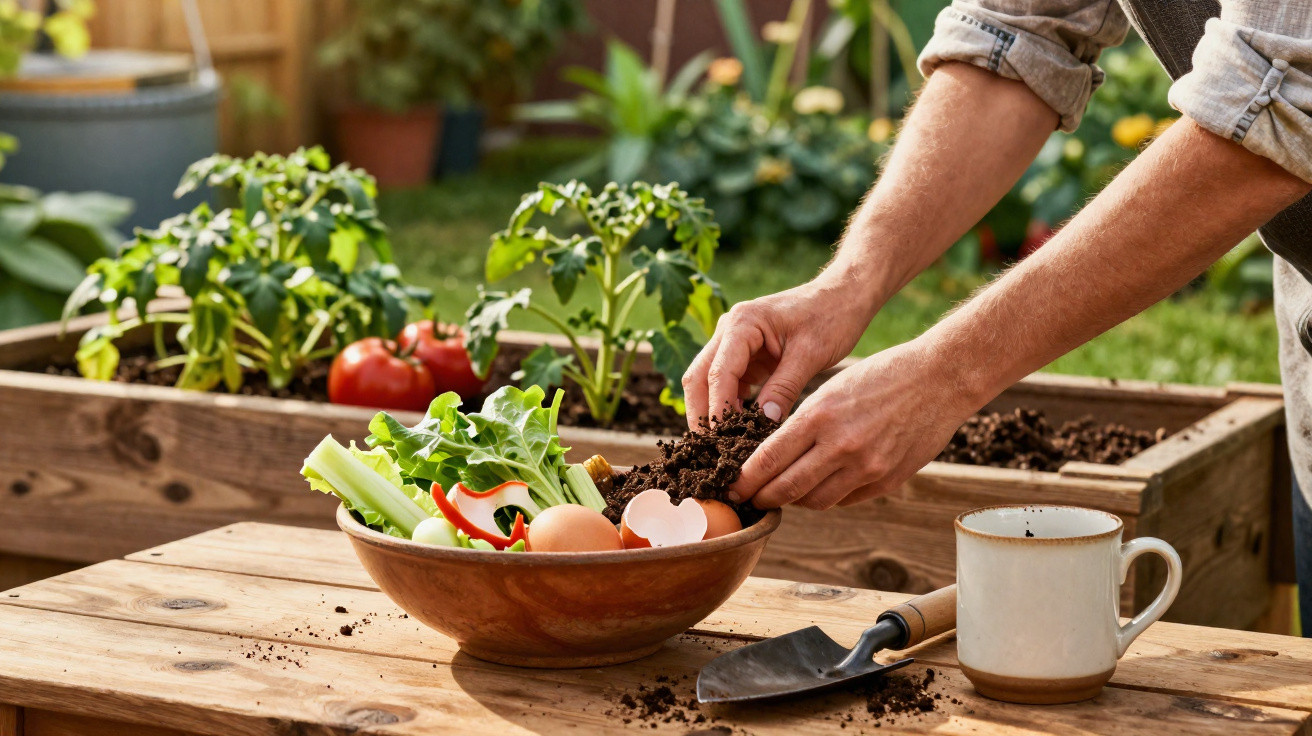
Carrot tops, onion skins, a small bunch of wilted parsley and the final forlorn leaves of a lettuce all sat waiting to be discarded. Outside, the vegetable beds appeared depleted and neglected, their soil hardened after a summer spent feeding tomatoes, roses and overly productive courgettes.
A neighbour walked past in muddy boots, wearing a knowing smile, and noticed the bag. “You’re throwing away your best fertilizer,” she said, as if it were the most obvious thing in the world. Within ten minutes, we were in the garden with our hands deep in the soil, turning supposed rubbish into what she described as her secret weapon.
The surprising thing was that, within a few weeks, the soil genuinely seemed transformed. It was darker, more open and somehow more full of life. That was when those overlooked kitchen remnants began to tell a much more compelling story.
From kitchen waste to soil gold
For many gardeners, there is a familiar and slightly guilty habit: clearing plates into the bin, tying up a bag of peelings and taking it out with the household rubbish. It is an almost unconscious routine. Yet those scraps contain what commercial fertilisers are designed to reproduce – only they come with living organisms built in.
Viewed more carefully, harvest remnants act like nutrient time capsules. The goodness that sustained carrots, tomatoes, pumpkins and herbs remains stored in their skins, stalks and roots. Harvesting the crop has not made that energy disappear; it is simply waiting to return to the soil.
So, when gardening experts say these leftovers can outperform commercial fertiliser, it is not merely a poetic claim. They are observing what occurs when natural cycles are allowed to reach their conclusion.
Picture a typical autumn clear-up. The final tomato plants are pulled out, bean vines are cut back and kale that has turned rather too bitter is trimmed away. This mass of plant material can form an untidy, almost shameful-looking pile beside neatly arranged bags of shop-bought fertiliser.
A gardener in Kent monitored the results over two growing seasons. One side of her allotment had raised beds fed with balanced NPK pellets. The other received only chopped plant matter and kitchen scraps, either buried or used as a thin mulch. By the second year, beds supplied with scraps produced sturdier stems and deeper green leaves, while requiring half as much watering.
She also found that soil beneath the scrap-fed beds remained friable after winter rain. The fertiliser-fed beds, by comparison, formed a crust before splitting open. It was the same plot and the same weather, but the difference was immediately apparent beneath a trowel.
That contrast comes down to what happens after leftovers reach the ground. Commercial fertiliser behaves rather like quick sugar, delivering nutrients rapidly and directly to plants. Harvest scraps work more like a slowly cooked meal, first nourishing the whole underground network – fungi, bacteria, worms and mites – which then makes nutrients available to plant roots.
As this material breaks down, it supplies nitrogen, phosphorus, potassium and a broad range of trace minerals. It also creates humus: the dark, springy component of soil that retains water and provides roots with a stable anchor. No glossy bag on a garden-centre shelf can properly replicate that.
Fertiliser may provide a rapid nutrient boost, but leftovers alter the soil itself. This is why many experienced gardeners gradually shift their attention from the garden-centre aisle to their own compost caddy.
Turn harvest leftovers into a quiet superpower
The simplest approach requires no specialist equipment: chop, spread, cover and wait. After harvesting, gather healthy, disease-free stems, leaves and roots, then cut them into roughly coin-sized pieces. Smaller pieces decompose more quickly.
Spread the material in a thin layer over the soil, no deeper than a slice of bread. Cover it with a carbon-rich material such as shredded cardboard, dry leaves, straw or torn egg boxes. In effect, you are creating a lasagne directly on the bed, minus the pasta.
Over the following weeks, worms pull the fragments down into the soil while fungal threads spread through the layers. The surface gradually settles, and the original mess begins to resemble rich, resilient soil. There is no industrial product and no dramatic reveal – just subtle work taking place beneath your feet.
Even experienced gardeners can make a few common mistakes. One is heaping too much material into one place. This can create slimy layers, unpleasant odours and the impression that a garden bed has become a swamp.
Another error is adding diseased plants or badly infested crops in the hope that the soil will simply deal with them. It sometimes can, but not always. Fungal diseases and pests may then return as unwelcome repeat visitors the following season.
There is also the pressure of believing that this must be done daily: weighing every peeling and recording each teaspoon of coffee grounds. Let’s be honest: nobody really does that every day. Gardeners who maintain the habit over time regard it as more like brushing their teeth than completing a tax return.
One long-time market grower put it simply:
“I don’t feed my plants anymore. I feed my soil, and the soil feeds the plants better than I ever did.”
His system is straightforward, almost unremarkable. After every harvest, some material returns to the beds: carrot tops around carrots, tomato stems beneath tomatoes and outer cabbage leaves between brassicas. It is a cycle rather than a one-way process.
- Begin small – try one bed, or even one large pot, and observe how the soil responds.
- Keep it clean – use only healthy, disease-free plant material.
- Build in layers – combine greens, meaning moist scraps, with browns, meaning dry materials.
- Remain curious – pay attention to scent, texture and worm activity instead of concentrating on products.
- Give it time – nature moves more slowly than product labels suggest, but its effects endure for longer.
Why this “waste” quietly outperforms bagged fertiliser
There is a certain relief in recognising that kitchen and harvest leftovers are not a disposal problem, but a useful resource ready to go back into the ground. Overripe tomatoes, fibrous bean ends and piles of pumpkin pulp no longer have to feel like waste or failure. They become the starting material for next season’s crops.
At family level, this change can also reshape how children understand food. Scraps do not simply disappear “away”; they return as strawberries, peas or the rose that finally flowers like the one in the catalogue. In a year that seems to rush past, that cycle can feel unexpectedly grounding.
Experts who rely on leftovers are rarely concerned with getting everything perfect. Instead, they focus on a regular rhythm: a bucket beside the sink, a corner of the garden for cuttings and a few loose layers over cleared beds after each harvest. It is nothing heroic, only a different default habit.
At a time when synthetic fertilisers are becoming more expensive, consume more energy and may leave soils depleted, this traditional practice feels remarkably current. It is not a trend or a moral lecture, but a style of gardening that becomes easier the longer it is practised.
Most of us recognise the moment of taking out the bin and thinking, “That’s a lot of food we never really used.” Perhaps the real twist is that it can still be used – simply not in the way we initially expected.
| Key point | Detail | Why it matters to the reader |
|---|---|---|
| Leftovers nourish soil life | Kitchen and harvest scraps feed microbes, worms and fungi that help support roots. | Helps produce stronger plants while relying on fewer purchased products. |
| A simple, low-cost approach | Chop the material, layer it on beds, cover it with dry matter and allow time to do the work. | Straightforward to test in any garden, balcony or small yard. |
| Improves structure as well as nutrients | Creates humus, holds moisture and reduces crusting and compaction. | Produces healthier soil that performs more effectively year after year. |
FAQ:
- Can I use all kitchen scraps as fertilizer? Use vegetable and fruit scraps, coffee grounds, tea leaves and crushed eggshells; avoid meat, fish, dairy products and very greasy food to prevent smells and pests.
- How long do harvest leftovers take to become usable by plants? When finely chopped and applied in thin layers, they begin feeding soil life within weeks and can noticeably improve soil during one growing season.
- Will this attract rats or other pests? Applying thin layers, covering them with dry leaves, cardboard or straw, and avoiding meat and cooked food makes your “fertilizer” almost undetectable to scavengers.
- Is this method enough, or do I still need commercial fertilizer? Many gardeners move towards feeding mainly with scraps and compost, adding organic fertiliser only for especially hungry crops, such as tomatoes grown in containers.
- Can I do this if I only have pots on a balcony? Yes: bury small quantities of finely chopped scraps a few centimetres below the surface, allow them to decompose and renew the potting mix each year.




Comments
No comments yet. Be the first to comment!
Leave a Comment