
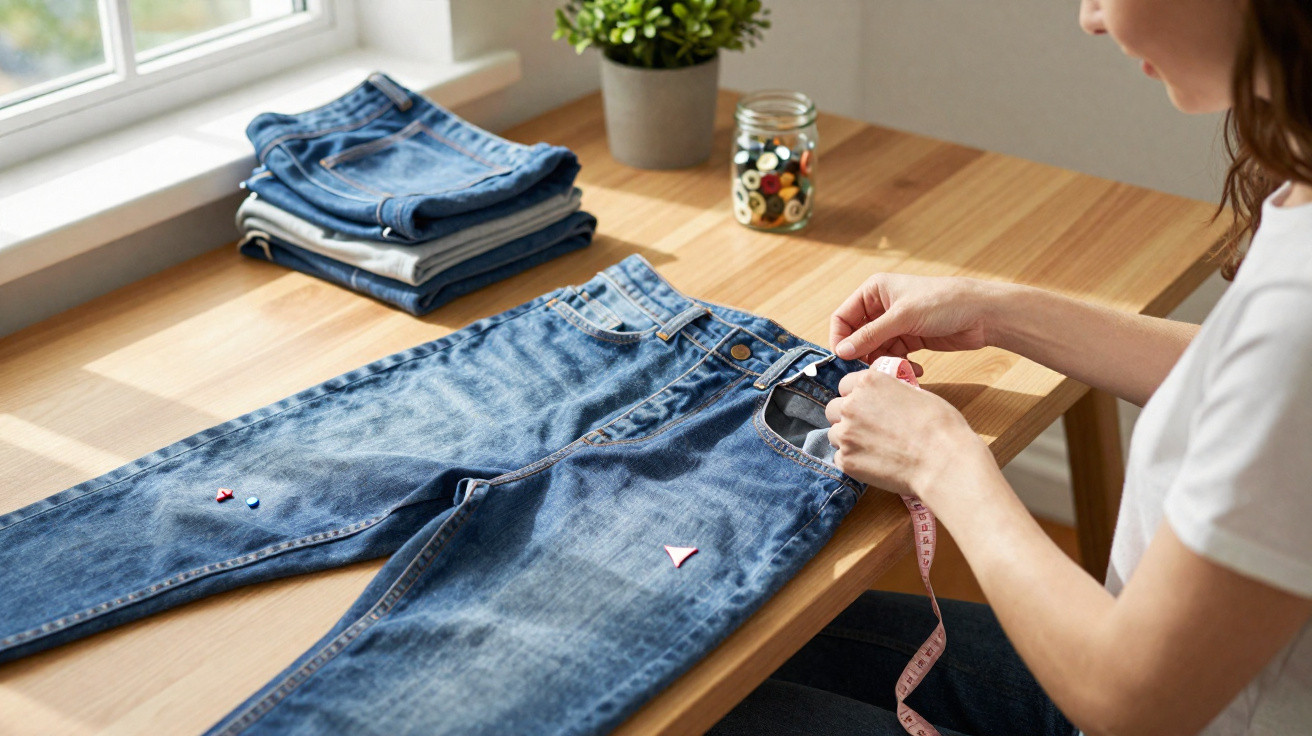
Many people know the feeling: a few extra kilos, a bloated stomach in the evening or a hot wash cycle, and suddenly the waistband will not cooperate. Rather than frustratedly moving up to the next size, you can widen the waist of many pairs of trousers by several centimetres with a simple sewing trick – without spoiling their shape around the seat or hips.
Why tight trousers do not have to go in the bin
Trousers are often sent to textile recycling far too soon, even though the fabric, cut and style are still ideal. Usually, the problem is simply the waistband: an extra centimetre here or two centimetres there, and all of a sudden the button will not fasten.
“With a targeted alteration to the waistband, many pairs of trousers can be enlarged at the waist by up to five centimetres – quickly and almost invisibly.”
That is exactly where this trick comes in. Instead of altering the entire garment, it focuses on the area where the most tension builds up: the waistband seam. This retains the trousers’ usual fit, while removing the tightness.
The weak point is the waistband construction
The waistband on conventional trousers is generally made from a fairly rigid strip of fabric with very little give. If your stomach subtly expands as the day goes on, pressure accumulates around the button and centre front. As well as being uncomfortable, this can stretch out the zip or button.
Redistributing these forces creates extra room: rather than allowing all of the tension to act at the front, add a small “buffer zone” at the side or back. This section moves flexibly, while the rest of the waistband keeps its shape.
The key trick: an elastic insert in the waistband
The quickest solution is to add an insert made from elastic material to the waistband. Acting as a small stretch panel, it is barely visible from the outside when positioned carefully – for example, in the centre-back seam or a side seam.
“A brief alteration at an inconspicuous seam, a small elastic insert – and the trousers become noticeably more comfortable without losing their look.”
What you will need
- A pair of trousers that is too tight (jeans, tailored trousers or chinos)
- Flat elastic, at least 3 cm wide, or firm stretch fabric
- A seam ripper (or small scissors)
- A sewing machine with a zigzag stitch, or a needle and strong thread
- Pins or sewing clips
- A tape measure and a pen or tailor’s chalk
A firm yet stretchy insert is best. It needs to give without becoming floppy, otherwise the trousers may slip down later.
Step by step: up to five centimetres of extra room
This method is particularly suitable for jeans and trousers with a firm waistband.
1. Create an opening in the right place
Turn the trousers inside out. Next, use the seam ripper to unpick a side seam or the centre-back seam for around four to five centimetres downwards. Important: open the waistband itself along this seam too, creating a V-shaped gap.
This opening provides the space for the elastic insert. The longer the opening, the more room you can gain in the end – although in practice, a few centimetres are usually enough.
2. Cut triangular inserts
Now cut two small triangles from the elastic or stretch fabric. The wide edge should match the extra width you want at the waistband, while the point should face towards the hip or seat.
| Desired increase | Width of insert (at the top) |
|---|---|
| approx. 2 cm | approx. 1 cm on each side |
| approx. 3–4 cm | approx. 1.5–2 cm on each side |
| up to approx. 5 cm | no more than approx. 2.5 cm on each side |
The precise measurements depend on the individual pair of trousers. Briefly trying them on with the inserts pinned in place will help you establish the right width.
3. Pin, try on, then sew in place
Place the triangles into the V-shaped opening, with the wide edge directly against the waistband and the point facing downwards. Secure them with pins, then turn the trousers right side out.
Now do a trial run: put the trousers on, fasten them, move around and sit down. If nothing pulls and the result looks symmetrical, sew the inserts in using a zigzag stitch. This stitch preserves the elasticity that the insert is intended to provide.
If you do not have a sewing machine, you can sew by hand with strong thread, but make close, careful stitches so the seam does not split.
An option without elastic: stretch from fabric alone
Anyone wishing to avoid synthetic fibres can use a leftover piece of old trouser fabric in a similar colour. The key is to cut the fabric on the bias, known as a “bias cut”. Even woven fabric gives slightly in this direction and becomes mildly elastic.
The process remains the same: make an opening of four to five centimetres, cut triangular inserts, pin them in place, check the fit and sew them in. The available stretch is slightly less than with elastic, but in many cases it is enough to add one or two centimetres of comfort.
Especially useful during periods of fluctuating weight
Many people experience noticeable changes in their waist measurement during the menopause, after pregnancy or while undergoing certain treatments, often over a short period. Favourite trousers may fit reasonably well in the morning, yet by evening every movement can feel as restrictive as a corset.
“An elastic insert makes trousers suitable for everyday wear when the body changes over the course of a day or over the years – without having to buy new ones every time.”
Jeans that fitted perfectly for years do not lose their style simply because they were tight for a year or two. Two small side inserts, hidden beneath a jumper or T-shirt, provide noticeable relief when sitting in particular and can keep the trousers in use for much longer.
A sustainable benefit: less waste, more money in your wallet
The textile industry places a heavy burden on the environment and climate. Every pair of trousers worn for a few more years saves raw materials, water and energy. This type of targeted alteration falls under “upcycling”: existing clothing is adapted rather than replaced.
There is a financial benefit alongside the environmental one: choosing a needle and thread, or taking trousers to an alterations service, rather than buying a new pair can reduce clothing expenditure in the long term. This is especially worthwhile for high-quality jeans or business trousers.
When this trick works – and when it does not
The method is particularly appropriate for:
- Jeans with a firm waistband that only just will not fasten
- Tailored trousers that are too tight only at the waistband
- Trousers that still fit well around the seat and legs
It is less suitable if the trousers are tight in several areas, such as around the thighs as well, or if the zip is already severely puckered. In these cases, the garment needs more extensive alterations – or it simply no longer suits your current shape.
For every other situation, half an hour, a piece of elastic and a little confidence are often enough to turn an apparent “wrong size” back into a wearable favourite pair of trousers. If you are unsure, start by practising on an older pair before tackling your much-loved favourite item.


Comments
No comments yet. Be the first to comment!
Leave a Comment