
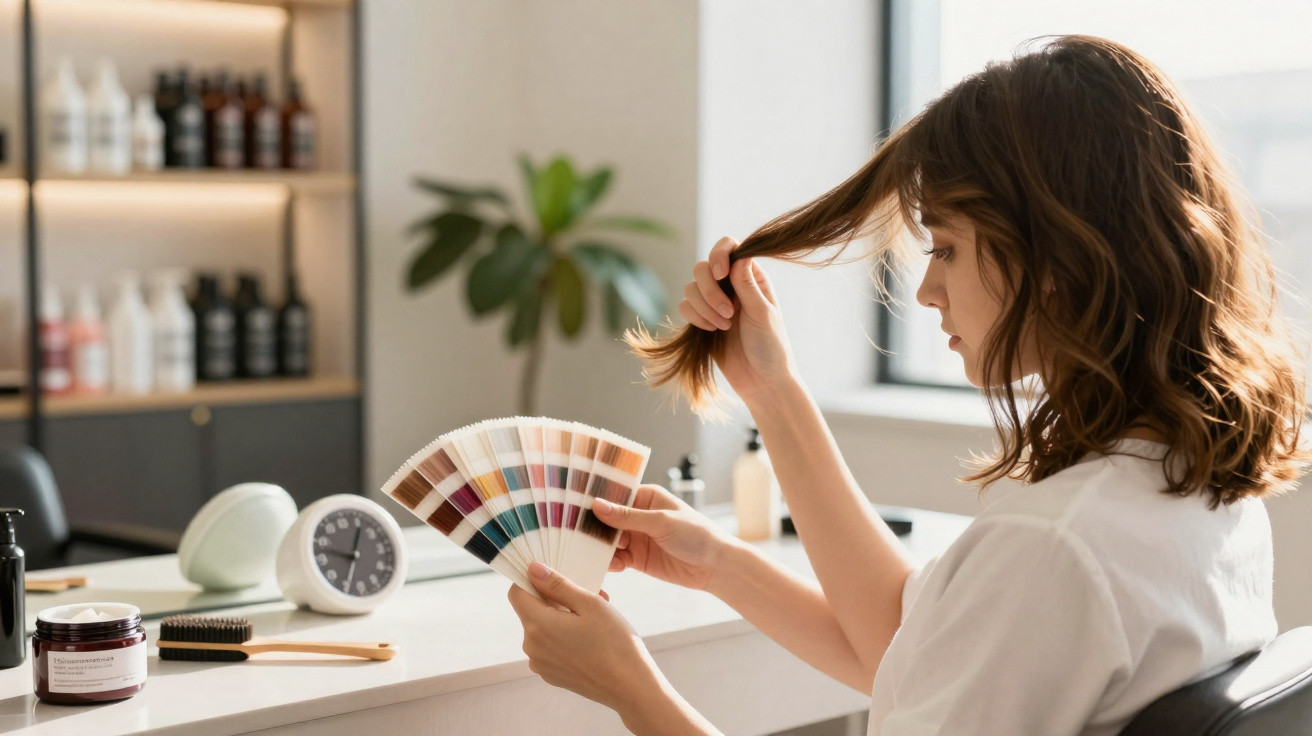
But your hair does not forget the chemicals.
Hair colour trends change more quickly than most people can follow. Social media feeds promote endless shade swaps, salons offer imaginative colour packages, and home kits claim to deliver a fresh identity in 30 minutes. Behind the transformation photos lies a practical question: how often can you dye your hair before taking it beyond the point of no return?
What hair dye really does to your strands
Before deciding how often to colour your hair, it helps to understand what dye does to each fibre. One colouring appointment can alter the hair shaft permanently, rather than simply changing its colour.
Permanent colour and bleach raise the cuticle, the protective outer layer of overlapping, shingle-like scales around the cortex. Ammonia, or comparable ingredients, lifts these cuticles. Peroxide then removes natural pigment and enables new colour molecules to settle within the hair.
Hair can handle a surprising amount of chemical stress, but damage builds up quietly long before you see breakage.
Every intensive colouring process may:
- Wear down the cuticle, leaving hair coarse and porous
- Disrupt keratin bonds, lowering strength and flexibility
- Create more dryness and frizz by damaging the natural lipid layer
- Cause hair to knot more readily and break when pulled or tensioned
Semi-permanent and temporary colours generally coat the surface more than they penetrate it, and their formulas are usually milder. They can still affect the hair’s condition, although far less than repeated bleaching or high-lift colour.
How often can you dye your hair safely?
There is no universal timetable that works for every person. Your hair’s condition, previous colour treatments and the type of product used all determine what counts as too frequent. Colourists use broad intervals and guidance rather than rigid rules.
| Type of colouring | Typical safe frequency | Key conditions |
|---|---|---|
| Root touch-up (permanent) | Every 4–6 weeks | Apply to regrowth only, avoid overlapping on lengths |
| Full-head permanent colour (no bleach) | Every 8–12 weeks | Refresh lengths with gloss or toner rather than full dye |
| Bleaching / lightening | Every 8–12 weeks minimum | Longer gap if hair is fine, curly or already damaged |
| Semi-permanent colour | Every 3–4 weeks | More often possible if hair condition remains stable |
If your hair still feels fragile after your last colour, the clock has not reset yet, no matter how long it has been.
Why your hair type changes the rules
Two individuals may follow an identical colouring routine yet have entirely different outcomes. Genetics, texture and strand thickness all affect how much chemical stress a hair fibre can withstand.
Fine and thinning hair
Fine hair has a narrower diameter and commonly a more delicate cuticle. Bleach and high-lift colour can process through it rapidly; while that may seem convenient, it also increases the chance of breakage.
- Leave as much time as possible between colouring appointments, within the limits of visible regrowth.
- Choose semi-permanent or low-ammonia options when changing tone.
- Do not have double-processing services, such as bleach followed by permanent colour on the same day, unless a professional confirms it is safe.
Curly and coily hair
Curly and coily strands naturally have vulnerable areas at every bend in the fibre. These sections lose moisture more quickly and are more prone to snapping. Regular colouring can intensify both issues.
Specialists often recommend:
- Wider intervals between colour appointments, commonly 10–12 weeks or longer
- Partial colouring methods, such as balayage or highlights, that leave the roots and some lengths untreated
- Including protein and moisture treatments within the colouring routine
Virgin vs. previously coloured hair
Hair that has not previously been dyed or bleached will normally tolerate an initial colour change more effectively. Once it has been chemically treated, however, the fibre does not genuinely return to its original condition. Every later service adds to the damage already present.
Think of coloured hair as having a damage budget. Every bleaching session spends more of that budget, and you never get a full refund.
Bleach: the game changer for timing
Bleach has earned its reputation as the most severe colouring process. Rather than adding pigment, it removes it, and overly aggressive use can break down parts of the cortex.
Colourists generally follow these basic rules:
- Do not bleach the whole head more frequently than every 8–12 weeks.
- Limit root-only bleaching to every 4–6 weeks at most, ensuring it does not overlap with lightened hair.
- Carry out strand tests before major transformations, particularly when moving from dark box colour to blonde.
Gummy or overly stretchy wet strands, broken ends, or white dots along individual hairs are signs that your hair has probably reached its bleaching limit for several months.
Signs you are colouring too often
Many people only recognise damage once it is obvious, such as clumps of hair in the shower drain or a frizzy halo that no serum can control. In reality, hair often gives quieter warnings first, provided you notice them.
Look out for these warning signs between dye appointments:
- Hair takes an unusually long time to dry, which can indicate high porosity and retained water.
- Strands break during gentle brushing, even when detangling spray is used.
- The ends remain coarse and rigid despite conditioning.
- Colour appears uneven or patchy because damaged sections take up pigment differently.
- Your scalp begins to sting or itch more quickly during processing than before.
When your hair starts misbehaving in new ways, the answer is rarely “more dye” – it is usually “more recovery time”.
How to keep hair healthier between colour sessions
The time between colouring appointments is just as important as the services themselves. Your routine during that period can either support the fibre or bring it nearer to breaking.
Adjust your washing routine
Washing too often removes natural oils and makes colour fade sooner, which can encourage premature top-ups. Most colourists recommend:
- Washing only two or three times weekly, where your lifestyle makes this practical.
- Using lukewarm rather than very hot water, as heat lifts the cuticle further.
- Selecting sulphate-free shampoo or a gentle formula intended for coloured hair.
Focus on targeted treatments
Coloured hair benefits most from a balance of moisture and protein, rather than an excess of either. Too much protein may leave hair brittle, while too much moisture can make it feel limp.
Create a straightforward treatment rotation:
- Once a week: a hydrating mask containing ingredients such as glycerin, aloe or plant oils.
- Every 2–3 weeks: a strengthening treatment featuring proteins, peptides or bond-repair technology.
- Daily or when required: a lightweight leave-in conditioner applied from the mid-lengths to the ends.
Dial down heat styling
Straighteners and curling wands can take already weakened strands beyond their limit. Frequent colouring combined with intense heat speeds up the damage.
To minimise strain:
- Let hair air-dry partly before using a hairdryer.
- Apply heat protection every time, including for quick styling.
- Set tools below 180°C unless your hair is exceptionally resistant.
Smart colour strategies that reduce damage
Keeping close to your natural shade leaves more room for error. Major changes require stronger chemistry and more regular maintenance.
Choose techniques that need less maintenance
Certain colour techniques can extend the interval between full appointments without making regrowth look uncared for:
- Balayage or foilyage leaves the root area softer, making regrowth lines less noticeable.
- Shadow roots deliberately merge the natural shade with coloured lengths.
- Lowlights restore depth to heavily bleached hair and reduce the need for further lightening.
The most sustainable hair colour is often the one that works with your natural base instead of fighting it every four weeks.
Use glosses and toners instead of full dyes
If colour seems lacklustre but there is little root growth, a gloss or toner can revive the tone without the full chemical impact. These products generally avoid strong developers and instead enhance shine and tonal dimension.
Many salons now rotate services: one appointment addresses regrowth, while the following visit uses a gentle gloss through the lengths. This approach gives hair time to recover while maintaining a polished appearance.
When to ask for a colour break
In some cases, the best option for your hair is to stop chemical services for several months. This can feel extreme, particularly when colour is connected to your identity, but it may prevent more significant damage.
Think about taking a break when:
- There is visible breakage near the roots or through the mid-lengths, rather than only at the ends.
- Your stylist must cut processing time substantially to avoid burning.
- Masks, serums and trims no longer make any difference to how your hair behaves.
While taking a break, temporary root sprays, hair mascaras and coloured powders can disguise regrowth. Scarves, headbands and carefully changed partings may also make the transition easier.
Extra angle: scalp health and long-term colouring
Hair dye discussions often centre on the hair shaft, yet the scalp has an important role too. Repeated contact with dyes, especially potent developers, may sensitise the skin.
Those who colour frequently should monitor for:
- Itching or burning that continues for more than a day after colouring
- Flaking or tightness that begins after using a new product
- Small blisters or swelling around the hairline
Patch testing before changing brands or formulas can lower the chance of severe reactions. Some dermatologists suggest that people who colour their hair for decades keep a record of the products they use, especially if sensitivity develops with age.
Looking ahead: balancing self-expression and hair biology
Hair colour can improve your mood, signal a life change or simply add enjoyment to the morning routine. Yet the chemistry behind those shades does not respond to trends. Hair fibres react to timing, pH, heat and accumulated exposure, not to how strongly you want a different look.
Approaching a major change, such as going from black to platinum, is usually more successful when treated as a project rather than an impulsive one-off decision. Spacing out appointments, using bond-protecting measures and accepting an in-between phase with softer shades can preserve years of length and texture. It requires patience, but it also leaves your options open if trends or your own preferences change again in six months.



Comments
No comments yet. Be the first to comment!
Leave a Comment