
The living room or kitchen is not the first thing that catches your eye.
It is the doors: the hallway door, the bathroom door and the ageing wooden door that opens onto the balcony. In the late-afternoon light, every greasy fingerprint, faded area and greyish trail left by “multi-purpose cleaner” suddenly appears ten times more obvious.
You try rubbing the mark with your sleeve, as people do in films. It makes no difference. If anything, the timber looks more worn, as though forty years of history have been rubbed into one gloomy smear. Someone at home suggests, “Just spray it with that stuff under the sink.” They mean the blue-labelled plastic bottle with the swimming-pool smell.
That is precisely when a small moment of doubt can protect your doors.
This is not a cleaning product: what your wooden doors are really telling you
Many people clean wooden doors as if they were plastic kitchen units: spray, wipe and move on. They may look presentable for a day, but the streaks soon reappear, the lustre fades and the wood develops an oddly tacky feel. This is not down to neglect. Modern cleaning products are made for speed, rather than timber that needs to breathe.
A wooden door has more in common with furniture than with bathroom tiles. Its surface is porous, it responds to humidity and it takes in what is applied to it. When an all-purpose degreaser or harsh bathroom spray is used on it, the door is not made “cleaner”; it is gradually stripped. The finish slowly changes from silky to hazy. That dull, exhausted appearance is the wood signalling that it needs another form of care.
One rainy Tuesday, a reader sent a photograph of her hallway, showing the same home and the same doors five years apart. In the earlier image, the oak had a honey-like glow. In the later one, the panels appeared pale and almost plastic. She had not sanded, painted or otherwise damaged them. She had simply “cleaned well” each weekend using the lemon-scented spray she used on her kitchen worktop.
She is far from the only one. Cleaning-brand surveys quietly acknowledge that most people use multi-surface sprays on every flat, accessible surface: wood, laminate, PVC and glass, all at once. It is convenient, it smells “fresh”, and the label rarely displays an unmistakable warning. The consequences emerge gradually in photographs, when you scroll through your phone and realise that your doors looked far more lively a few years ago.
The chemistry behind this is straightforward, if a little harsh. Powerful cleaners and alcohol-based sprays remove grease quickly, but they also break down waxes, oils and varnishes. The protective coating on a wooden door becomes uneven, with some areas left exposed while others remain glossy. Light then strikes these irregular microscopic surfaces and reflects unpredictably. Your eyes interpret this as dullness, making the door seem unclean even immediately after washing. So you scrub more vigorously with the same spray, creating an almost perfect vicious circle.
The gentle routine that makes wooden doors shine again
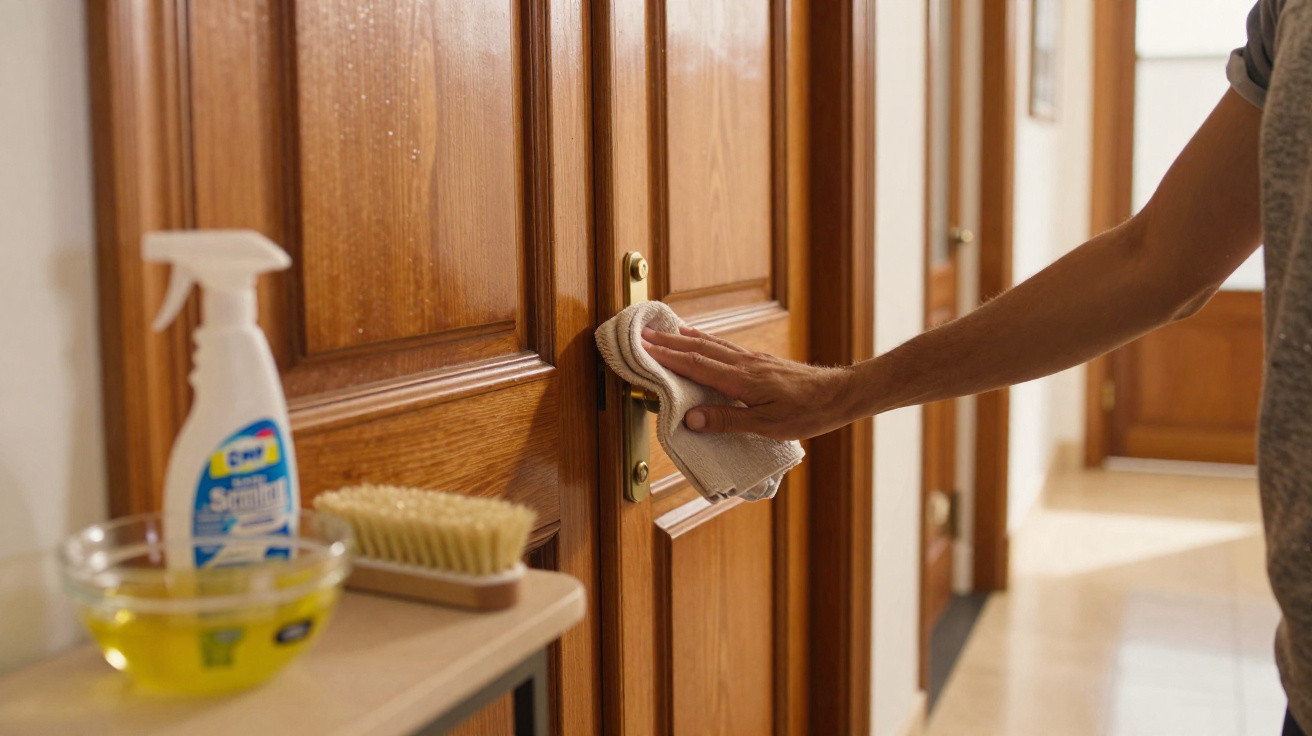
The approach that genuinely works does not begin with a miracle product. All you need is a bucket of warm water, a drop of mild washing-up liquid and a soft microfibre cloth. There is no fluorescent bottle or “extreme power” claim involved. Instead, the method respects the existing wood finish rather than battling against it.
Dampen the cloth lightly with the soapy water, wring it out until it is nearly dry, then clean in small sections from top to bottom. The cloth should be only just damp, never wet. Rinse it regularly and replace the water once it becomes grey. Afterwards, dry every section with a second clean cloth. Once the door is both clean and dry, use the secret weapon: a very small amount of wood polish or natural oil-based conditioner. Apply it in circular movements, then buff in the direction of the grain. This is when the shine starts to return.
Let us be honest: nobody really does this every day. Most of us think about our doors twice a year, generally before visitors arrive or when sunlight falls on them at exactly the wrong angle. That is perfectly fine. Timber does not require a daily ritual; it simply needs the right treatment from time to time.
The most damaging habit is reaching for glass cleaner simply because the bottle is already to hand. It seems practical, smells clean and is an easy automatic choice. Another frequent mistake is applying too much water, particularly on lower panels where mop splashes and shoe marks accumulate. The wood swells slightly, the joints are put under strain and, eventually, the door can begin to warp.
The trick is to think “as little as possible, as gentle as necessary”. Clean only when fingerprints are genuinely visible. Choose products made for wood, or at least products that are neutral and diluted. If the door is painted, try the method on a small concealed patch first. Wood can cope with honesty, but not with surprises.
“I stopped using my heavy-duty degreaser on the doors for three months,” says Claire, 41, who lives in a rented flat with beautiful but neglected beech doors. “I switched to warm water, a drop of soap, and a cheap beeswax polish once a season. The landlord honestly thought I’d had them professionally restored.”
Her method is straightforward and almost traditional, which is exactly why it succeeds. There are no explosions of foam or overpowering odours. There is simply time, a cloth and a product that nourishes the timber instead of removing its finish. Watching a dull panel gradually reflect the light again as you buff it brings a quiet satisfaction. It feels more like looking after a musical instrument than tackling an ordinary household task.
- Use: lukewarm water + mild soap for regular cleaning
- Add: wood polish or beeswax 2–4 times a year
- Avoid: bleach sprays, oven cleaners, undiluted alcohol
What not to clean: the “non-cleaner” that destroys shine
Here is the uncomfortable reality: the strong kitchen or bathroom spray beneath your sink, the one promising to “cut through grease in seconds”, is not suitable for cleaning wooden doors. Its small print may say “for hard surfaces”, but wood is only hard on its exterior. Beneath that surface, it acts like a sponge with a memory.
Applying these degreasers to doors gives an immediate but misleading sense of success. Greasy fingerprints vanish at once, the fragrance announces “job done”, and the surface feels squeaky clean. Yet beneath the surface, the finish is being removed one microscopic layer at a time. What looks “clean” may actually be damaged varnish. In time, the aggressive product produces the very dull, stained appearance you are trying to eliminate: slow sabotage concealed in a spray bottle.
On a quiet Sunday, place your cleaning products in a row on the worktop and read each label aloud. Watch for terms such as “degreaser”, “disinfectant”, “descaler” and “anti-mould”. Most of these products belong in the bathroom, on tiles or in the oven, not on your doors. Standing in the kitchen with those bottles laid out in front of you is the point at which control returns to you.
Once you understand that wooden doors do not need “stronger” products but “smarter” ones, it is difficult to forget. Some people make a complete switch to just three items: mild soap, microfibre and a good wood polish. Others retain their favourite spray for the hob, but mentally classify it for what it is: a product that should never touch oak, beech or walnut. The shine you want is not achieved by attacking dirt more forcefully. It comes from working with the timber, rather than against it.
There is a subtle emotional side to this, too. Doors are touched more often than any other surface in the home: every hand, every hurried departure and every late-night return. When they gleam, the entire space seems calmer and better looked after. When they appear grey and worn, the house can feel permanently trapped in its “before” photographs, waiting for an update. During a busy week, that small detail at the edge of your vision can quietly lower or lift your mood.
There is no need for a complicated regime. You only need to stop treating doors as though they were worktops. Once that aggressive spray is removed from the task, the wood can quietly begin to recover. Its pores close, the finish becomes more even and the light returns. The process is gradual and almost unnoticeable at first. Then, one afternoon, sunlight catches the surface and you see the change. You can either keep the secret to yourself or share it with a friend who is fed up with grey doors too.
| Key point | Detail | Benefit for the reader |
|---|---|---|
| Choose the right “real” product | Use lukewarm water + mild soap + wood polish | Achieve lasting shine without damaging the doors |
| Avoid the false cleaner | Put degreasers and harsh sprays aside | Protect the varnish, colour and texture of the wood |
| Adopt a light routine | Clean infrequently but properly, using a microfibre cloth and gentle movements | Save time while keeping doors that give the impression of a well-kept home |
FAQ:
- Can I use glass cleaner on my wooden doors? It’s better not. Glass cleaners often contain alcohol and ammonia that dry out and cloud wood finishes over time.
- How often should I clean interior wooden doors? A light wipe every few weeks in busy areas is enough, with deeper cleaning and polishing two to four times a year.
- What’s the safest homemade mix for wooden doors? Warm water with a small drop of mild washing-up liquid, used with a well-wrung microfibre cloth, is gentle and efficient.
- My door is already dull and patchy. Is it too late? Not necessarily. Switching to gentle cleaning and adding a quality wood polish can often revive the shine without sanding.
- Do I need special products for varnished vs oiled doors? Yes, ideally. Varnished doors like light cleaners and occasional polish, while oiled doors respond well to specific maintenance oils.



Comments
No comments yet. Be the first to comment!
Leave a Comment