
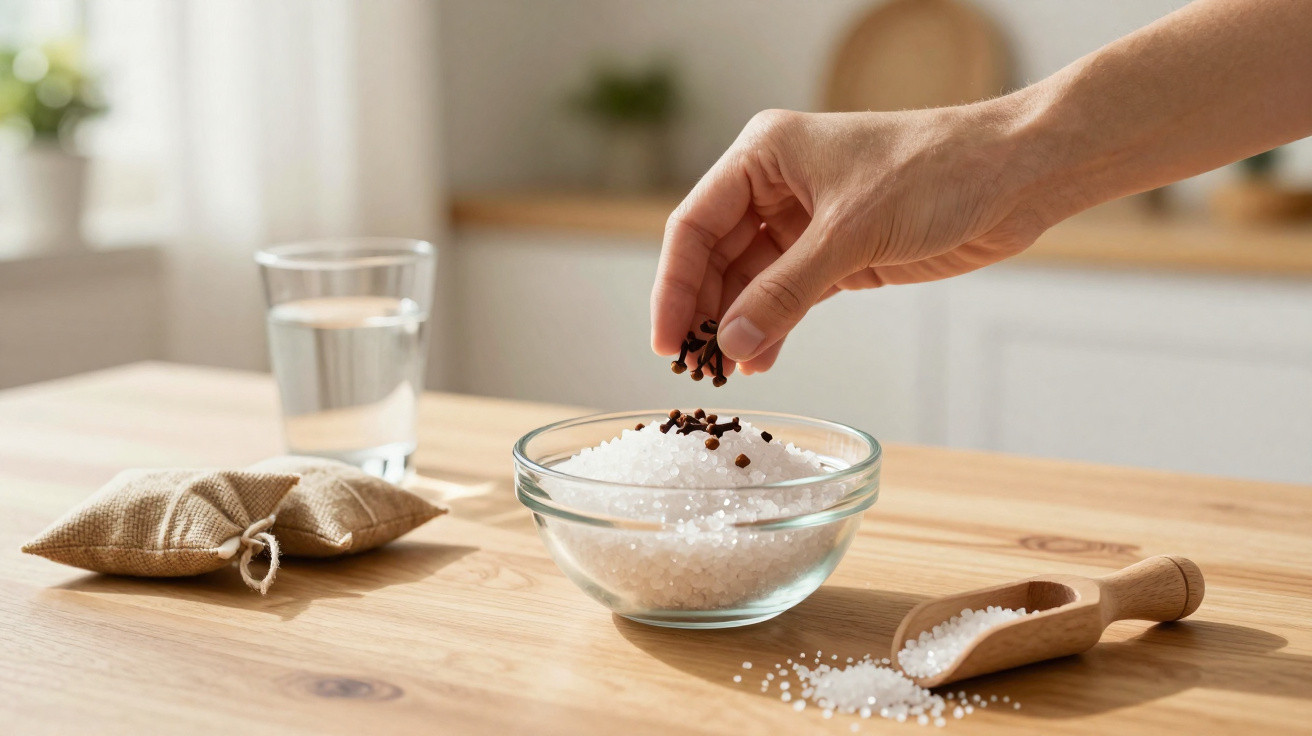
Mixing cloves with coarse salt has become a straightforward household habit because it combines a strong fragrance, mild moisture absorption and practical use in various parts of the home. Cloves release a distinctive scent due to eugenol, while coarse salt helps keep small containers dry and may lessen odours in enclosed spaces.
Why do cloves with coarse salt work so well at home?
Cloves have a powerful, warm and long-lasting aroma. Their fragrance can cover mild odours in cupboards, bathrooms, kitchens and utility rooms, while making the space feel clean without artificial fragrances.
Coarse salt provides a dry base. It is not a replacement for a dehumidifier or thorough cleaning, but it is useful in small pots because it retains some surface moisture and supports the cloves, allowing their scent to disperse gradually.
How do you make the basic mixture?
The most practical ratio is straightforward: use 1 teaspoon of whole cloves for every 3 tablespoons of coarse salt. Put both ingredients into an open small pot, stir gently, and keep it out of reach of young children and pets.
- For scenting a space: 3 tablespoons of coarse salt and 1 teaspoon of cloves.
- For small cupboards: 2 tablespoons of coarse salt and 8 to 10 cloves.
- For bathrooms: 4 tablespoons of coarse salt and 1 level tablespoon of cloves.
- For drawers: use a fine fabric sachet, ensuring the salt does not touch delicate clothing.
Where should cloves with coarse salt be used in each room?
In the kitchen, cloves with coarse salt can be placed near the bin, on high shelves or in a dry corner of the pantry. It can help soften food smells, but it should not be kept near the cooker or allowed to come into contact with uncovered food.
In the bathroom, place the pot on a ventilated shelf, away from the shower enclosure and basin so it does not turn into a damp paste. In bedrooms and living rooms, the mixture works best in enclosed spots such as cupboards, shoe racks and sideboards.
Which household problems can this combination help control?
This mixture is not a miracle solution and will not fix structural mould, a leak or an insect infestation. Its most realistic uses fall into three areas: scenting rooms, reducing stale smells and making certain spots less appealing to insects that are sensitive to strong aromas.
- Closed-cupboard smell: use a small pot and replace it every 10 to 15 days.
- Shoe rack: put the mixture in a sachet to prevent direct contact with footwear.
- Kitchen bin: keep the container nearby, never inside wet rubbish.
- Pantry: use it as an aromatic aid, while keeping grains and flour securely sealed.
- Bathroom: replace it before the salt becomes too damp or clumped.
The habit has spread because it is inexpensive, simple and easy to try
Cloves with coarse salt have become popular because the ingredients are common, no complicated preparation is needed, and the amount can be adapted to suit the size of the room. Once the fragrance fades or the salt becomes damp, simply discard the mixture and make a fresh portion.
The best results come when the combination is used alongside regular cleaning, ventilation and moisture control. In this way, the cloves provide fragrance, the coarse salt acts as a dry base, and the home has a simple resource for dealing with stale odours in specific areas.






Comments
No comments yet. Be the first to comment!
Leave a Comment