
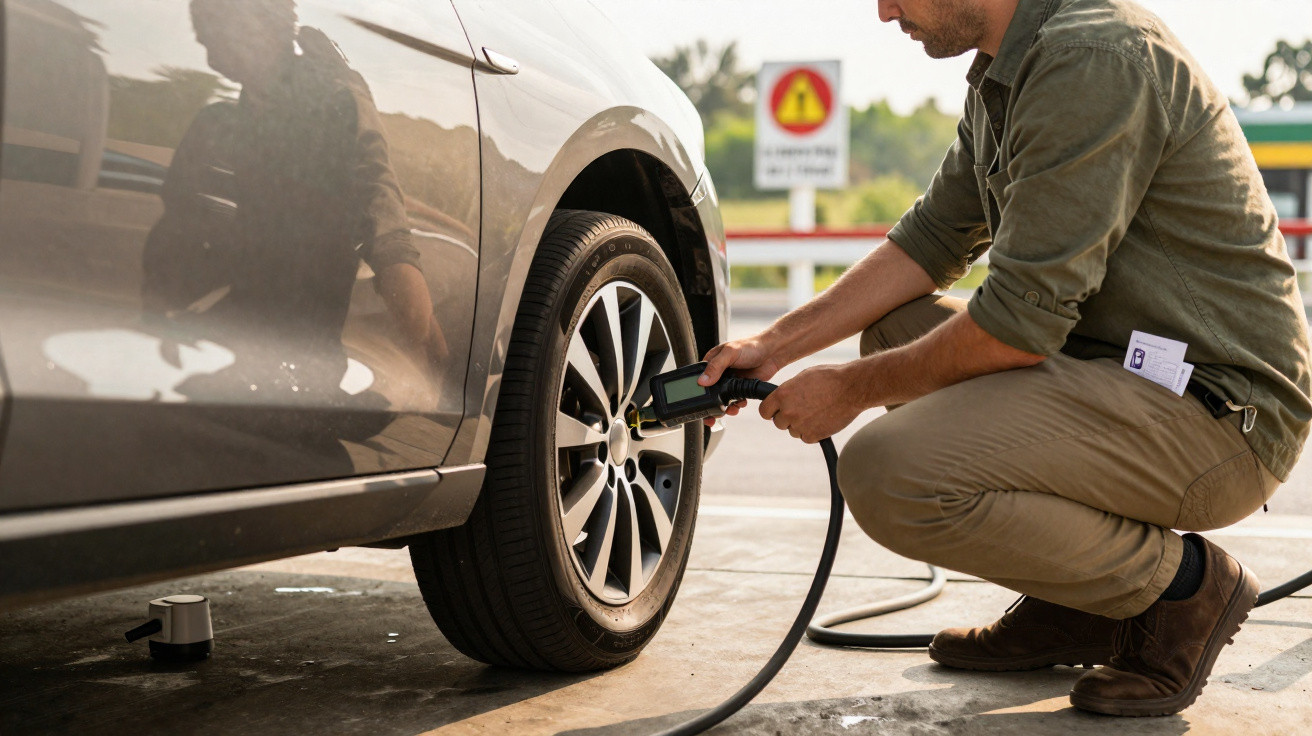
Same journey to work, same supermarket trip, same school run. But the figures on the fuel pump continue to rise, while the car seems slightly weightier through the steering and less eager when leaving roundabouts. You put it down to congestion, fuel prices or the car’s age. Then, on a wet Sunday morning at a forecourt just off the A40, you crouch beside the wheels and spot it: the front-left tyre is noticeably low. It is not flat or obviously unsafe. It simply looks weary. Soft. Neglected.
Five minutes later, after putting coins into a spluttering air machine, the drive home feels crisper and lighter, as if the car itself is relieved. The fuel computer, normally ignored, discreetly shows a slightly improved figure. It leaves you wondering how long money, grip and braking performance have been lost through tyres that nobody inspects unless they appear visibly damaged.
The reality is that most tyres do not shout for attention. They murmur.
Why tyre pressure quietly eats your fuel and your safety
On a clear Tuesday outside a retail park, stand near the air pump and you will see the pattern. Motorists get out, inspect their tyres from a respectful distance, shrug and climb back in. Front tyres carry children, shopping, laptops and lives, but tyre pressure is often treated as a dull optional task, little different from cleaning out the boot.
The difficulty is that an underinflated tyre seldom looks alarming. It can be 15% low and still appear “fine” at a quick glance. Yet the rubber is then flexing more, the sidewalls are under extra strain, and the tyre’s contact patch with the road no longer matches the engineers’ design. In that unseen divide between “looks okay” and “actually okay”, safety and efficiency gradually disappear.
The figures make the case more serious. The UK’s RAC estimates that tyres 15 psi underinflated can consume up to 6% more fuel. For a typical family hatchback covering 10,000 miles annually, that is far from trivial. Over several years, it can mean hundreds of pounds being burned purely through increased rolling resistance. Braking is also affected: safety-agency tests indicate that severely underinflated tyres may add several car lengths to wet-weather stopping distances, precisely when grip matters most.
There are less obvious costs as well. Tyres consistently run at low pressure wear unevenly around their outer edges, potentially requiring replacement thousands of miles sooner than necessary. That means more expense, more wasted rubber and more wasted energy. Week after week, it all stems from air pressure quietly being wrong.
From a mechanical perspective, it is straightforward. Tyres are engineered to maintain a particular shape while carrying a load. When pressure falls, more rubber is pressed into the road and creates additional friction. Your engine must overcome that friction with every metre travelled. The sidewalls flex further, generating heat and accelerating ageing. Steering becomes less precise, the car feels more unsettled in bends, and systems such as ABS and stability control have more work to do because the tyres are no longer responding as intended.
Overinflation creates the reverse problem. With too much air, the car rides on a narrower strip of central rubber, potentially reducing grip and making it twitchy on wet or uneven tarmac. You may see a very small fuel-economy benefit, but comfort and control suffer in return. The recommended figure on the door pillar or fuel flap exists for good reason: it is not merely advice, but a carefully chosen balance.
Turning tyre checks into a five-minute habit, not a chore
The most straightforward approach is also the one many motorists avoid: make a relaxed five-minute inspection with a reasonably good pressure gauge part of your routine. Do not rely on the gauge that has spent three years rolling beneath the passenger seat and collecting crumbs. Use one with a clear display that does not leak around the edges. Store it in the glovebox or door pocket rather than under a folded pushchair and football in the boot.
Check tyres when they are “cold”, broadly meaning that the car has travelled no more than a couple of miles. On level ground, apply the handbrake and slowly walk around the vehicle. Begin with a visual inspection: bulges, cracks or a shiny object embedded in the tread are immediate warning signs. Next, measure every tyre and compare the readings with the driver’s door sticker or handbook. Front and rear settings may be different, particularly when the vehicle is fully laden.
Let’s be honest: nobody really does this every day.
A more effective option is to connect tyre checks with something already in your routine. For many people, that means filling up. On every second or third fuel stop, use the air machine while the engine is off and the tyres remain relatively cold. You may have to wait behind someone attempting to recall their pressure settings, but that is simply part of life at a busy forecourt.
Select the required pressure on the machine, take off the valve cap, fit the nozzle and wait for the beep. It is neither glamorous nor Instagrammable, but it quietly improves how the car performs for the next few hundred miles. If being charged for air is irritating, a small plug-in compressor powered from the 12V socket can be surprisingly satisfying. Park on the drive, make a cup of tea and inflate each tyre in turn while it cools.
Most of us have been the person who notices a fault only when a dashboard warning appears. Modern TPMS systems are helpful, but they are not psychic. They alert you to a substantial pressure drop, rather than the gradual loss of a couple of psi each month caused by changing temperatures and time. It is this slow decline that steals fuel economy and confidence without any obvious drama.
“If you treat tyre pressure like brushing your teeth – quick, regular, boring – you’ll barely think about it. If you ignore it, the problems show up far more dramatically and at the worst possible moment,” says a London-based MOT tester who’s lost count of how many nearly-flat cars he sees each week.
To make it harder to forget, link pressure checks to a short routine:
- Every payday weekend: inspect all four tyres and the spare.
- Before long journeys or holidays: carry out a quick top-up and visual inspection.
- At autumn’s first cold snap: check again, because pressure falls as temperatures drop.
The emotional benefit can matter as much as the mechanical one. There is quiet reassurance in knowing that the tyres gripping wet tarmac on a dark motorway have been checked by you, rather than simply assumed to be “fine”. That feeling of control comes from small, repeatable actions that take less time than scrolling through your phone while filling up.
When small numbers on a tyre pressure gauge change how you drive
Regular pressure checks bring a subtle change in how you sense the car. What once seemed like drag caused by the wind may become recognisable as a soft rear tyre. The vague steering noticed on a blustery day has an identifiable reason and an easy remedy. It is a quiet form of confidence, created through a basic habit and a £10 gauge.
Fuel economy can sound like a clinical subject, but it raises a more fundamental issue. How much everyday driving happens on autopilot, with the assumption that everything beneath the car “just works”? How many children are taken to school on tyres barely within the legal limit? How many late journeys home take place on rubber that has not been inspected since the previous MOT?
This is not about assigning blame; it is about paying attention. Checking tyre pressure is one of the few aspects of modern motoring that remains completely under your control. No app can do it on your behalf, and no subscription can silently put it right in the background. Despite all the technology in current cars, four small areas of rubber and air still determine how you brake, steer and remain on the road. Ignoring them does not remove the risk; it merely conceals it behind a busy week and a lengthy to-do list.
| Key point | Detail | Benefit for the reader |
|---|---|---|
| Correct pressure | Follow the figures on the door sticker or in the handbook, with tyres “cold”. | Cuts fuel consumption and keeps handling predictable. |
| Regularity | Carry out a quick check every 3–4 weeks and before lengthy journeys. | Prevents premature wear and reduces unwelcome motorway surprises. |
| Practical habit | Link the check to filling up or to a particular weekend. | Turns a chore into a simple reflex that protects both budget and safety. |
FAQ:
- How often should I really check my tyre pressure? Every three to four weeks is a solid routine for normal driving, with an additional check before long motorway journeys or when the weather becomes sharply colder.
- Is the pressure listed on the tyre sidewall the one I should use? No. That figure is the maximum pressure the tyre can withstand, not its recommended setting; always use the numbers on your car’s door pillar, fuel flap or in the handbook.
- Can wrong tyre pressure really affect fuel consumption that much? Yes. Underinflation raises rolling resistance, making the engine work harder and use more fuel, particularly on longer trips and at higher speeds.
- Do I still need to check pressure if my car has a TPMS warning light? Yes. TPMS is a back-up rather than a complete solution; it may not warn you about mild but ongoing underinflation that gradually wastes fuel and wears tyres.
- Are petrol station air machines accurate enough? Most are suitable for everyday use, although using your own handheld gauge as well can help identify unreliable readings and keep you closer to the ideal pressure.





Comments
No comments yet. Be the first to comment!
Leave a Comment