
You know that awful drop in your stomach at the check-in desk, when you’re hoping your suitcase has not tipped over the weight allowance?
I used to know it all too well. My knees would wobble slightly as I acted casual, while preparing to throw half my possessions into the airport bins. For years, I packed as though every holiday might turn into a permanent move: four pairs of shoes, “just in case” dresses and a hairdryer roughly the size of a small animal. It meant mess, anxiety and a minor breakdown on my bedroom floor before every flight.
That changed when a low-cost airline fare and its unforgiving baggage rules gave me only one choice: one carry-on for an entire week away. There would be no checked luggage or spare bag. It was just me, a compact suitcase and the daunting task of deciding what mattered. What amazed me was not simply that it was possible, but how much freer I felt crossing the airport with everything I needed rolling beside me. There is no magic involved: it takes a different mindset, firm editing and a few tips that almost seem unfair.
The night I understood the suitcase was not the issue
The shift came on a Thursday evening, ahead of an early flight to Lisbon. My bed had disappeared beneath clothes: striped tops, four pairs of jeans and three jackets “for different moods”. I was partly seated on the floor, partly engulfed by fabric and completely overwhelmed. My open suitcase was already packed to capacity, yet I had not added toiletries, shoes or the chargers that seemingly control modern life.
I picked up a dress I adored but had not worn for two years and simply turned it over in my hands, as the room held the soft scent of laundry powder. That was when I understood that my suitcase was not the real issue. The problem was my fear of being unprepared, of not looking like the “best version” of myself on holiday unless I had limitless choice. It felt absurd to say, yet it was also uncomfortably accurate.
So I did something rather theatrical: emptied the whole suitcase and began from scratch. This time, I set one absolute rule: every item had to justify its place. One week, one carry-on and no panic. Rather than seeing it as a restriction, I would approach it as a puzzle.
The “7-piece formula” for 20 outfits
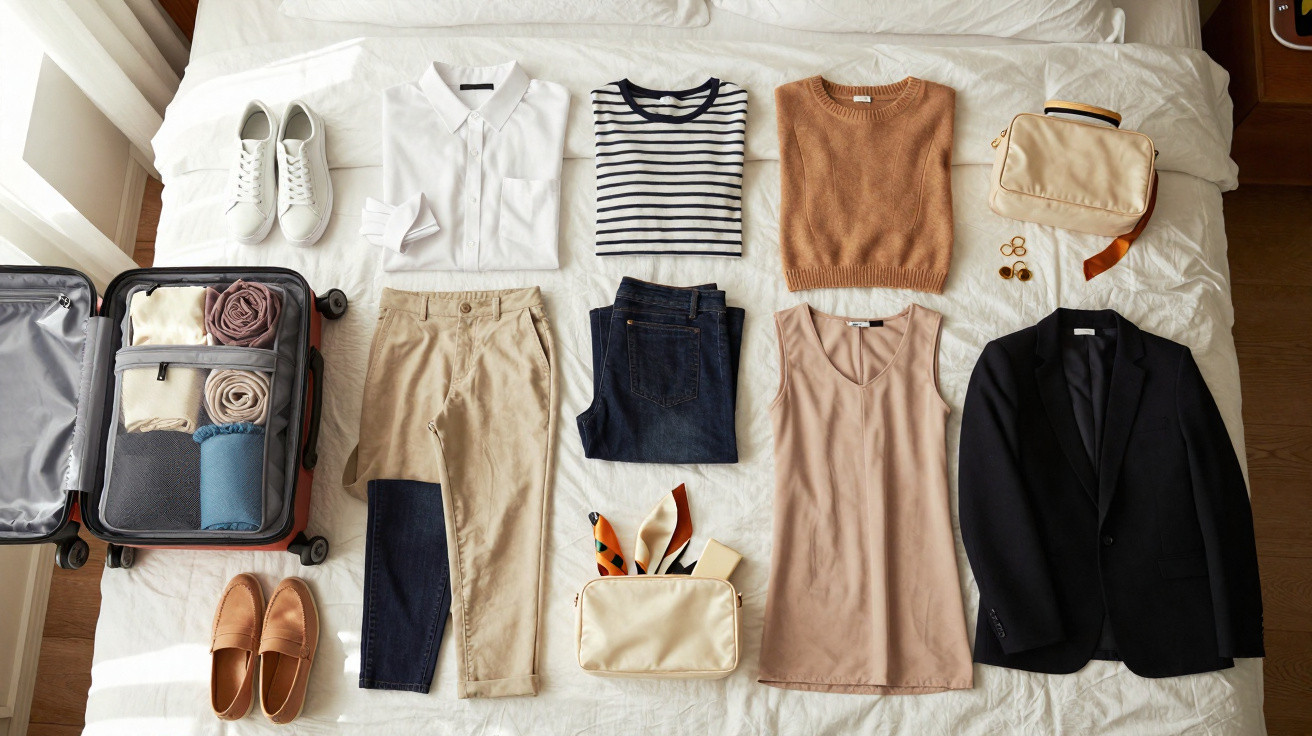
The first technique that genuinely transformed my packing was neither an expensive cube nor a viral TikTok trick. It was a basic formula written on a post-it note: 3 tops, 2 bottoms, 1 dress, 1 layer. That was all. Seven essential pieces for seven days inside a small carry-on suitcase. When I showed it to a friend, she laughed: “That’s cute, but I like choice.” I do too, which is exactly why it works.
Its strength lies in picking garments that combine so easily they work like Lego. Each top needs to suit each bottom. The dress must work as a daytime look with trainers and an evening option with sandals. The single layer - whether a blazer, denim jacket or lightweight knit - must complement everything without demanding attention. Once I committed to this approach, I found I had roughly 18–20 outfit combinations, without transporting half my wardrobe across a continent.
Photo idea: the flat-lay that began it all
Picture an overhead shot of a small cabin suitcase opened on a wooden floor. On one side are carefully folded pieces: a white T-shirt, a striped shirt and a black silky vest. Beside them sit light jeans, black trousers and an uncomplicated black midi dress. A soft beige cardigan lies across the lot, like a subtle final punctuation mark. It does not appear to be much, and that is exactly the idea. That single image holds a week of outfits that say “I’ve thought about this”, without any fuss.
Honestly, hardly anyone wears everything they take away. We all have a “holiday hero” - the outfit we keep reaching for because it feels most like us - while the rest remain in the wardrobe, silently judging us. Reducing your options removes the guilt of an overpacked case and means that, each morning, you already know your clothes will coordinate. Somehow, that feels unexpectedly luxurious.
The true packing superpower: a disciplined colour story
This is the advice people tend to reject first: choose a colour palette and genuinely follow it. I used to dismiss the suggestion too. It sounded like guidance from a capsule wardrobe blog run by someone who enjoys ironing socks. Yet when I first selected a base colour of black, a neutral of beige and rusty orange as an accent, packing changed from frantic to almost peaceful.
With every item within one colour story, you no longer spend time asking, “Does this go with that?” because it nearly always does. Black jeans pair with the white T-shirt, while black trousers work with the striped shirt and the dress suits the cardigan. Use the accent colour in a scarf, top or perhaps earrings, and each look seems consciously styled rather than randomly assembled. You appear to have made an effort, even if you have not.
Photo idea: colour story on a bed
Imagine another photograph: garments arranged across a plain bedspread in three distinct colour groups. The black items - jeans, trousers and dress - sit to the left. The neutral pieces - a white T-shirt, beige knit and cream shirt - are placed in the centre. To the right are small touches of rusty orange and gold: a scarf, narrow belt and earrings. It is oddly pleasing, rather like a carefully ordered bookshelf. Your mind stops racing and simply thinks, “Yes. That’s enough.”
There is a quiet freedom in accepting that you will not become a different person every day on holiday. You remain yourself, only in a handful of slightly altered outfits. Once you stop attempting to reinvent yourself through every top in your suitcase, there is room for the actual purpose of the trip: the sea, city streets and dinners that stretch later than expected. Clothes move into the background rather than becoming the main attraction.
Rolling, folding and the oddly intimate packing cubes
Getting a week’s belongings into a carry-on is part puzzle, part therapy. I once pushed items in until the zip practically begged for relief. These days, I roll them instead. I make tops into firm cylinders, fold jeans in half before rolling them, and roll dresses from hem to shoulders. The point is not some mythical extra room; it is being able to see everything at once when you open your case in a compact hotel room.
For years, packing cubes seemed unnecessary to me, as if they were simply a way of arranging chaos rather than reducing it. Then I found a set in a sale and became quietly devoted to them. I use one cube for clothes, another for underwear and sleepwear, and a third for “extras” such as gym clothing or swimwear. There is an unexpectedly calming feeling in closing a cube and knowing, “That’s done.” It breaks an overwhelming job into three or four small, achievable tasks.
Opening them at your destination brings its own modest pleasure. There is the sound of soft fabric, a trace of your laundry detergent and the pleasant realisation of, “Oh yes, I packed that top.” You feel like the organised version of yourself you expected to become in your thirties, even if you packed everything while eating crisps on the floor the previous evening.
The shoe dilemma: two pairs, no cheating
Shoes are where most carry-on ambitions collapse. I used to plan from the ground up: heels for evening meals, trainers for walking, sandals for the beach and perhaps boots “if it rains”. That makes four pairs for one person over seven days. Something needed to change. I therefore made a rule that initially felt extreme but gradually became normal: take only two pairs, with one worn to the airport.
Choose one comfortable pair you can happily be photographed wearing, plus one pair that makes an outfit feel a little smarter. White trainers and strappy sandals work, as do chunky loafers with ballet flats, or ankle boots with sleek trainers. The particular pairing matters less than ensuring both options suit every outfit you pack. There should be no “special occasion” exceptions.
One of my favourite images from that Lisbon trip is not the view or the well-known yellow tram. It shows my feet in battered white trainers resting on my little suitcase at the departure gate. You can see my black jeans, the edge of my beige cardigan and the faintest glimpse of chipped nail varnish. It is not an Instagrammable photograph, yet whenever I look at it, I remember walking around an entire city in those shoes without ever wanting another pair.
The vanity case confession: scaling back the beauty routine
Clothes receive most of the attention, but toiletries are where the real excess happens. There is the full-size shampoo “just in case the hotel’s is weird”, five make-up brushes, two foundations and enough hair tools to challenge a backstage dressing room. Restricting myself to one transparent, airport-sized pouch forced a slightly awkward question: what do I truly use daily, and what is merely habit?
I began transferring products into tiny reusable bottles and choosing miniature versions of products I genuinely enjoy. I take one cleanser, one moisturiser, one SPF and one multipurpose hair product. For make-up, everything must fit in my palm: concealer, mascara, brow gel, a small palette and one lipstick suitable for day and night. The first time I arranged it all, it looked almost embarrassingly minimal. Still, I did not miss a single item while travelling.
I discovered a surprising relief in acknowledging that I do not need three separate serums to feel like myself. I thought I’d feel less “put together” with a smaller beauty bag, but the opposite happened: I got ready faster, stressed less, and cared more about where I was going than how many shades of blush I had. That small pouch now feels like a quiet rebellion against every “must-have” product promoted to me online.
The secret weapons: accessories and laundry
If the 7-piece formula provides the structure of a travel wardrobe, accessories supply its character. A silk scarf can be worn in your hair one day and tied around your neck the next. Gold hoops can make even a T-shirt look intentional. A slender belt may cinch the dress or alter an oversized shirt. They barely add any weight, but they completely change an outfit’s mood - which is exactly what you want when rewearing the same pieces.
Then there is the less glamorous but highly useful element: washing a few things. Everyone has experienced sniffing a T-shirt in a hotel room while pretending to assess whether it is “ok”. I now bring a small packet of laundry detergent sheets and a foldable hanger. Halfway through the week, I quickly wash underwear and one or two tops in the sink, hang them by the window and wake up to dry clothes without worrying about a shortage of clean options.
There is a small image on my phone that would interest nobody else: two tops quietly dripping from hangers in a bathroom beside a steamed-up mirror. It reminds me that travelling is not a photoshoot; it consists of small, human routines carried out in unfamiliar settings. Oddly, that makes a journey feel more settled, more like temporarily living somewhere else than escaping your own life.
What a carry-on truly gives you
Walking through arrivals with only a small suitcase, passing the crowd waiting at the baggage carousel, gives you a slight spark of smug satisfaction. Underneath it, though, is something softer: a sense of lightness. You are no longer hauling an overfilled bag or wondering whether the airline has misplaced half your wardrobe. Instead, you leave the airport, wheel your case into the city and begin the week.
The greatest surprise is not that a week’s outfits fit inside a carry-on. It is that you begin to prefer travelling this way. You become someone who knows precisely what is in their suitcase and the reason every item is there. “Maybe I’ll need it” stops being an excuse to pull your worries along on wheels.
The next time you sit on the floor beside an open suitcase, you may find yourself smiling as you roll the last T-shirt, place the scarf in a corner, close the zip and think: that’s everything. Not merely enough belongings, but exactly the right ones.



Comments
No comments yet. Be the first to comment!
Leave a Comment