
The sofa was pushed hard against the wall. The television had been wedged into a corner. A small rug sat adrift in the centre, like a tiny island. The room was not especially small, yet it seemed cramped, cluttered and almost starved of air.
The issue was not the room’s dimensions. It was how the space registered the moment you entered.
When I returned a few weeks later, the walls, sofa and windows were exactly the same. Yet the room appeared almost twice as large. The difference came down to one straightforward decorator’s trick – one you can replicate in an afternoon.
The illusion decorators discreetly use
Decorators’ preferred way to make a living room feel more expansive is neither a miraculous paint shade nor an extreme decluttering regime. It is subtler: raising the visual horizon. In practical terms, this encourages your gaze to move upwards, across and into the room as soon as you walk through the door.
If your eye is held low by the back of a slouchy sofa, a low television unit or a modest rug, the room can seem squat and stunted. But when your gaze travels upwards towards full-length curtains, elevated artwork, tall lamps and a generously sized rug, the same room immediately feels more impressive. The floor area is unchanged; the impression is entirely different.
Nothing has altered on the floor plan. Physically, though, it changes everything. You hold yourself more upright and breathe more easily. Rather than wondering, “Where could we possibly put people?”, you begin to think about whom to invite.
Designers understand this instinctively. They compose a room as they would a skyline, with low, middle and high points. By building up layers of height, they make walls appear taller, ceilings feel loftier and floors seem to extend further. It is a psychological device rather than an architectural one.
Last year, I visited a New York studio where the living space measured barely 3.0 by 3.4 metres. There was a bed to one side, a kitchenette to the other and a window looking onto a brick wall. On paper, it appeared undeniably cramped. In reality, it had the polished feel of a hotel suite.
Its owner, a stylist, had positioned the curtain poles almost at ceiling height despite the short window. The drapes dropped in long, abundant columns. Rather than being dotted around, artwork was arranged vertically. A floor lamp rose like a sculptural object, while the sofa’s slim, exposed legs allowed light to pass beneath it.
The compact proportions had not vanished, but your focus had moved elsewhere. Instead of measuring every centimetre, your eye followed forms and lines. You registered the ceiling height rather than the narrowness of the floor, and the lamp’s glow rather than the limited floor area. That is the illusion at work in real time.
There is sound reasoning behind this familiar decorator’s approach. Our brains interpret rooms extraordinarily quickly, relying on visual shortcuts. Low, horizontal lines suggest something “wide but flat”, whereas vertical lines signal “taller, airier, lighter”. Emphasising the vertical effectively borrows perceived height from the walls.
Our eyes also seek out visual anchors. A tiny rug makes the whole room seem tiny. Low-hung curtains make the window appear undersized. A short bookcase can make the ceiling seem lower. Turn each of these around and the perception changes: a large, carefully positioned rug suggests a bigger room; curtains hung high imply taller windows; and a tall bookcase evokes a loft rather than a den.
The technique, then, is not about one individual item. It is a sequence of visual prompts all delivering the same quiet message: this room extends further than you imagine. That is what decorators are really creating.
The one change that transforms a living room
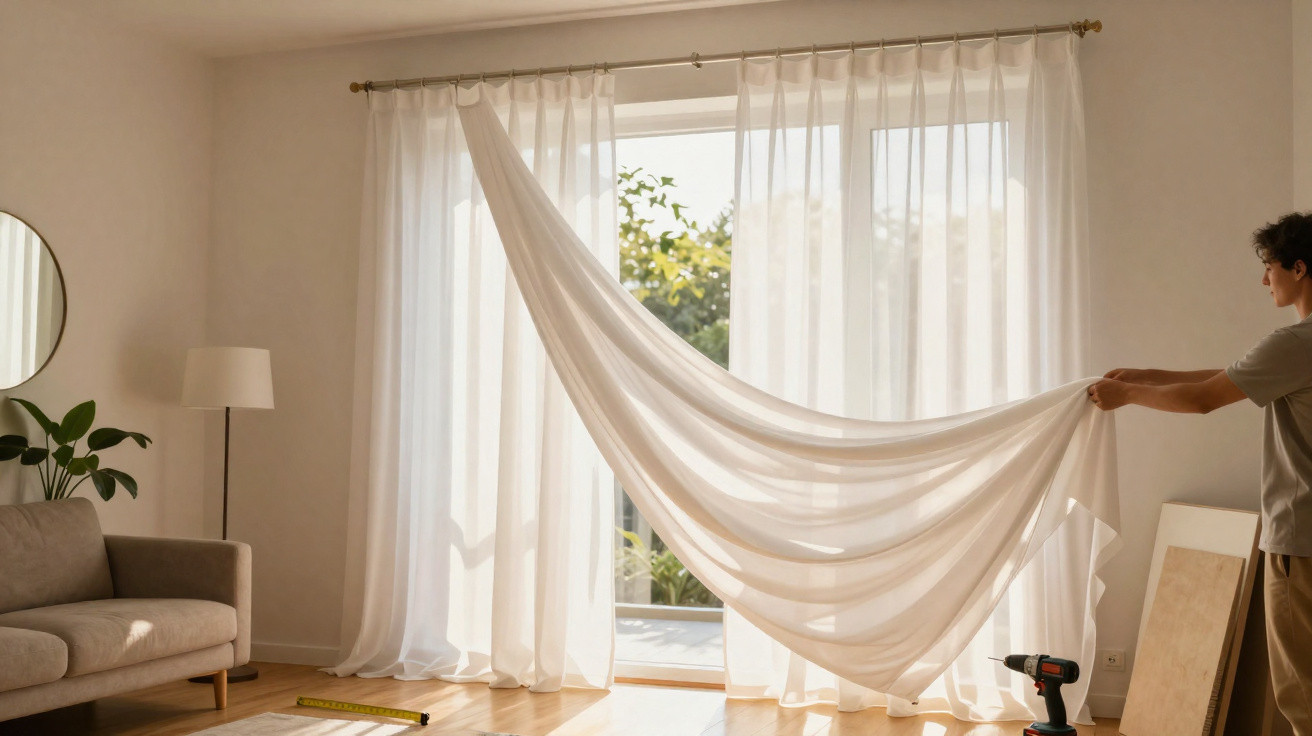
If you adopt only one professional technique, make it this: hang curtains high and wide. Place the pole close to the ceiling and extend it roughly 10–15 cm beyond both sides of the window. You are doing more than framing the glass; you are redrawing the outline of the entire wall.
The material forms a vertical column that makes the wall seem taller. Its additional width persuades your brain that the window – and therefore the wall – is broader. With the curtains open, most of the fabric gathers on the wall rather than covering the glass, allowing the full window to look larger and brighter.
That, in essence, is the decorator’s favourite illusion. It works in living rooms, bedrooms and even small home offices tucked into a corner. Wherever there is a window, there is an opportunity to make the entire room appear larger.
You can build on the effect from there. Introduce one tall lamp that reaches at least eye level when you are standing. Position artwork so that its centre sits slightly higher than feels instinctive. Opt for a bookcase or shelving unit that nearly reaches the ceiling instead of ending halfway up the wall. Each vertical line is another gentle prompt towards a feeling of space.
This is also where its emotional effect emerges. On a difficult day, a confined room can feel as if it is judging you: too much stuff, too little space, too little of you. Raise the sightlines and the room no longer feels as though it is pressing down. Instead, it begins to feel supportive.
People often make certain mistakes simply because nobody has explained otherwise: curtains ending just below the window ledge, rugs sitting far away from the furniture, or shelves hovering awkwardly halfway up a wall. None is inherently “wrong”, but each can quietly make the room feel smaller in your mind.
Let’s be honest: nobody really does this every day. Nobody wakes up thinking, “Today I shall optimize my visual horizon.” You are simply trying to arrange a sofa and coffee table without catching your toes. That is precisely why decorators value this trick: it is a modest, low-effort adjustment with an enormous reward once it is in place.
“When I raise the curtains and oversize the rug, my clients always say the same thing,” London interior designer Amara Field told me. “They don’t say, ‘Oh, smart spatial hack.’ They say, ‘It feels calmer. I can breathe.’ That’s the reaction I’m chasing.”
To make this practical, here is the brief checklist designers return to when they want a small living room to feel markedly larger:
- Position curtain poles 10–15 cm below the ceiling and extend them at least 10–15 cm beyond the window on each side.
- Select a rug large enough for at least the front legs of the sofa and chairs to rest on it.
- Include at least one tall feature – such as a lamp, plant or bookcase – to direct the eye upwards.
- Arrange artwork in vertical groupings rather than scattering small frames around the room.
- Choose furniture with visible legs so light can travel beneath each piece.
A small room that finally feels like yours
Once you recognise this technique, it becomes visible everywhere: hotel lobbies that seem vast, small Airbnbs photographed to resemble lofts and Instagram posts where it is difficult to pinpoint why a room looks so generous. Each uses the same understated choreography of height, scale and sightline.
There is no requirement to reproduce it flawlessly. If you cannot alter your landlord’s blinds, you can still introduce a long fabric side panel to add height. If a large rug is beyond your budget, choose the biggest bound carpet offcut you can afford. The effect is not all or nothing; every modest adjustment contributes.
On a more personal level, altering the way a room feels also alters the way your evenings feel. You can sit in a space that no longer constantly reminds you of its constraints. You may invite over a friend you have been meaning to see, or read on the sofa without fixating on the television corner and wondering where another person could possibly sit.
We have all entered someone else’s home and thought, “Wait, this is the same square footage as mine?” On paper, the walls, windows and floor may be identical. What differs is the narrative the room presents to your brain. Height, light and generous gestures make the space seem as though it has more to offer.
That is why decorators’ favourite trick matters beyond appearance. It is about claiming a small part of the world and allowing it to expand around you rather than work against you. A higher curtain pole, a larger rug and a taller lamp are small acts of defiance against the belief that you need a larger home to feel as though you have room.
| Key point | Detail | Benefit for the reader |
|---|---|---|
| Raise the visual horizon | Use tall curtains, lamps and shelving to guide the eye upwards | Makes ceilings and walls feel higher without structural alterations |
| Use generous anchors | Choose larger rugs and fuller curtain panels than you think you need | Helps the room appear wider and more expansive |
| Layer vertical focal points | Stack artwork vertically and add one or two tall accents | Creates a cohesive illusion of space in any small room |
FAQ:
- Does hanging curtains higher really make a small living room look bigger? Yes. Curtains hung high and wide encourage the eye to read the window – and the entire wall – as taller and broader, making the room seem more spacious.
- What if my ceilings are already low? This is when the technique is most valuable. Position the pole just beneath the ceiling and use full-length panels that just touch the floor to visually lengthen the walls.
- Is a bigger rug always better in a small living room? Within reason, yes. A rug that links the main furniture pieces makes the space feel unified and larger, rather than fragmented and cramped.
- Can this illusion work in a rental where I can’t repaint or drill? Absolutely. Use tension poles, clip rings, tall floor lamps, high bookcases and leaning artwork to establish vertical lines without permanent alterations.
- How fast can I see a difference? Most people notice the change as soon as high curtains are installed or a larger rug is laid down. The room should feel calmer and more open almost immediately.





Comments
No comments yet. Be the first to comment!
Leave a Comment