
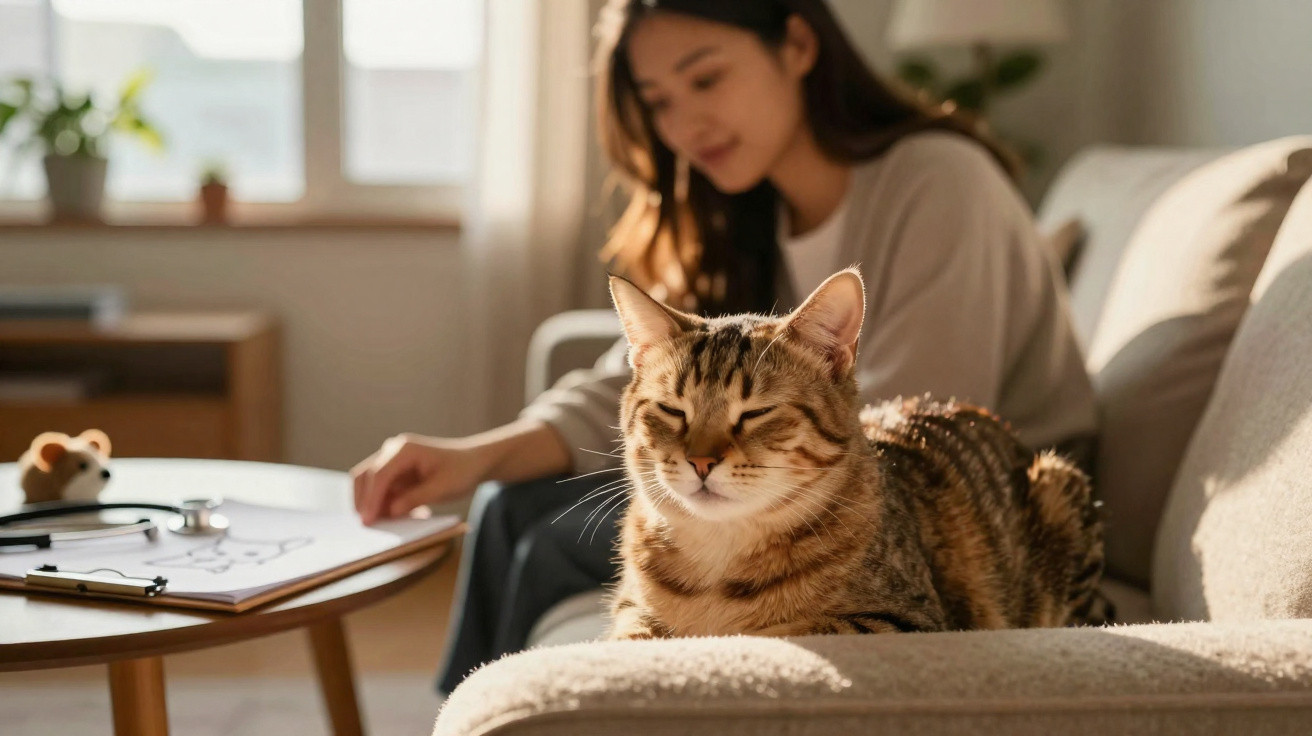
Cats are often thought of as aloof (and wonderfully floofy), yet if you are not forming a bond with your feline companion, it may simply be because you are not communicating in their language.
Fortunately, research suggests that learning it is simpler than you might expect. You merely need to smile more often - in the feline sense. Rather than baring your teeth as humans do, narrow your eyes and blink slowly.
In 2020, scientists observing interactions between cats and people confirmed that this straightforward signal makes cats, whether known to the person or not, more inclined to come closer and interact.
"As someone who has both studied animal behavior and is a cat owner, it's great to be able to show that cats and humans can communicate in this way," University of Sussex psychologist Karen McComb said when the study was published.
"It's something that many cat owners had already suspected, so it's exciting to have found evidence for it."
Watch the video below for a summary of the research:
How cats use the slow blink
Anyone who has spent time with cats will likely have noticed the facial expression of ‘partially closed eyes’, often paired with a slow blink. It resembles the way human eyes narrow during a smile, and generally appears when a cat is calm and content. The expression is understood as a type of cat smile.
Stories from cat owners had suggested that people could imitate this expression to tell cats they were friendly and willing to engage. A group of psychologists tested that possibility through two experiments.
The first study involved 21 cats across 14 households. After each cat had settled comfortably in a place within its home, owners were asked to sit roughly 1 metre away and slow blink whenever the cat looked at them.
Cameras captured the faces of both cats and owners, with the footage then compared against cats’ blinking behaviour when there was no human interaction.
The findings revealed that cats were more likely to slow blink at their humans after receiving a slow blink from them than in the condition involving no interaction.
Cats respond to humans’ slow blinking
For the second experiment, researchers worked with 24 cats from eight households. Instead of their owners blinking, the cats were approached by researchers who had not previously met them. As a control, researchers filmed the cats’ reactions during a no-blink condition, where people looked at the cats without blinking.
The researchers repeated the slow-blink method used in the first experiment, while also extending a hand towards the cat. They discovered that cats were not only more likely to blink in return, but were also more likely to move towards the person’s hand after that person had blinked.
"This study is the first to experimentally investigate the role of slow blinking in cat-human communication," McComb said.
"And it is something you can try yourself with your own cat at home or with cats you meet in the street. It's a great way of enhancing the bond you have with cats.
"Try narrowing your eyes at them as you would in a relaxed smile, followed by closing your eyes for a couple of seconds. You'll find they respond in the same way themselves, and you can start a sort of conversation."
Dogs may show their feelings far more enthusiastically than cats, but cat lovers will not be surprised by this finding. Research from recent years indicates that feline companions are considerably more attuned to the people they share a home with than was once believed, and that measuring them against dogs does them a disservice.
For instance, cats respond in a similar manner to people who are receptive towards them - so, if cats seem distant to you, the issue may lie with you rather than the kitty.
Cats also mirror the personality traits of the people they live with, which could help explain why they appear to notice when their humans are unhappy.
They can recognise their names too, although they often decide to ignore them. Their relationships with their humans are also unexpectedly profound.
What slow blinking may mean for feline welfare
Why cats slow blink at people in this way remains hard to establish. It has been seen as a way of communicating harmless intentions, because cats are believed to regard an unbroken stare as a threat. However, cats may also have developed the expression because humans react favourably to it. With domesticated animals, it is frequently impossible to know for certain.
Whatever the reason, it appears to help create rapport - and that is useful to understand. Discovering ways to strengthen our relationships with these mysterious animals may also support their emotional wellbeing, not only at home but in many situations that can potentially be stressful.
"Understanding positive ways in which cats and humans interact can enhance public understanding of cats, improve feline welfare, and tell us more about the socio-cognitive abilities of this understudied species," said psychologist Tasmin Humphrey of the University of Sussex.
"Our findings could potentially be used to assess the welfare of cats in a variety of settings, including veterinary practices and shelters."
You are going to try it now, aren’t you?
The research appeared in Scientific Reports.
An earlier version of this article was published in October 2020.




Comments
No comments yet. Be the first to comment!
Leave a Comment