
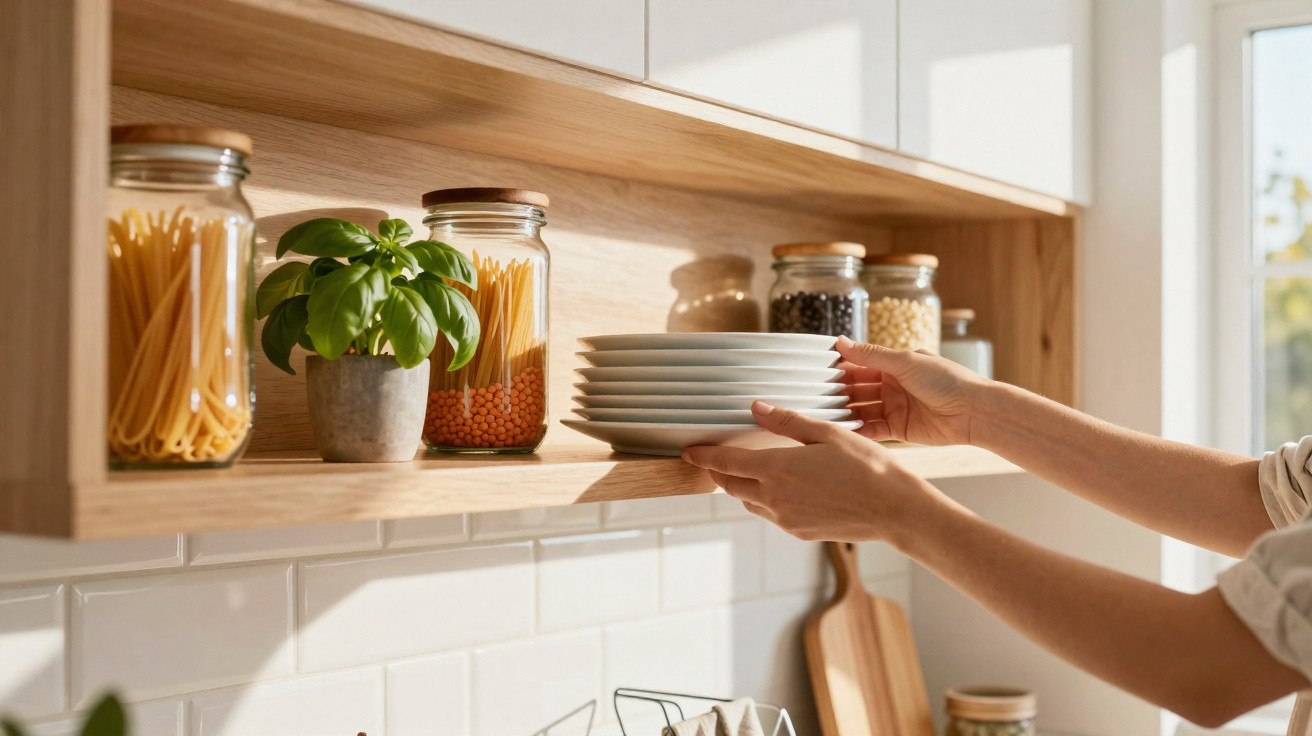
No cupboards banging shut, no creaking hinges, no desperate searching behind faded cabinet doors. Instead, there are exposed shelves, white plates arranged as though they belong in a design shop, and the slightly surreal sense that you have stepped into Instagram rather than an ordinary kitchen where toast gets burnt and pasta is reheated.
On a dull Tuesday morning in a compact London flat, Emma looks at the space once occupied by her wall cabinets. Now there are just a few pine shelves, a pile of bowls and one trailing houseplant. The wall appears higher and brighter - but also unexpectedly bare.
Her husband says something about dust. Her mother messages, “Where are you going to put the good glasses?” Emma simply shrugs, photographs it and uploads the picture. The likes begin arriving within minutes. Something is changing in our kitchens, and it goes beyond storage.
Goodbye boxy cabinets, hello open “showroom” kitchens
The traditional kitchen playbook was clear: conceal everything. Cabinets on the walls, cabinets below the worktop, cabinets in the pantry - all fitted with doors. Now, increasing numbers of people are taking those wall boxes down and replacing them with open shelves, rails and furniture-like units that feel more like a living room than a laboratory.
A scroll through Instagram or TikTok reveals the same aesthetic: walls flooded with sunlight, exposed shelving and matching glasses standing in neat formation. The kitchen is no longer merely the place where we cook; it has become a backdrop for our online lives. That creates a fresh kind of pressure: it is no longer enough to feed everyone; your frying pan has to photograph well too.
This movement did not begin in high-end showrooms. It grew in small flats and rented homes, where money was limited and wall cabinets seemed oppressive. With a tin of paint, a few brackets and a simple timber board from the DIY shop, an ageing kitchen can shift from “basic builder finish” to “European café”. It costs less than a complete refurbishment, creates less waste than stripping out an entire kitchen, and feeds a tempting idea: everyday disorder, transformed into a quiet and carefully curated image.
One London design studio estimates that over 40% of its recent city projects omit upper cabinets from at least one wall. Landlords say younger renters are asking whether they can “remove these boxes and just do shelves”. In Paris, some estate agents now loosely call tiny flats a “gallery kitchen” when the reality is two open shelves and a rail replacing the former cabinets.
A couple in Berlin said they saved nearly €3,000 by leaving out wall units in their 10 m² kitchen and using reclaimed timber planks instead. Their reasoning was straightforward: cupboards were the most expensive individual item in the estimate, and they preferred to put the money towards quality appliances. Their before-and-after images are striking - it is the same slim room, but it now feels airy enough to have friends over without anyone hitting their head on an open cupboard door.
Designers may describe the development in restrained language, but the reasons behind it are deeply human. We want to see what we have rather than lose it in dark cupboards. We are weary of bulky visual blocks hanging over narrow worktops. We want more adaptable options: a shelf that can be restyled, a movable rail or a stool that becomes a side table when friends arrive.
The “Instagram showroom” kitchen turns storage into a stage. Mugs become decoration, jars of pasta become props, and the everyday objects provide the styling.
There is a psychological aspect as well. Open storage quietly - or sometimes firmly - encourages you to own fewer things and select them more carefully. Once every chipped mug is visible, the urge to declutter becomes difficult to ignore. It can feel freeing and ruthless in equal measure.
How to turn a cluttered kitchen into an open-shelf star
This trend does not require starting with a sledgehammer. Begin with a single empty wall. If your kitchen lacks cabinets but overflows with clutter, choose the least useful row of upper units - often those that are difficult to reach or filled with unidentified Tupperware lids - and picture the space without them.
Then organise in terms of “zones” rather than disorder. Dedicate one shelf to daily crockery, another to glasses, and another area to jars and pantry goods that genuinely look attractive. Repetition is the visual shortcut: identical plates in stacks, matching jars in a line and mugs of the same style. Your eyes interpret this as order, even if the drawer underneath is crammed with plastic tubs.
Renters do not need to remove anything permanently. Cabinet doors can be taken off and stored safely, leaving the interiors to serve as imitation shelving. Paint the inside, add a strip of LED lighting, and the old cabinet carcass becomes a display alcove rather than a dim, enclosed box.
Let’s be honest: nobody truly maintains that look every day. The immaculate, colour-graded shelves seen online are often arranged once, photographed and then slowly taken over by real life: packets of rice, vitamin bottles and children’s cups with cartoon characters.
The key is deciding which 20% of your storage is for “showtime” and which 80% may remain out of sight. Keep unattractive but essential items in lower cupboards, drawers or one pantry unit with doors. Open storage should hold only the things you use constantly and do not object to seeing at 7 a.m., before you have fully woken up.
The first common error is making shelves too deep. Deep shelves invite stacks and piles. Slim, shallow shelves - 20 to 25 cm - almost compel tidiness because there is no room to double-stack items. The second mistake is combining thirty different colours and styles. When everything appears random, the mind reads it as cluttered however regularly you clean it.
“We used to design kitchens like storage machines,” says interior designer Lara K., who has watched the trend explode over the last three years. “Now clients want them to feel like social spaces. Open shelving is less about perfection and more about saying: this is how we really live, but nicer.”
There is an emotional current running through the idea, too. On a difficult day, a chaotic kitchen seems to shout at you before you have had a coffee. On a good one, a neat line of bowls and a plant by the window can feel like a small daily indulgence. On an ordinary Tuesday, you may simply want to take a plate without opening five doors.
- Start with one open area rather than changing the entire room.
- Place daily essentials at eye level and less frequently used items above.
- Repeat colours and materials to create a more peaceful appearance.
- Keep less attractive objects in baskets or boxes on the highest shelf.
- Allow for a “lived-in” degree of clutter; this is a home, not a shop display.
Living with a showroom-style kitchen in real life
Open kitchens may look glamorous online, but the important part is the gradual everyday reality: the rushed morning, the midnight snack and Sunday batch cooking. Once cupboards are gone, your routines are exposed. That can sound unforgiving, but it can also feel surprisingly grounding.
Those who move to open storage often describe much the same progression. During the first week, there is excitement as the room seems twice its former size. In the second, dust and fingerprints cause concern. By the fourth week, a new routine tends to emerge. They repeatedly use the same small set of plates, give away surplus items and spend less time staring at a cupboard door trying to remember what is inside.
For many, the major surprise is how sociable the room becomes. Friends gather around open shelves much as they would around a bar: helping themselves is easy, grabbing glasses is simple and the space feels welcoming. The boundary between host and guest becomes less defined. The kitchen no longer operates as a private backstage area and joins the main event, for better or worse.
A wider story sits behind this design change. As homes become smaller and more costly, people expect their kitchens to fulfil more functions: office, dining area and background for video calls. The showroom look is not solely about likes; it is a quiet way of saying, “This tiny space is worthy of attention.”
We also recognise that moment of entering someone’s home, seeing the kitchen and immediately understanding something about how they live. Open shelves, no wall cabinets and a deliberately edited collection of bowls convey a particular message: not so much perfection, but a decision about what remains in view - and what does not.
| Key point | Details | Why it matters to readers |
|---|---|---|
| Removing uppers cuts renovation costs | Omitting wall cabinets can save £800–£2,000 in a small kitchen, particularly where bespoke doors and hardware are involved. Basic pine or metal shelves, with brackets and paint, often cost less than £250. | It makes a “new kitchen” appearance financially attainable when a full refit is not possible, leaving more money for better appliances or worktops. |
| Use shallow shelves for a tidy look | Shelves measuring roughly 20–25 cm deep accommodate plates and glasses while preventing double-stacking. Anything deeper rapidly turns into a dumping ground. | This limits visual clutter and everyday annoyance, especially in compact homes where every extra centimetre counts. |
| Hide 70–80% of your stuff | Display only daily-use, matching or neutral possessions. Put plastic containers, children’s bottles and food packets in closed base units or one “utility” cabinet. | You can enjoy an Instagram-worthy look without acting as though your home contains only three plates and one wooden spoon. |
FAQ
- Won’t open shelves just collect dust and grease? Some dust will settle, but shelves holding items used every day remain surprisingly clean because those items are moved frequently. Wiping them quickly every week or two, plus washing rarely used pieces before a special meal, will generally keep it manageable.
- Is this trend practical for families with kids? It can work if you choose carefully. Reserve open shelves for unbreakable bowls, everyday cups and snacks that children can reach themselves, while keeping fragile or heavy objects lower down or behind doors.
- Do I have to get rid of most of my kitchen stuff? No, although editing your belongings is useful. Many people pack away duplicate items and untouched gadgets, go without them for a month and then donate only what they genuinely have not missed.
- Can I try the look without drilling into the walls? Yes. Take off several cabinet doors and paint the interior, or use freestanding ladder shelves and slim bookcases to recreate the open, airy effect.
- Will losing wall cabinets hurt my home’s resale value? It may do in homes with very little storage, but buyers in many urban markets now expect at least one open, styled wall. Retaining a reasonable amount of closed storage elsewhere generally provides balance.


Comments
No comments yet. Be the first to comment!
Leave a Comment