
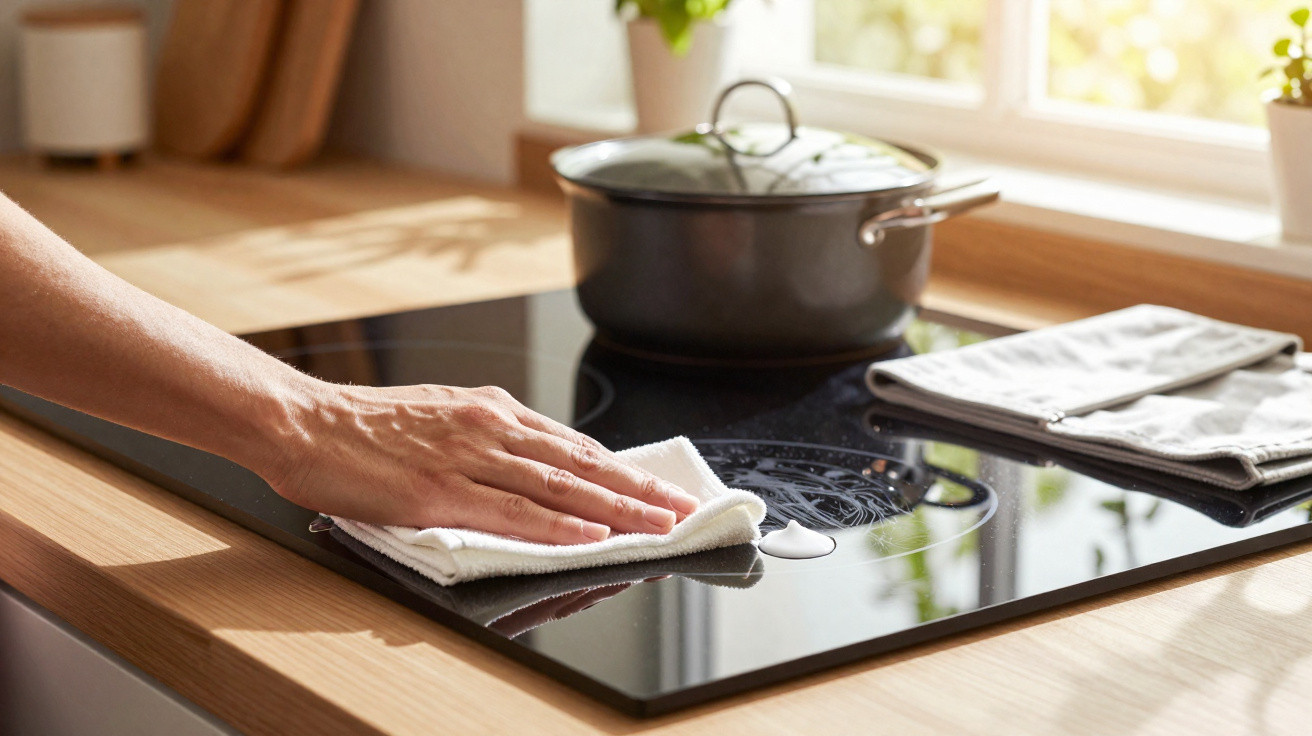
A fine, pale streak appears on the glossy black glass-ceramic cooktop you admired when it was first delivered. You wipe it once, then again, scrub a little more firmly with the sponge and wonder whether it is merely a stain. Then the light catches it from the side and your heart sinks. That mark is there to stay.
Later, after the guests have gone and the kitchen is silent, you spot others. Small rings left where a pan was moved too quickly. A rough circular mark from a grain of salt trapped beneath a saucepan for one meal too long. The cooktop still functions perfectly, naturally, but its magic has disappeared. All at once, it looks… worn.
That is when you understand something that many owners would rather not acknowledge.
Scratches do not simply “happen” – they build up through our habits
Glass-ceramic cooktops feel robust to the touch. They are marketed as durable, heat-resistant and high-tech. As a result, many people use them like a platform rather than a delicate surface. Pans are dragged instead of lifted. Hot cookware is set down wherever there is space. The abrasive side of the sponge is used first. Over time, these seemingly minor decisions leave their marks on the glass.
Scratches seldom result from one dramatic accident. Instead, they develop slowly, much like subtle lines on a familiar face. Owners often blame “one bad pan” or “that time the sugar spilled and burned”, but everyday routines are usually responsible. The material is certainly hard, but it is not indestructible. Glass-ceramic withstands heat well; grit is another matter.
By the time those faint lines become visible, their story will already have begun weeks earlier.
Speak to other owners and the pattern is familiar. There is the new cooktop, its mirror-like sheen and the pride of the first meal cooked on it. At first, it is treated like a prized possession: soft cloths, careful handling and specialist cleaner kept nearby. Then the weekly shop arrives, children are hungry, someone is running late and ordinary life takes over. Pans are put down a little more heavily, foil trays graze the surface, and sugar spills beneath a boiling saucepan.
One owner showed me photographs from the first month and from the second year. The contrast was striking. In the later image, a faint web of lines surrounded the zones used most often. She insisted that she “cleaned it every day”. She probably did. Just not in the way glass-ceramic quietly requires. That is the problem: damage remains unseen until it suddenly does not.
We often dismiss scratches because the cooktop continues to work. It still heats properly. Food tastes no different. Nothing signals “danger”. The issue is therefore mentally labelled as cosmetic. Yet the principle is straightforward. Glass-ceramic starts out smooth. Once that finish is disrupted, grime adheres more easily, cleaning becomes more aggressive and the process speeds up. Micro-scratches trap burnt-on residue. You scrub harder. The surface becomes more heavily marked.
With time, the shine disappears first, followed by the feeling that you are in control. What was once a precise-looking surface begins to appear dull and uneven. Some people conceal it beneath pans and chopping boards when visitors arrive. Others contact a technician because they believe there is something “wrong” with the material. Usually, it is simply the result of friction, repetition and a few tiny grains of sand.
Removing scratches from a glass-ceramic cooktop: simple steps that seem magical, but are not
There is some encouraging news: mild to moderate scratches can often be softened, blended in or made less noticeable. They cannot be rubbed away as easily as a mark on a tablet screen, but they can often be reduced enough that your eye no longer catches them. The approach is surprisingly uncomplicated. There is no miracle paste and no unusual device required. Just patience, gentle abrasives and the correct technique.
Begin with a cold, thoroughly clean cooktop. Clear away all grease and crumbs so that you do not create further scratches as you work. Many technicians discreetly recommend combining bicarbonate of soda with water to make a thick paste. Spread it across the scratched area using a soft cloth, then work in small circular movements without applying the force you would use to sand wood. Think massage, not punishment. Wipe it away, examine the area under strong light and repeat as needed.
For slightly deeper marks, a purpose-made glass-ceramic polish or a cerium oxide-based product may achieve more. Apply it with a microfibre pad, work patiently and allow the product sufficient time to carry out its fine polishing action.
Pressure and impatience are where most people make mistakes. They expect a dramatic “before/after” result in five minutes, then rub as though removing graffiti from a train. Afterwards, the glass may look glossier because friction has warmed it, rather than because the scratch has disappeared. Once the surface cools, the line returns and frustration follows.
With a tired-looking cooktop, the objective is not so much “perfect restoration” as “visual softening”. The aim is to smooth the tiny edges of a scratch so that light does not catch them so sharply. That calls for gentle, regular treatments rather than one determined battle. Let us be honest: nobody really does that every day.
Abrasive scouring pads, powdered bathroom cleaners and knives used to remove burnt sugar are where real damage begins. The surface may appear to “resist” these methods once or twice, creating a misleading sense of security. Then the first deep groove appears, often close to the front cooking zones. From that point onwards, every cleaning session carries greater risk.
“Treat a glass-ceramic cooktop more like a camera lens than a metal stove. It still cooks like a beast, but it doesn’t forgive grit,” explained one appliance repair technician who sees scratched tops every week.
For many people, the key change is adopting a new routine rather than pursuing perfection. After each use, clean gently with a soft cloth and a product designed for glass-ceramic. Keep polishing sessions for occasions when scratches genuinely bother you visually. If the cooktop is heavily marked, it may be kinder to your nerves to make its appearance more even than to fight every individual line.
- Choose clean, flat-bottomed pans, and lift rather than slide them.
- Remove salt, sugar and sand-like crumbs before switching on the heat.
- Keep a dedicated soft sponge or cloth exclusively for the cooktop.
- Select specific glass-ceramic cleaners or mild homemade pastes instead of unspecified powders.
- Regard a light patina as part of normal use, and concentrate on preventing deep grooves.
Living with a cooktop that reflects the life cooked on it
After cleaning and polishing, many owners reach a quiet moment: they stand back, look at the cooktop and see more than scratches. They see years of shared meals, hurried breakfasts, burnt sauces and birthday dinners that became slightly chaotic. The surface no longer feels like a showroom display piece; it becomes something closer to a kitchen diary.
That does not mean abandoning proper care. It means changing the target. Rather than trying to preserve an untouched, flawless black mirror, the goal becomes a clean, safe, fully working surface that still appears cared for. A few softened marks that only catch the light at sunset do not undermine that. They simply suggest that people genuinely live there.
In practical terms, this perspective also changes the way we look for answers online. Rather than searching for “erase scratches instantly”, the more realistic question is: “How far can I reasonably reduce them?”. Once you have attempted the basic methods – a gentle paste, dedicated polish, light circular movements and regular cleaning habits – the next choice is emotional rather than technical. Can I live with this, or should I start setting money aside for a replacement?
On a hectic weekday, the answer is likely to be “I can live with it”. On a peaceful Sunday, with a cloth in hand, you may decide to give it another careful treatment. Under the unforgiving flash of a friend’s phone camera, you may suddenly see a scratch you had stopped noticing at home. On an online forum, you may find cooktops in worse condition than yours and feel strangely reassured.
We all experience versions of the same sequence: a new cooktop, a proud owner, the first scratch, denial, experiments and acceptance. Mention it and others will nod. They too have tried toothpaste, bicarbonate of soda, miracle creams and old household remedies. Some helped a little; others did nothing at all. Very few people admit that the greatest improvement came from changing how they handled the surface day after day.
A glass-ceramic cooktop does not require perfection. It quietly rewards careful, regular habits and punishes harsh shortcuts. The scratches visible now are not a failure. They are a conversation between your routines and a material that never learned to pretend.
| Key point | Detail | Benefit for the reader |
|---|---|---|
| Micro-scratches result from repeated actions | Sliding saucepans, leaving grains of sugar or salt behind, and using the abrasive side of sponges | Understanding the cause helps you adjust habits before the issue worsens |
| A gentle method can reduce visible marks | Careful cleaning, a bicarbonate of soda paste or specialist polish, and light circular movements | Provides a practical, accessible option without professional equipment |
| The aim is reduction, not perfection | Accepting a light patina, preventing fresh scratches and maintaining a simple, realistic routine | Reduces frustration and makes it easier to live with your cooktop every day |
FAQ:
- Can deep scratches on a glass-ceramic cooktop be completely removed? Deep grooves usually cannot be completely removed at home. Their appearance can often be softened, but full removal generally requires professional resurfacing or, in some cases, replacement of the glass.
- Is baking soda really safe for glass-ceramic surfaces? When used as a soft paste with light pressure and a soft cloth, bicarbonate of soda is generally safe. The danger comes from scrubbing too firmly or combining it with other abrasive tools.
- Do special glass-ceramic cleaners make a real difference? Yes, they are formulated to break down grease and residue without creating new scratches. They will not perform miracles on deep damage, but they can slow overall wear.
- Can scratches affect how well my cooktop heats or works? Mild to moderate surface scratches do not usually alter performance. Concerns arise if there are cracks, chips around the edges or damage that appears structural rather than cosmetic.
- Should I replace my cooktop if it’s heavily scratched but still working? If there are no cracks or safety issues, this is often a personal decision. Many people use a scratched cooktop for years, prioritising cleanliness and function over appearance.





Comments
No comments yet. Be the first to comment!
Leave a Comment