
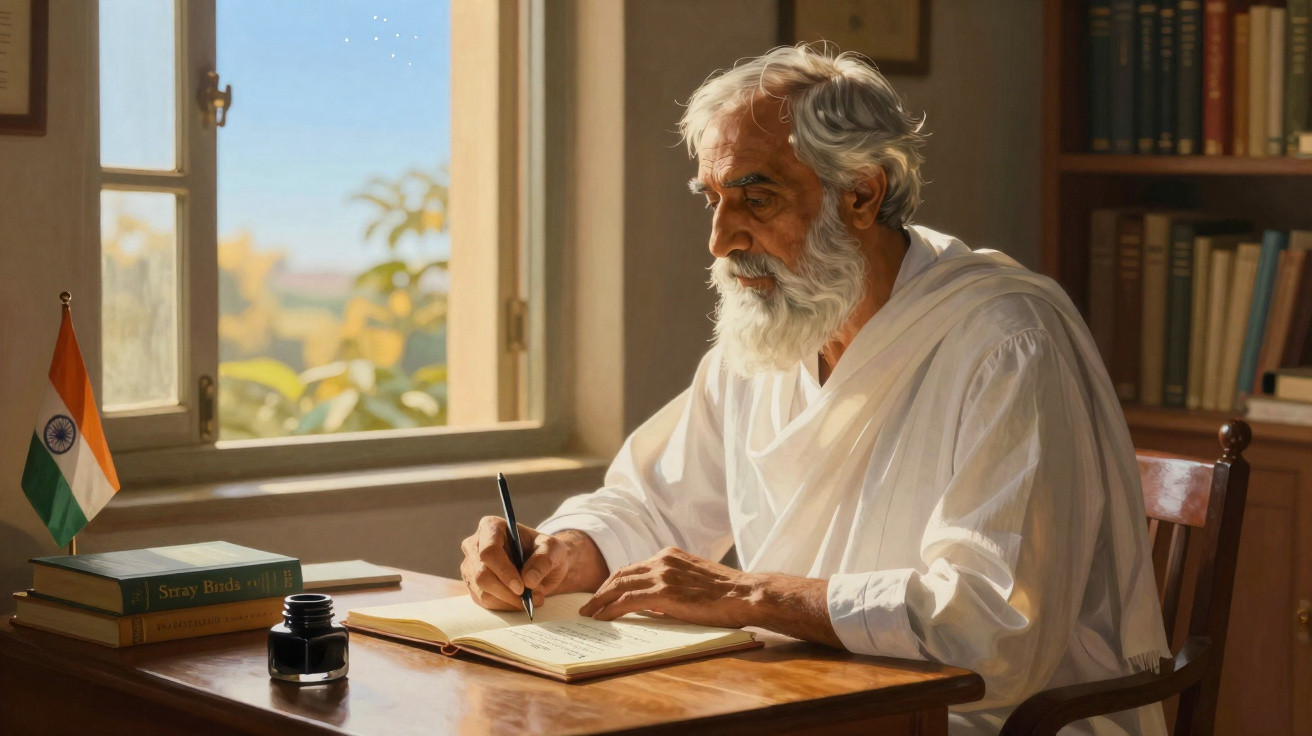
Rabindranath Tagore captured an image of loss, attention and life's continuation in just a few words: “If you shed tears when you miss the sun, you also miss the stars.” The thought appears in Stray Birds, a collection published in 1916 and translated from Bengali into English by Tagore himself. In its original form, it links the sun's disappearance with an inability to notice the stars that remain in view.
What did Tagore mean by the sun and the stars?
The sun stands for something once central that has been lost: a person, an opportunity, a period of life or something that seemed irreplaceable. The stars, meanwhile, refer to what remains after that absence. Yet they can go unnoticed when all attention is still fixed on what is no longer there.
Why does the phrase not tell people simply to forget a loss?
Rabindranath Tagore's image is more nuanced than advice to simply “move on”. The aphorism does not suggest that tears are wrong. Instead, it identifies the point at which grief becomes so overwhelming that it stops someone from seeing other things that still hold value.
This interpretation becomes clearer when every part of the metaphor is considered in its proper place. The passage can be read through three movements:
- the sun signifies something important that can no longer be reached;
- the tears signify attention focused on what has been lost;
- the stars signify possibilities, relationships and experiences that still exist nearby.
Where does this quote attributed to Rabindranath Tagore come from?
The passage appears in Stray Birds, published by Macmillan in New York in 1916. The edition states that Tagore translated the texts from Bengali into English himself. In aphorism number 6, the English wording is shorter than many versions now in circulation: it suggests that someone who sheds tears because they miss the sun also fails to see the stars.
How does Stray Birds turn small observations into larger reflections?
Stray Birds does not explore this idea in a long poem. Instead, the book brings together hundreds of brief reflections, many shaped by images from nature: birds, leaves, rivers, flowers, the sky, night and light. Tagore uses everyday elements to connect abstract emotions with scenes readers can picture straight away.
That very concision helps the passage about the sun remain recognisable more than a century later. Other aphorisms in the collection work in much the same way, placing philosophical ideas within straightforward relationships between natural elements. Several features recur throughout:
- contrasts between light and darkness;
- change expressed through the seasons and nature's movement;
- small images used to address human feelings;
- short phrases that leave part of the interpretation to the reader.
How did a poet write songs that became the national anthems of two countries?
Rabindranath Tagore was more than a poet. He also composed songs, wrote novels, short stories and plays, developed educational projects, and received the Nobel Prize in Literature in 1913. His musical work achieved an almost unique distinction: works he wrote became the national anthems of India and Bangladesh, a fact noted even in official Nobel records.
“Jana Gana Mana” became India's national anthem in 1950, while “Amar Sonar Bangla” was adopted by Bangladesh in 1971. The same ability to turn expansive feelings into simple images is present in the line from Stray Birds: when the sun vanishes, Tagore neither denies the darkness nor demands that it be forgotten; he recalls that, after it, there are stars that can only be seen once the eyes look again at the rest of the sky.






Comments
No comments yet. Be the first to comment!
Leave a Comment